Liberapay member team twitter account broken Link Hijacking via Expired Twitter Account Link
A Liberapay team member's profile linked to an expired Twitter account, and the donation page falsely confirmed that account as verified. An attacker could register the expired handle and use the apparent official link to impersonate the team member and scam donors.

- Fixed in 18 hours
- Disclosed after 19 hours
The Liberapay profile of Liberapay team member at liberapay.com/martindelille contains a link to an expired Twitter account, creating a Broken Link Hijacking (BLH) vulnerability. An attacker could register the expired handle and control what appears to be an officially linked social media account.
On the donation page at https://liberapay.com/martindelille/donate, Liberapay displays a "Recipient Identity" section stating: "We have confirmed through an automated verification process that martindelille has control of the following accounts on other platforms:" - including the expired Twitter account. This falsely confirms to donors that the account is legitimate and verified.
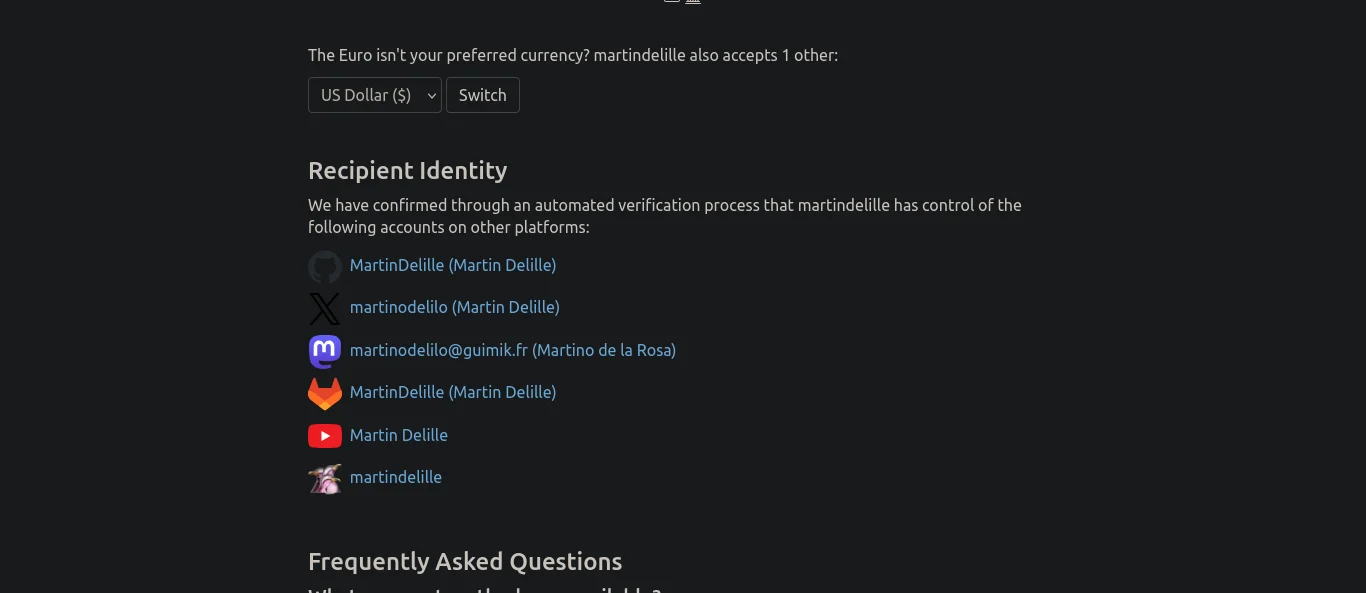
Note: martindelille is a Liberapay team member (developer/translator/community manager). This account should not be claimed by security researchers as it would directly impersonate an official team member.
Steps to Reproduce:
- Go to https://liberapay.com/Liberapay/
- Search for the martindelille account in the members section
- Access the martindelille account at https://liberapay.com/martindelille
- Locate the Linked Accounts section
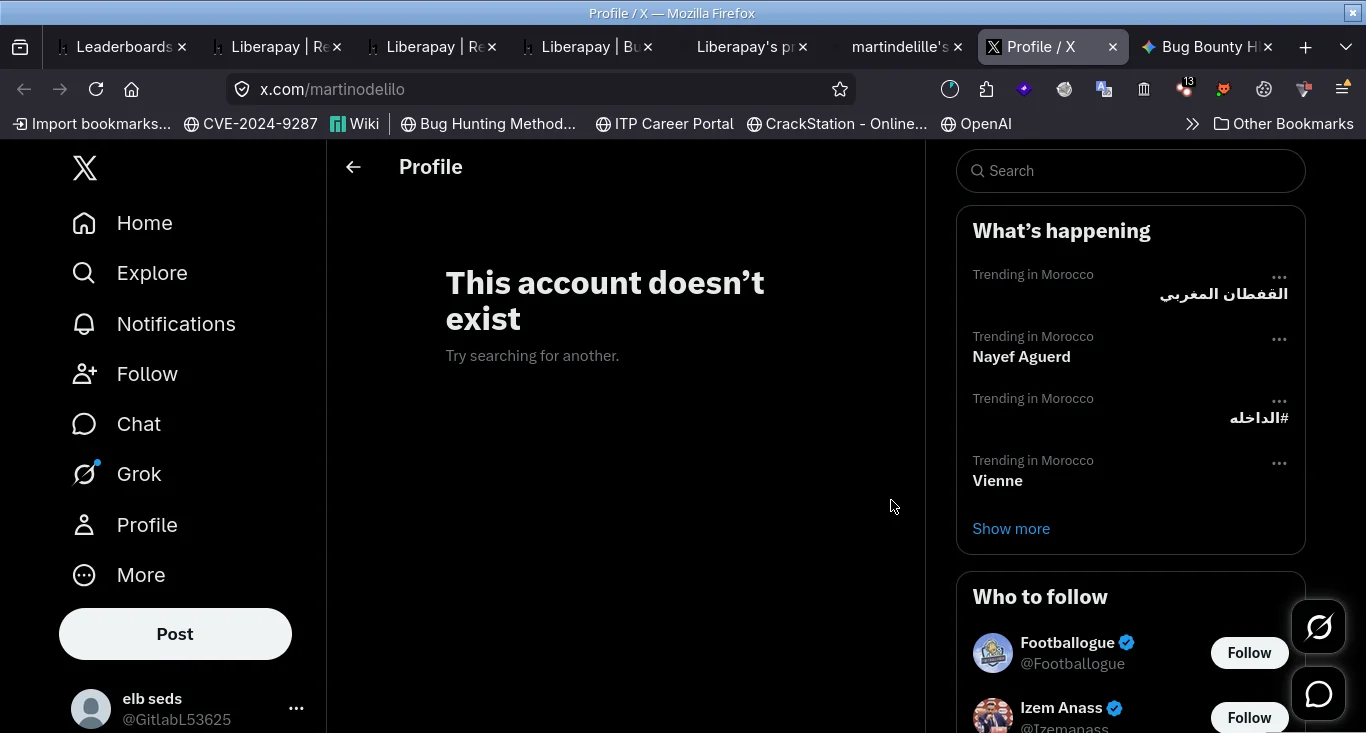
- Click on the Twitter link https://x.com/martinodelilo
- In the normal case, you will find that it's a broken link that can be hijacked
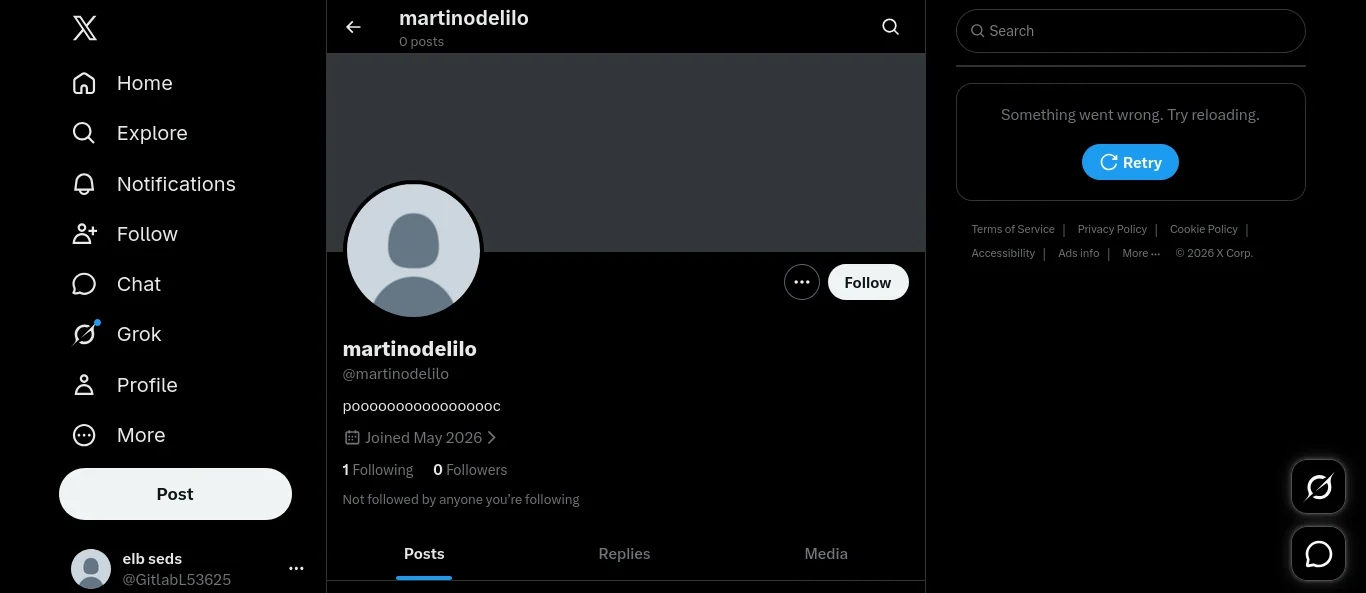
- For proof of concept purposes, I have hijacked the link to demonstrate what someone with malicious intent could do, such as spamming or posting illegal content on the account
Impact
An attacker who claims the expired Twitter account could leverage the perceived legitimacy from the Liberapay profile link to conduct social engineering attacks, scam users, impersonate the profile owner, or spread misinformation. Users who trust the link from the official Liberapay website may be deceived into believing the attacker-controlled account is legitimate, potentially leading to financial fraud or reputation damage.
The impact is particularly severe because martindelille is identified as a Liberapay team member (developers, translators, community managers who work on the platform). An attacker impersonating an official team member could exploit the heightened trust users place in Liberapay staff to conduct more sophisticated scams, request donations fraudulently, or damage the reputation of both the individual team member and the Liberapay platform itself.
The risk is amplified by the fact that the donation page displays a "Recipient Identity" verification message that explicitly confirms the linked accounts belong to martindelille. This creates a false assurance to donors that the expired Twitter account is legitimate and verified, making them highly susceptible to scams if an attacker claims the account and uses it to contact donors or solicit additional payments outside the platform.
Context
Liberapay is a donation platform where people and organisations collect recurring donations. Each member has a public profile at liberapay.com/<username> and a donation page at liberapay.com/<username>/donate. Profiles can carry a Linked Accounts section, and the donation page shows a "Recipient Identity" block that tells donors which external accounts have been verified as belonging to the recipient.
The report concerns the profile of martindelille, a Liberapay team member (developer, translator and community manager). One of the linked accounts on that profile is a Twitter account, and the handle behind that link had expired. Because the link is presented as verified, anyone who registers the expired handle inherits the trust Liberapay places in it. The researcher classifies this as Broken Link Hijacking (BLH).
Setup
No special tooling, account or privilege is needed to observe the issue. The only precondition is that the external account linked from a profile no longer exists, so its handle becomes available for registration. The researcher notes that martindelille is a Liberapay team member and asks that the account not be claimed by security researchers, since doing so would directly impersonate an official team member.
Finding it
The researcher looked at the Linked Accounts section of the martindelille profile and followed the Twitter link to https://x.com/martinodelilo. In the normal case the link is broken and can be hijacked. That turns an ordinary profile link into something an attacker can take over.
The more serious part is on the donation page. At https://liberapay.com/martindelille/donate, Liberapay shows a "Recipient Identity" section with the following statement:
We have confirmed through an automated verification process that martindelille has control of the following accounts on other platforms:
The expired Twitter account is listed among those accounts. The platform therefore tells donors that an expired Twitter account has been verified as belonging to the recipient.
The screenshot of the donation page shows the Recipient Identity section with the linked accounts, including the Twitter account in question.
Exploitation
Step 1: reach the Liberapay organisation page
https://liberapay.com/Liberapay/
This is the organisation profile that lists its members.
Step 2: find the member
In the members section of that page, search for the martindelille account.
Step 3: open the member profile
https://liberapay.com/martindelille
This is the public profile of the team member.
Step 4: locate the Linked Accounts section
The profile lists the external accounts that Liberapay associates with the member.
Step 5: follow the Twitter link
https://x.com/martinodelilo
In the normal case this is a broken link that can be hijacked.
The screenshot shows the broken Twitter link as reached from the profile.
Step 6: demonstrate the hijack
For proof of concept purposes, the researcher hijacked the link to demonstrate what someone with malicious intent could do. This shows what someone with malicious intent could do with it, such as spamming or posting illegal content on the account.
The screenshot shows the hijacked Twitter account behind the link that Liberapay presents as verified.
Root cause
Liberapay presents the external account as verified on the profile and on the donation page, through an automated verification process. When the Twitter handle expired, the stored link stayed in place and the "Recipient Identity" text kept asserting that martindelille controls it. The verification is a point-in-time check applied to a resource whose ownership can lapse, and the platform does not treat the lapse as a change of state.
Impact
An attacker who claims the expired Twitter account can lean on the perceived legitimacy of the Liberapay profile link to run social engineering attacks, scam users, impersonate the profile owner or spread misinformation. Users who trust a link published on the official Liberapay site may believe the attacker-controlled account is legitimate, which can lead to financial fraud or reputation damage.
The impact is heightened because martindelille is identified as a Liberapay team member. Impersonating an official team member exploits the extra trust users place in Liberapay staff, enabling more convincing scams, fraudulent donation requests, or damage to the reputation of both the individual and the platform.
The donation page makes this worse. Its "Recipient Identity" message explicitly confirms that the linked accounts belong to martindelille, giving donors false assurance that the expired Twitter account is legitimate and verified. If an attacker claims the handle and uses it to contact donors or solicit payments outside the platform, those donors are highly susceptible to the scam.
Fix
The report does not describe a fix or a change made in response.
Variants to test
- Other linked platforms on the same profile. Check every entry in the Linked Accounts section, not just Twitter, for handles or URLs that have lapsed. A positive result is a link that resolves to nothing while the profile still lists it as verified.
- Other members and organisations. Walk the member lists of organisations and popular profiles and resolve each linked account. A positive result is any expired handle still shown under a verification claim.
- Donation pages specifically. Compare the "Recipient Identity" block on
/donatewith the current state of each linked account. A positive result is a verification statement naming an account that no longer exists or has changed hands. - Re-registration of a released handle. Where a handle is free, register it in a controlled way and confirm that the Liberapay link now points at your account. A positive result is the platform's verified link resolving to an account you control.
- Handle changes rather than expiry. Look for linked accounts where the original owner renamed the handle and someone else took the old one. A positive result is the same mismatch between the stored link and the person the platform says controls it.
What happened, in plain words
Liberapay is a website where people collect donations, often as a recurring monthly payment. Every person or organisation that uses it gets a public page, and that page can list other places on the internet where you can find them, such as a Twitter account. Liberapay also has a special section on the donation page that tells donors, in effect, "we checked, and these outside accounts really belong to this person."
One of those linked accounts belonged to a Liberapay team member, someone who helps run the platform. The Twitter link behind the account was broken and could be hijacked. On Twitter (now called X), when an account is deleted or abandoned, its username, called a handle, becomes free again. Anyone can sign up and take that exact name. So the link on Liberapay pointed at a name that was up for grabs.
That is the whole problem in one sentence: Liberapay kept telling donors that a Twitter account was verified as belonging to its team member, while the link to it was broken and could be claimed by a stranger. The researcher calls this Broken Link Hijacking, or BLH. To prove it, the researcher hijacked the link to demonstrate what someone with malicious intent could do.
The pieces involved
Before walking through the steps, here are the parts of the website the report talks about.
- A profile lives at
liberapay.com/<username>, where<username>is the person's chosen name on the site. It is the public page anyone can visit. - A donation page lives at
liberapay.com/<username>/donate. This is the page a donor lands on when they want to give money. - The Linked Accounts section is a part of the profile that lists the person's accounts on other platforms, with links to them.
- The Recipient Identity block is a part of the donation page. It is a trust signal: it tells the donor which outside accounts the platform has confirmed belong to the person asking for money.
The profile in question belongs to martindelille, described in the report as a Liberapay team member who works as a developer, translator and community manager. That detail matters later, because people trust staff more than they trust strangers.
Why a dead link is a security problem
A normal dead link is just an annoyance: you click it, you get an error, you move on. It becomes a security problem when two things are true at the same time.
- The name in the link can be re-registered by anyone.
- The place that publishes the link still vouches for it.
Think of it like a company website that says "our accountant is John, reach him at this phone number." If John gives up the number and someone else is assigned it, the website is now sending customers to a stranger while still calling that stranger the accountant. The website did nothing wrong at the moment it published the number. The problem is that it never went back to check.
That is the situation here. Liberapay kept the link and the verification message in place even though the Twitter link was broken.
What the researcher needed to start
The report is clear that no special tools, accounts or permissions were required. You only need a browser. The one precondition is that the outside account linked from a profile no longer exists, so its handle is available for someone else to register.
The researcher also adds a note of care: martindelille is a Liberapay team member, and the account should not be claimed by security researchers, because doing so would directly impersonate an official team member. In other words, proving the point by taking the handle is itself a form of impersonation, so it has to be handled carefully and disclosed responsibly.
Finding it
The researcher opened the Linked Accounts section of the martindelille profile and followed the Twitter link, which pointed to https://x.com/martinodelilo. In the normal case the link is broken and can be hijacked. That is what turns an ordinary profile link into something an attacker can take over.
The more serious part is on the donation page. At https://liberapay.com/martindelille/donate, Liberapay shows a Recipient Identity section with this statement:
We have confirmed through an automated verification process that martindelille has control of the following accounts on other platforms:
The expired Twitter account is listed among those accounts. So the platform is telling donors that an expired account has been verified as belonging to the recipient.
The screenshot of the donation page shows the Recipient Identity section with the linked accounts, including the Twitter account in question.
Walking through the steps
The report lays out a numbered path that anyone can follow in a browser. Each step is listed below with the reason for taking it.
Step 1: reach the Liberapay organisation page
https://liberapay.com/Liberapay/
This is the organisation profile for Liberapay itself, and it lists the people who are members of that organisation. The researcher starts here because it is a public, official entry point: it shows how an ordinary visitor would naturally arrive at a team member's page, without needing to know the username in advance.
Step 2: find the member
In the members section of that page, search for the martindelille account. This is just using the site's own listing to locate the person, the same way a curious donor might browse the team.
Step 3: open the member profile
https://liberapay.com/martindelille
This is the public profile of the team member. Opening it is how you see what the platform publicly says about this person, including which outside accounts it associates with them.
Step 4: locate the Linked Accounts section
The profile lists the external accounts that Liberapay associates with the member. This is the list that contains the link in question, so it is where the problem becomes visible.
Step 5: follow the Twitter link
https://x.com/martinodelilo
In the normal case this is a broken link that can be hijacked. Following the link is the check that confirms the account is gone. If the account still existed and was still run by the same person, there would be nothing to report.
The screenshot shows the broken Twitter link as reached from the profile.
Step 6: demonstrate the hijack
For proof of concept purposes, the researcher hijacked the link to demonstrate what someone with malicious intent could do. This shows what someone with malicious intent could do with it, such as spamming or posting illegal content on the account.
A proof of concept, often shortened to PoC, is a small, safe demonstration that a problem is real rather than theoretical. Instead of just saying "someone could take this name," the researcher takes the name in a controlled way and shows the result. The report is explicit that this was done for demonstration only, and it repeats the warning that the account belongs to a team member and should not be claimed by other researchers.
The screenshot shows the hijacked Twitter account behind the link that Liberapay presents as verified.
Why this happens
Liberapay presents the outside account as verified on the profile and on the donation page, through an automated verification process.
When the Twitter handle expired, the stored link stayed in place and the Recipient Identity text kept asserting that martindelille controls it. The verification is a point-in-time check applied to something whose ownership can lapse, and the platform does not treat the lapse as a change of state.
A useful comparison is a passport check at a hotel. The receptionist looks at your passport when you arrive, which is fine for that moment. If the hotel then kept a sign in the lobby for years saying "this room is occupied by the person in this passport photo," the sign would be wrong as soon as you checked out. The check was correct when it happened; the sign simply never got updated.
What an attacker could do with it
An attacker who claims the expired Twitter account can lean on the perceived legitimacy of the Liberapay profile link to run social engineering attacks, scam users, impersonate the profile owner or spread misinformation. Social engineering means manipulating people into trusting you or doing something you want, rather than breaking in through technical means. A link from an official website is a powerful prop for that kind of manipulation.
Users who trust a link published on the official Liberapay site may believe the attacker-controlled account is legitimate, which can lead to financial fraud or reputation damage.
The impact is heightened because martindelille is identified as a Liberapay team member. Impersonating an official team member exploits the extra trust users place in Liberapay staff, enabling more convincing scams, fraudulent donation requests, or damage to the reputation of both the individual and the platform.
The donation page makes this worse. Its Recipient Identity message explicitly confirms that the linked accounts belong to martindelille, giving donors false assurance that the expired Twitter account is legitimate and verified. If an attacker claims the handle and uses it to contact donors or solicit payments outside the platform, those donors are highly susceptible to the scam.
What the report says about a fix
The report does not describe a fix or a change made in response.
Other places to look for the same pattern
These are ideas for further checking, not confirmed findings.
- Other linked platforms on the same profile. Check every entry in the Linked Accounts section, not just Twitter, for handles or web addresses that have lapsed. A positive result is a link that resolves to nothing while the profile still lists it as verified.
- Other members and organisations. Walk the member lists of organisations and popular profiles and resolve each linked account. A positive result is any expired handle still shown under a verification claim.
- Donation pages specifically. Compare the Recipient Identity block on
/donatewith the current state of each linked account. A positive result is a verification statement naming an account that no longer exists or has changed hands. - Re-registration of a released handle. Where a handle is free, register it in a controlled way and confirm that the Liberapay link now points at your account. A positive result is the platform's verified link resolving to an account you control.
- Handle changes rather than expiry. Look for linked accounts where the original owner renamed the handle and someone else took the old one. A positive result is the same mismatch between the stored link and the person the platform says controls it.
Glossary
- Liberapay: a website where people and organisations collect donations, including recurring ones.
- Profile: a public page on Liberapay at
liberapay.com/<username>describing a member. - Donation page: the page at
liberapay.com/<username>/donatewhere a donor gives money. - Linked Accounts section: the part of a profile that lists the member's accounts on other platforms, with links.
- Recipient Identity block: the part of the donation page that tells donors which outside accounts the platform has confirmed belong to the recipient.
- Handle: the username that identifies an account on a platform such as Twitter/X, for example the name in
x.com/martinodelilo. - Expired handle: a handle whose account no longer exists, so the name is free for anyone to register.
- Broken Link Hijacking (BLH): taking over a link that points at a name or address nobody controls any more, so the link now leads to something the original publisher did not intend.
- Verification: a check that an outside account really belongs to a given person. Here it is done once, automatically, and the result is displayed afterwards.
- Point-in-time check: a check that is only valid at the moment it is made and is not repeated later.
- Proof of concept (PoC): a small, controlled demonstration that a security problem is real.
- Social engineering: manipulating people into trusting you or acting in your interest, using psychology rather than technical exploits.
- Impersonation: pretending to be someone else, here by taking over a name the real person used to hold.
- Root cause: the underlying reason a problem exists, as opposed to its visible symptoms.
- Variant: another place or situation where the same underlying mistake might occur.
- Browser: the program you use to visit websites, such as Firefox or Chrome.
- URL: the address of a page or resource on the web, such as
https://liberapay.com/martindelille. - HTTP: the language browsers and websites use to exchange pages and data; the
httpcode blocks above are simply web addresses. - Automated verification process: a check performed by software rather than a person, used here to confirm ownership of outside accounts.




