Improper Authentication Throttling Allows Attacker-Controlled Account Lockouts
The application locks an account after several failed login attempts based only on the username, without considering the request origin. An attacker who knows a valid username can deliberately lock that user out by submitting repeated wrong passwords.

- Disclosed after 21 days
The application lacks sufficient safeguards in its authentication throttling logic. It permits arbitrary users to trigger lockouts on any account by submitting multiple failed login attempts using a known or guessed username. Because the system does not verify the request origin or impose intelligent rate-limiting tied to session/IP/fingerprint, an attacker can intentionally lock out legitimate users — impacting their access to the application.
Steps To Reproduce:
[add details for how we can reproduce the issue]
- Obtain a valid username
Usernames are publicly available via the platform's user directory, leaderboard, or other public features.
- Attempt multiple failed logins
Submit several login attempts using the valid username with incorrect passwords.
- Observe the account lockout
After a specific number of failed attempts (e.g., 5–10), the application prevents further login for that user
PoC:
Demonstrating that sending multiple failed login requests targeting a specific username results in that account being locked out.
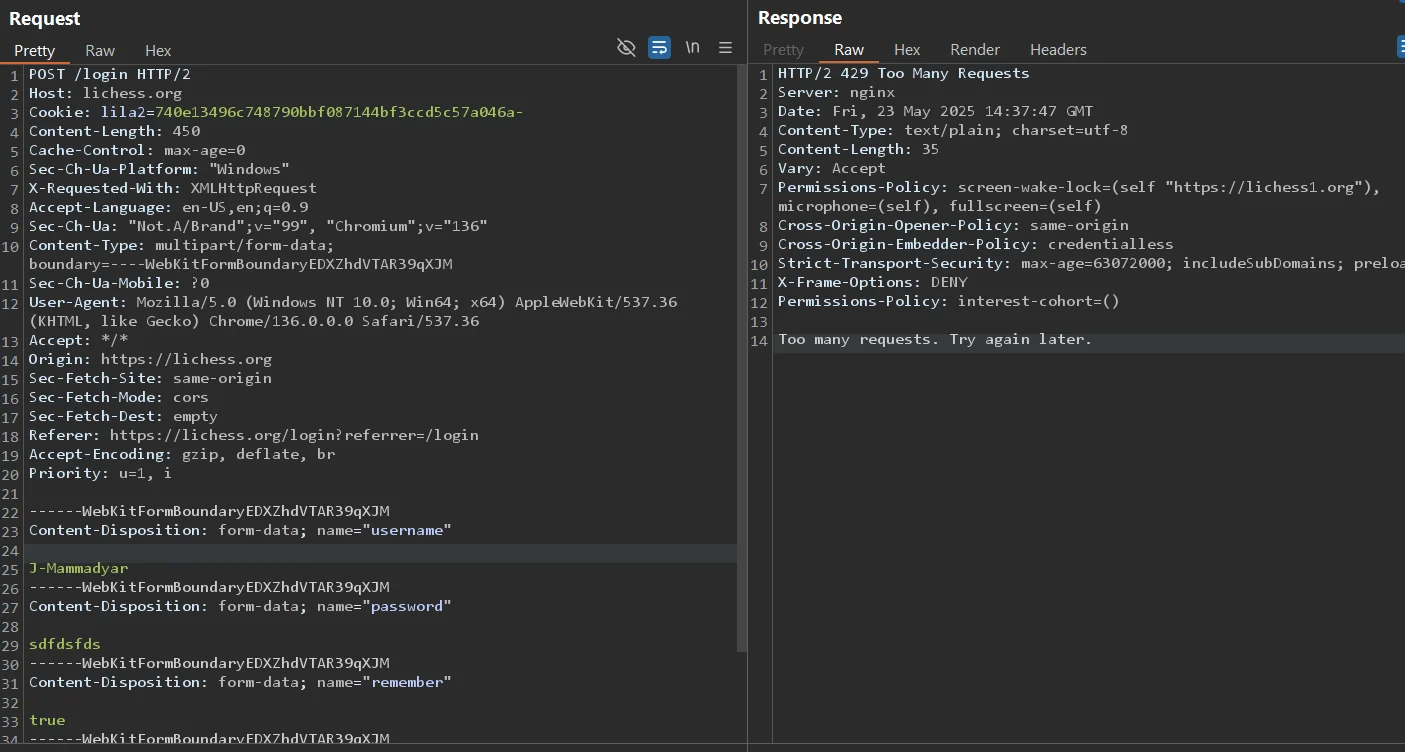
I verified this by attempting to log into my own account from a different IP address using the correct password, and I was rate limited — confirming that the lockout mechanism is based solely on the username, not on the IP address or session context.
This demonstrates that an attacker can remotely prevent legitimate users from accessing their accounts without needing valid credentials, resulting in a loss of account availability for targeted individuals.
Impact
-
Enables unauthorized control over another user's account availability.
-
May disrupt access for legitimate users, causing support overhead, trust degradation, or account compromise attempts.
Not written yet. The AI write-up for this report has not been written yet. The Original tab links to the source.
How it worked
Impact
An attacker could remotely deny access to any known account, causing loss of availability, support overhead and possible account compromise attempts; the reporter confirmed the block applied even from a different IP address with the correct password.
What the attacker needed
A known or guessable username; no authentication needed
How it was found
- Find a valid username through public features such as the user directory or leaderboard.
- Submit several login attempts for that username with incorrect passwords.
- Observe that after a small number of failures the application blocks further login for that user.
Explained by bugbounty.wiki with AI from the original and checked against quotes from it; it can still be wrong. Read the original before relying on a detail.
Not written yet. The AI write-up for this report has not been written yet. The Original tab links to the source.
When you type a wrong password too many times, many sites temporarily block the account to stop guessing. Here the site blocks the account no matter where the attempts come from, so anyone who knows your username can trigger that block on purpose. That means a stranger can stop you from logging in even though they do not know your password.
What is Business logic?
The application works as coded but not as intended: a negative price, a skipped payment step, a limit that can be crossed.




