Host Header injection in oslo.io (using X-Forwarded-For header) leading to email spoofing
The invitation-by-email feature on oslo.io accepted a client-supplied X-Forwarded-Host header and used it to build the invitation link. An attacker could make the invitation email point to a domain they control, which could be used to deceive the recipient or send them to a fake login page.

- Triaged in 33 hours
- Fixed in 47 hours
- Disclosed after 2 days
#Hello team ##I hope it will be a happy year for you and for me 😇
Summary:
I found Host Header injection in oslo.io
I tried to use it to show the security effect on users And I found this
Steps To Reproduce:
- Well, first of all, enter your project
2.Make an invitation by email 3.Now through the burpsuite If we try to change the host, 403 will appear
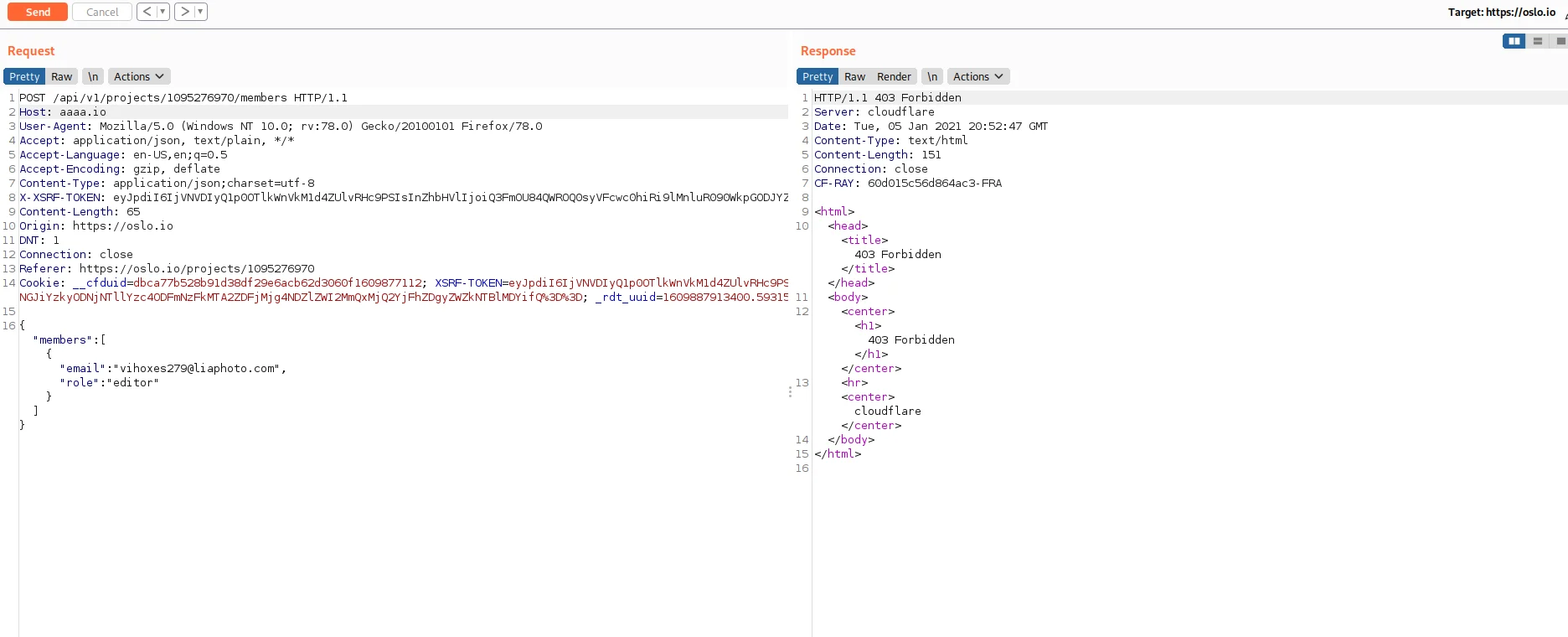
So we will use X-Forwarded-Host: example.com
PoC :
Impact
Many things can be done, including deceiving the user and referring to something else or a login page and stealing their account
There is a lot of information about it here :
Not written yet. The AI write-up for this report has not been written yet. The Original tab links to the source.
How it worked
Root cause
Likely the application built the invitation link from the client-supplied X-Forwarded-Host header instead of a fixed, trusted hostname.
Impact
The attacker could deceive the recipient and point the invitation link at a fake login page to try to steal their account, though the report only demonstrates the link manipulation and does not show a working theft.
What the attacker needed
Ability to send project invitations; victim opens the invitation email
How it was found
- Open your project on the site.
- Send an invitation by email.
- Intercept the request in a proxy tool and try changing the Host header, which returns a 403.
- Set the X-Forwarded-Host header to example.com and observe the resulting invitation link.
Explained by bugbounty.wiki with AI from the original and checked against quotes from it; it can still be wrong. Read the original before relying on a detail.
Not written yet. The AI write-up for this report has not been written yet. The Original tab links to the source.
When a website sends an email with a link in it, it has to decide which domain name to put in that link. This site trusted a value the visitor's browser can set, so a person sending an invite could make the link point at their own site instead. The recipient would then see a real-looking email that leads somewhere the attacker controls.
What is Business logic?
The application works as coded but not as intended: a negative price, a skipped payment step, a limit that can be crossed.