Mattermost Server OAuth Flow Cross-Site Scripting
The OAuth flow reflected an unsanitised query parameter into an HTML error page, allowing a crafted link to run script in the victim's browser. An attacker could hijack a victim's session to read their messages, or, if the victim was an administrator, add a new administrator.

- Triaged in 4 days
- Fixed in 47 days
- Paid in 13 days
- Disclosed after 2 months
Summary by the researcher
Andrea `zi0black` Cappa of Shielder found a Reflected Cross-Site Scripting (XSS) in the OAuth authentication flow of Mattermost. Once fixed he found a bypass for it which was promptly fixed by the Mattermost team.
The vulnerability could have been abused to hijack a victim session and based on their privileges steal their conversations / send messages (user) and/or add a new administrator on the Mattermost instance (admin).
All the details are available in the advisory published on Shielder's website: https://www.shielder.it/advisories/mattermost-server-reflected-xss-oauth/
The report
Summary:
The vulnerability is a reflected Cross-Site Scripting (XSS) via the OAuth flow. A victim clicking a malicious link pointing to the target Mattermost host will trigger the XSS. If the victim is a regular user, it is possible to obtain all of their Mattermost chat contents; if it’s an administrator, it is possible to create a new administrator.
Root Cause Analysis:
The application fails to sanitize an HTTP query parameter before reflecting it within the HTML response during the OAuth flow.
        if props != nil {
                action = props["action"]
                isMobile = action == model.OAUTH_ACTION_MOBILE
                if val, ok := props["redirect_to"]; ok {
[1]                     redirectURL = val
                        hasRedirectURL = redirectURL != ""
                }
        }
        renderError := func(err *model.AppError) {
                if isMobile && hasRedirectURL {
[2]                     utils.RenderMobileError(c.App.Config(), w, err, redirectURL)
                } else {
                        utils.RenderWebAppError(c.App.Config(), w, r, err, c.App.AsymmetricSigningKey())
                }
        }
The file "/web/oauth.go" (https://github.com/mattermost/mattermost-server/blob/master/web/oauth.go) contains the function "completeOAuth" which on line 284 values the variable "redirectURL" with the parameter "redirect_to" [1] of the query string of the HTTP GET request. Subsequently always inside of the same function to the line 291 comes called the function "utils.RenderMobileError" to which it comes passed like argument the variable "redirectURL" [2].
func RenderMobileError(config *model.Config, w http.ResponseWriter, err *model.AppError, redirectURL string) {
        RenderMobileMessage(w, `
                <svg xmlns="http://www.w3.org/2000/svg" viewBox="0 0 576 512" style="width: 64px; height: 64px; fill: #ccc">
                        <!-- Font Awesome Free 5.15.3 by @fontawesome - https://fontawesome.com License - https://fontawesome.com/license/free (Icons: CC BY 4.0, Fonts: SIL OFL 1.1, Code: MIT License) -->
                        <path d="M569.517 440.013C587.975 472.007 564.806 512 527.94 512H48.054c-36.937 0-59.999-40.055-41.577-71.987L246.423 23.985c18.467-32.009 64.72-31.951 83.154 0l239.94 416.028zM288 354c-25.405 0-46 20.595-46 46s20.595 46 46 46 46-20.595 46-46-20.595-46-46-46zm-43.673-165.346l7.418 136c.347 6.364 5.609 11.346 11.982 11.346h48.546c6.373 0 11.635-4.982 11.982-11.346l7.418-136c.375-6.874-5.098-12.654-11.982-12.654h-63.383c-6.884 0-12.356 5.78-11.981 12.654z"/>
                </svg>
                <h2> `+i18n.T("error")+` </h2>
                <p> `+err.Message+` </p>
[1]                <a href="`+redirectURL+`">
                        `+i18n.T("api.back_to_app", map[string]interface{}{"SiteName": config.TeamSettings.SiteName})+`
                </a>
        `)
}
The function "RenderMobileError" is contained within the file "utils/api.go" (https://github.com/mattermost/mattermost-server/blob/master/utils/api.go) at line 103, and the fourth argument of this function is "redirectURL". At line 104 the "RenderMobileMessage" function is called and at line 111 the variable "redirectURL" is concatenated (without being sanitised) with another string argument of the "RenderMobileMessage" function [1].
[...]
                        </head>
                        <body>
                                <!-- mobile app message -->
                                <div class="message-container">
[1]                                     `+message+`
                                </div>
                        </body>
                </html>
        `)
Inside the "RenderMobileMessage" function (declared at line 117 of utils/api.go) "fmt.Fprintln" is called to print the HTTP response and the HTML page is dynamically built concatenating the "message" variable [1] (second argument of the function).
Call graph: completeOAuth -(redirectURL=redirect_to)-> util.RenderMobileError(,redirectURL) -(message=string+redirectURL)-> RenderMobileMessage(,message) -> fmt.Fprintln(string+message)
Since the HTTP GET request parameter "redirect_to" is never sanitized and is appended to the HTML page, it is possible to trigger a reflected XSS.
Steps To Reproduce:
- Visit the following URL after replacing <mattermost_url> with the domain/ip of the mattermost server instance:
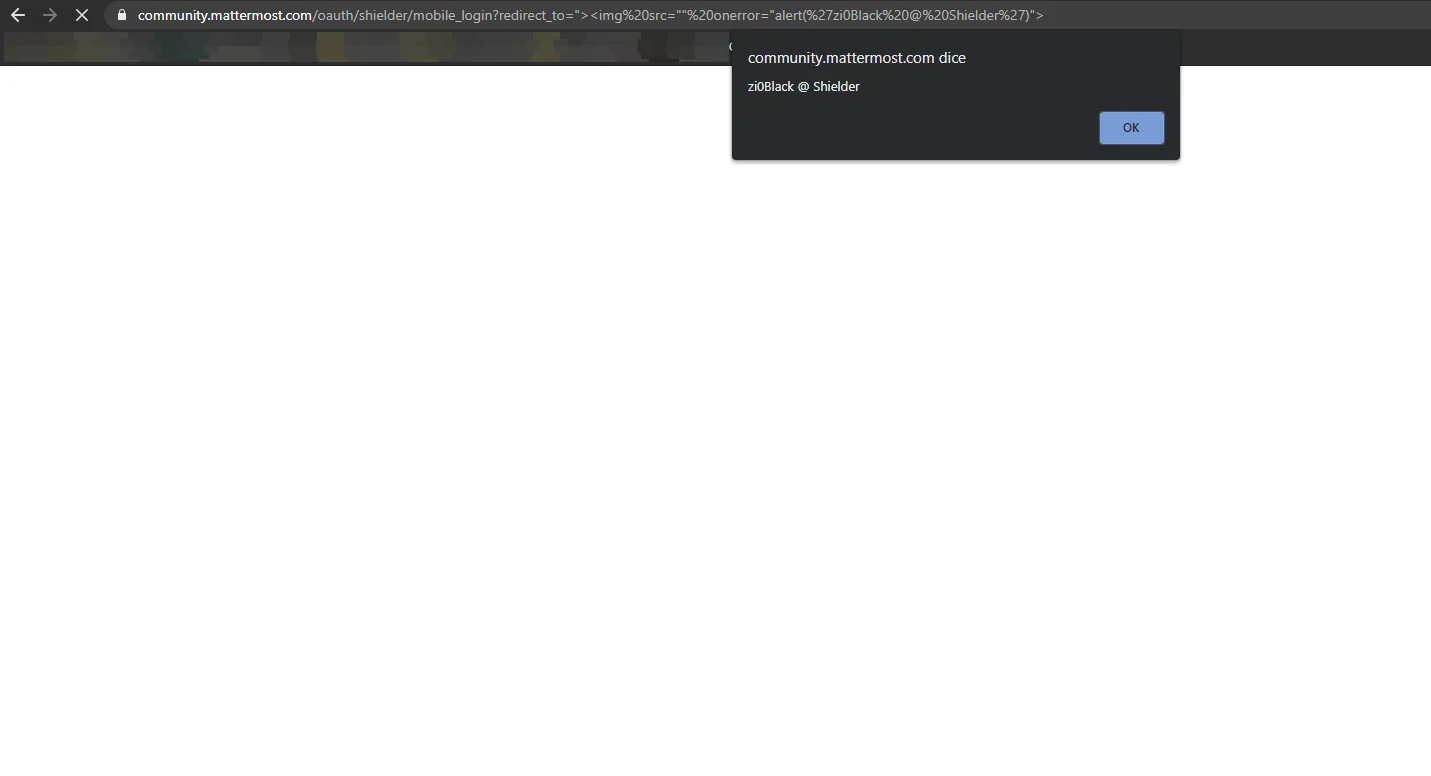
https://<mattermost_url>/oauth/shielder/mobile_login?redirect_to=%22%3E%3Cimg%20src=%22%22%20onerror=%22alert(%27zi0Black%20@%20Shielder%27)%22%3E
- Notice the JavaScript's generated pop-up
Supporting Material/References:
- [attachment / F1324661]
Impact
The following attack scenarios have been identified:
- If the victim is a regular user, the attacker could read the messages sent and received by the user.
- If the victim is an administrative user, the attacker could change the server settings (e.g. add a new administrative user).
Attachments
Not written yet. The AI write-up for this report has not been written yet. The Original tab links to the source.
How it worked
Root cause
The redirect_to query parameter was concatenated into the HTML of the mobile error page without sanitisation or escaping.
Impact
A victim who clicked the link could have their session hijacked, letting the attacker read their messages or, for an administrator, add a new administrator; the text also notes a bypass was found after the first fix.
What the attacker needed
Victim clicks a crafted link; victim is logged in to Mattermost
The fix
The issue was fixed, and a bypass found afterwards was also promptly fixed by the Mattermost team.
How it was found
- Open the OAuth mobile login URL on the target server with a crafted redirect_to value.
- Observe the script pop-up in the browser.
Explained by bugbounty.wiki with AI from the original and checked against quotes from it; it can still be wrong. Read the original before relying on a detail.
Not written yet. The AI write-up for this report has not been written yet. The Original tab links to the source.
When you log in with another service, the site sometimes shows an error page and puts a value from the web address into that page. Here it did so without cleaning the value first, so a link could carry hidden code that the browser runs as if it came from the site. That lets an attacker act as the logged-in victim.
What is XSS?
Script an attacker supplies runs in another user's browser, on the target's origin, with that user's session.