Three Microsoft Store vulnerabilites
The Microsoft Store generated invoices for game purchases even when payment failed and the game licence was revoked, and it also issued small gift credits after refund failures. An attacker could exploit these flaws to profit from tax rebate schemes and to obtain premium game content while paying only for the standard edition.
 Published on gccybermonks.com
Description of the 3 vulnerabilities: “Generating invoices in the Microsoft Store without making purchases”, “Adding money in the Microsoft Store Wallet” and “Buying Definitive / Deluxe / Ultimate games for the price of a standard game”.
The full write-up lives on its author's site
It belongs to its author, so we link to it rather than copy it. The other two tabs are our own rewrites, checked against it.
Context
The target is the Microsoft Store and its payment and licensing pipeline, as reached through an Xbox Live / MSA account and the Microsoft developers' Sandbox used for Gamepass subscriptions. The feature under scrutiny is the normal purchase flow: a card is registered on the account, a game (including pre-orders) is bought, a charge is attempted around ten days before launch, a licence is issued, and an invoice (Nota Fiscal, NF) is generated for the purchase.
The write-up describes three logic flaws in that pipeline:
- Generating invoices for Xbox games without completing the purchase, and monetising them through the Brazilian Nota Fiscal Paulista consumer credit programme.
- Adding money to the Microsoft Store wallet through repeated refunds of a failed purchase.
- Buying a Definitive / Deluxe / Ultimate edition for the price of the Standard edition.
A summary of the steps for the two bypasses (purchases of infinite games and subscriptions within Microsoft's sandbox) is linked from the report at https://github.com/smarlonfabiano/xbox_xpl.
Setup
The preconditions are modest and all come from the first bug the researcher had reported earlier:
- A valid card registered on an Xbox Live or MSA account, which is then cancelled and blocked at the issuing bank. Alternatively, a PayPal account with no credit card registered, or a prepaid credit card.
- One or more MSA accounts. The invoice abuse is explicitly multiplied across accounts.
- For the third flaw, the ability to choose the most expensive edition of a pre-order game.
No special tooling is described; the work is done through the ordinary store purchase flow and the MSA account pages.
Finding it
The starting point was the earlier payment bypass: after subscribing to Gamepass through the Microsoft developers' Sandbox by bypassing payment methods, the researcher looked at what else the payment process did when a charge failed. The observation that mattered was that the financial processes continued regardless of whether the payment succeeded, and the invoice was still issued after the licence was revoked.
Exploitation
Step 0: the original payment bypass
This is the foundation for all three flaws.
- Register a valid card on the Xbox Live or MSA account.
- Cancel and block the credit card at the issuing bank. A PayPal account with no credit card registered, or a prepaid credit card, also works.
- With the invalid card, PayPal account or prepaid card, buy the games as pre-orders. Because the charge can be made as early as 10 days before launch, the games can be downloaded without the game fee ever being charged.
- The attempted debit of the registered card happens 10 days before launch, and several notifications about the payment failure may arrive.
- At that moment the first fault was found: the product licence was not revoked. After that was fixed and the licence is revoked, access to the product is lost, but the rest of the financial processes continue regardless of whether payment is made.
So when Microsoft revokes the game licence, the MSA account still receives the product invoice without payment.
Step 1: invoices without purchases (Vulnerability 1)
The Microsoft Store generates NFs without any kind of control. A user can try to buy pre-sale games without paying, and even when the licences are revoked for non-payment, the invoice arrives as if the purchase had been made. Xbox then pays the tax amount of the game sold.
Monetising it through Nota Fiscal Paulista:
- The malicious agent uses the bug to obtain multiple invoices without paying for the games. Example given: the attacker buys R$ 10,000 worth of games using multiple MSA accounts.
- Microsoft generates the invoice and pays R$ 1,700 to São Paulo (the rate is between 17%).
- Even if payment for the games is not made, the malicious agent receives the invoices after the game licences are revoked by Microsoft.
- The scammer logs in at
https://www.nfp.fazenda.sp.gov.br/login.aspxand redeems R$ 510 from his own CPF or from the CPF of a victim.
The scaling is stated directly:
1 MSA account buying R$ 10,000 will redeem R$ 510 with the Nota Fiscal Paulista

10 MSA account buying R$ 10,000 will redeem R$ 5,100 with the Nota Fiscal Paulista
The report notes that the minimum wage in Brazil is R$ 1,100, so the scammer can reach almost five times that amount.
Proof of concept screenshots:
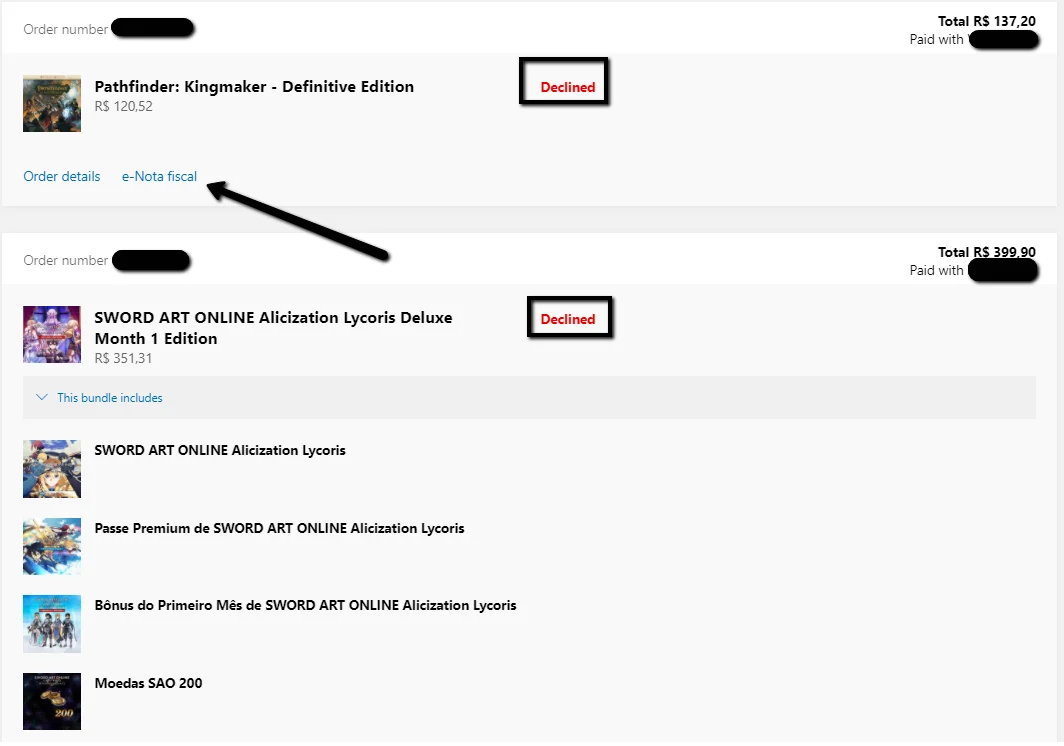
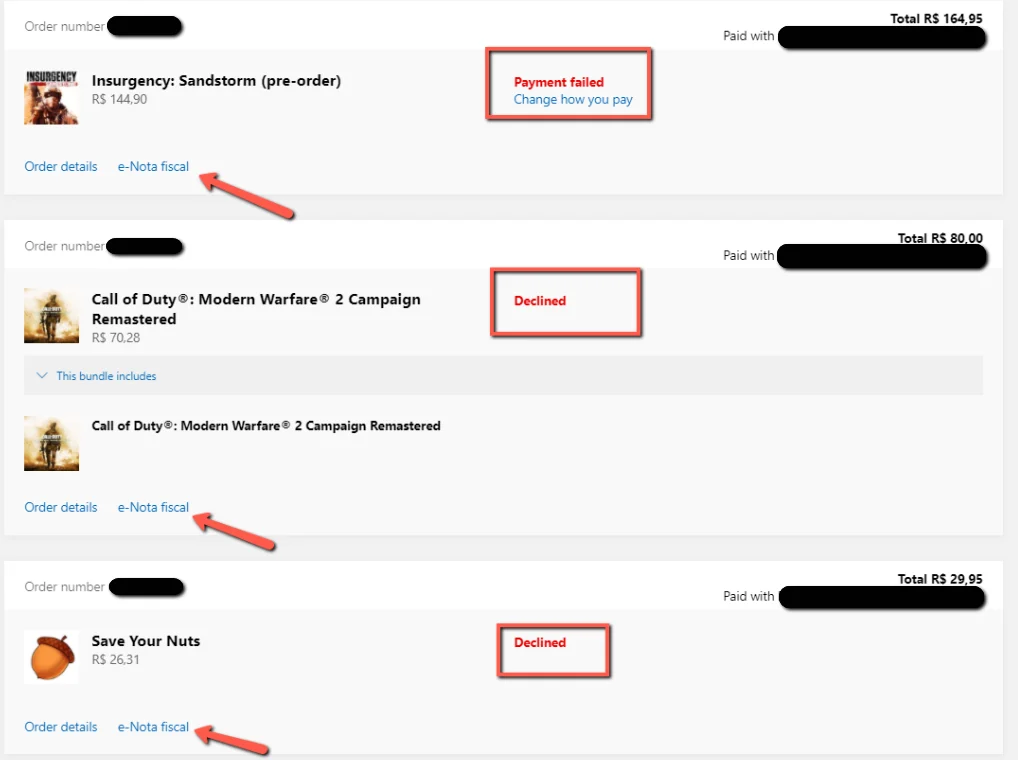
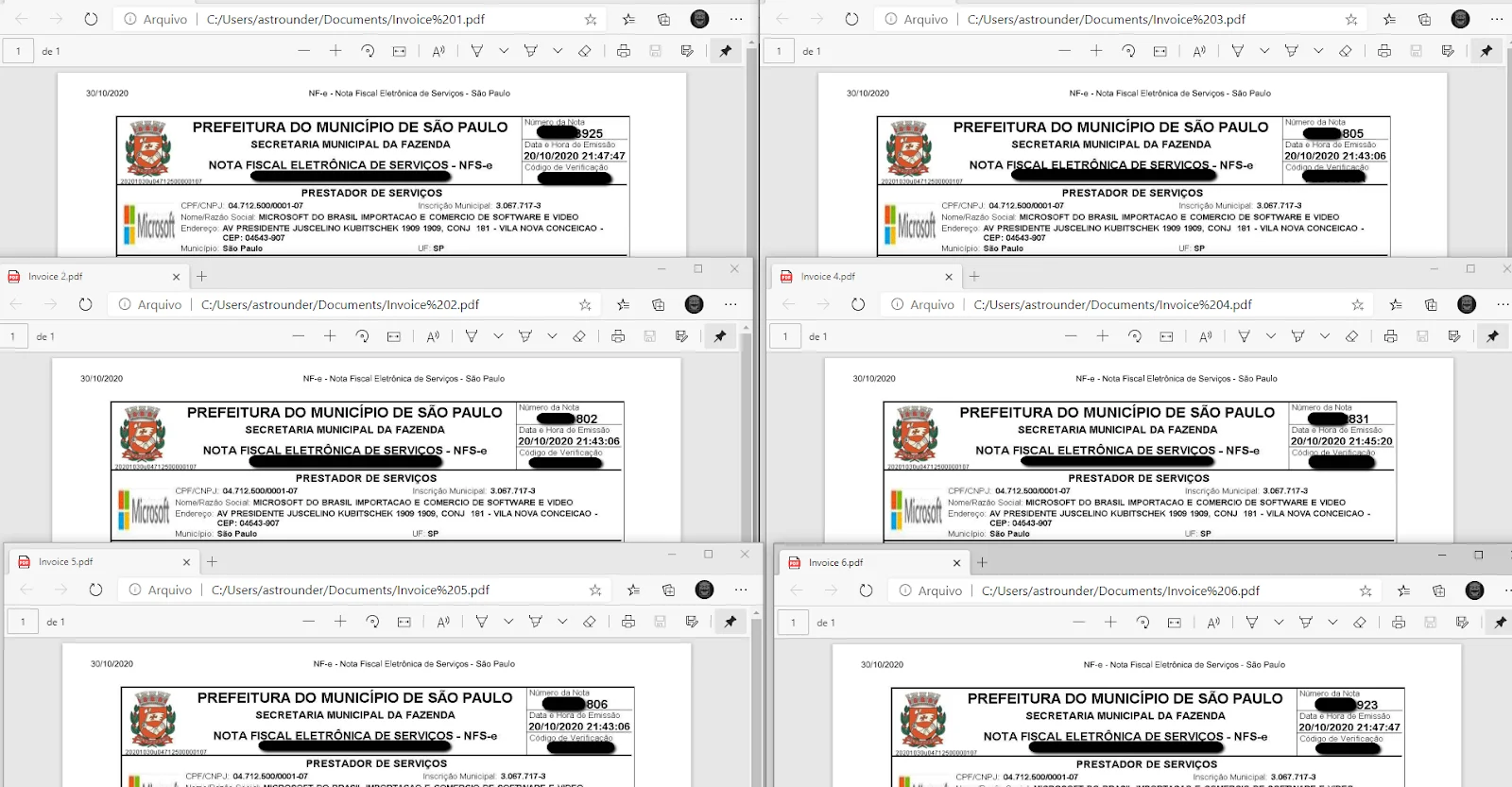
References given for the tax side: https://portal.fazenda.sp.gov.br/servicos/nfp, https://portal.fazenda.sp.gov.br/servicos/nfp/Paginas/Como-%C3%A9-feito-o-c%C3%A1lculo-do-cr%C3%A9dito.aspx and https://epocanegocios.globo.com/colunas/Financas-de-Bolso/noticia/2017/01/como-ganhar-dinheiro-com-nota-fiscal-paulista.html.
Step 2: adding money to the wallet (Vulnerability 2)
This continues from the same reproduction. When the invoices for the purchased games arrive but the purchased game does not, there is a window of 1 to 3 days after release in which the games bought with the bug can still be played. After that the licence is revoked and play stops.
A validation process then checks whether the user who received the invoice also received the game. If the user received the invoice but not the game, the purchase price is refunded to the registered credit card. Since the card is not valid, no refund is received.
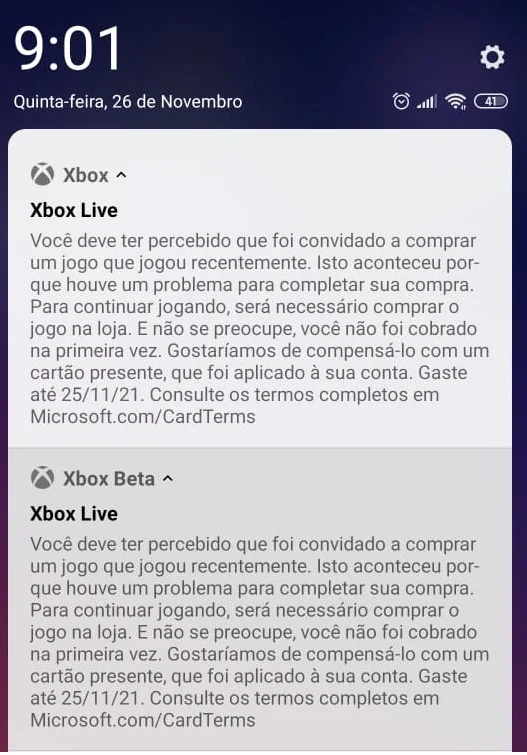
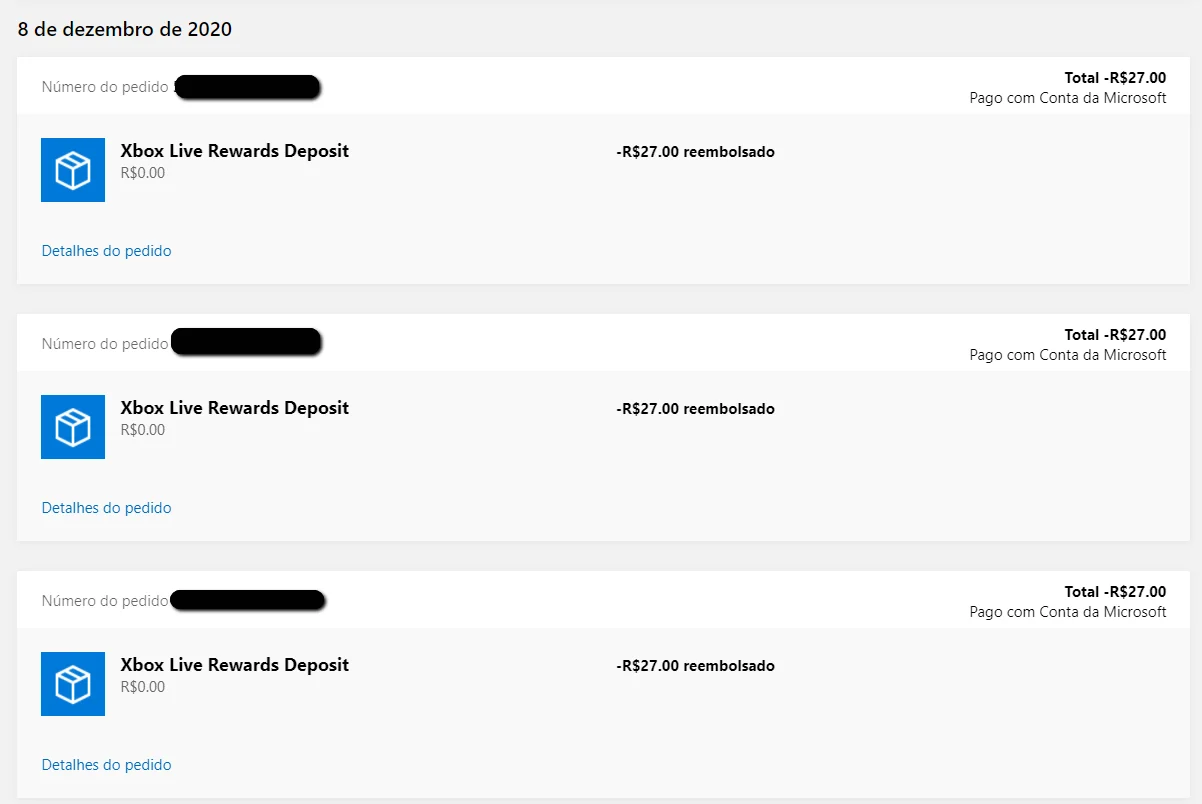
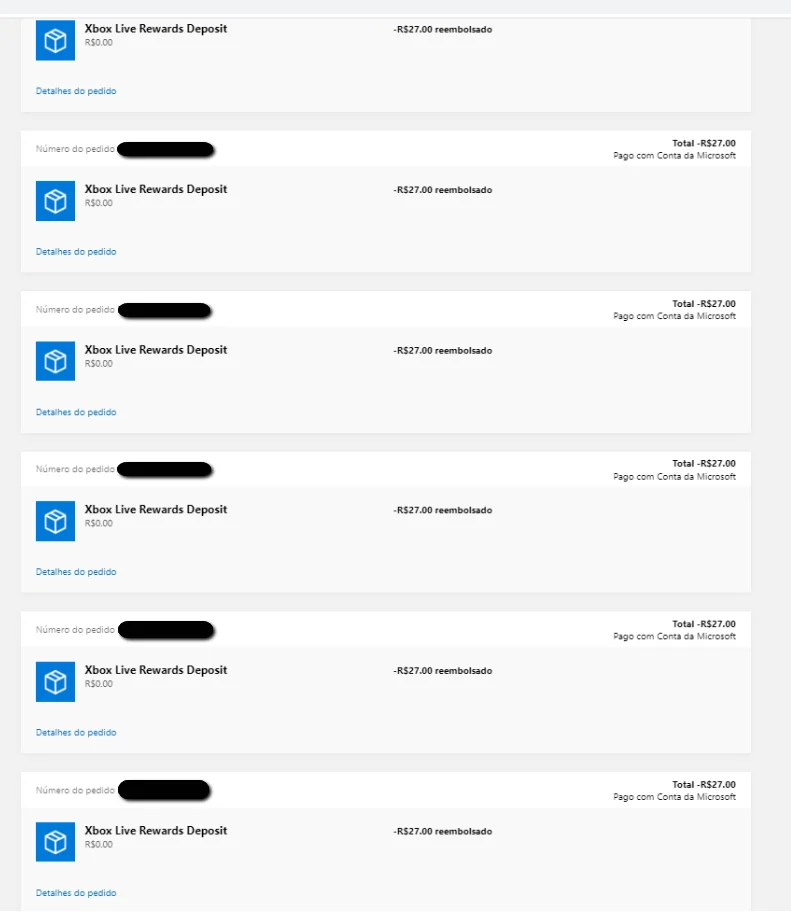
To smooth this over for the customer, Microsoft sends a "gift" of R$ 27.00. Repeating the same bug several times in a row accumulates that gift:
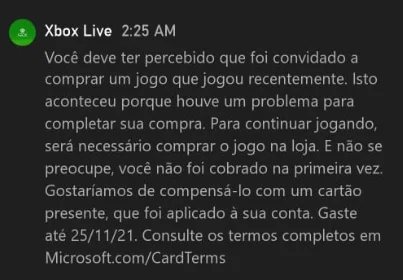


So the process can be repeated patiently to receive refund money. A malicious agent could create multiple accounts, add money to their wallets and resell store games: because games can be bought as a gift, they can be sent or sold to any Xbox Live user. There is also no segregation between the Microsoft Store and the Xbox store, so a balance on the account can buy not only games but licences of Windows, Office 365, keyboards, mice, notebooks and so on.
Step 3: Ultimate edition for the Standard price (Vulnerability 3)
- Follow the same steps used to generate invoices without paying for the game, but choose the most expensive version of the game. This works for pre-order games.
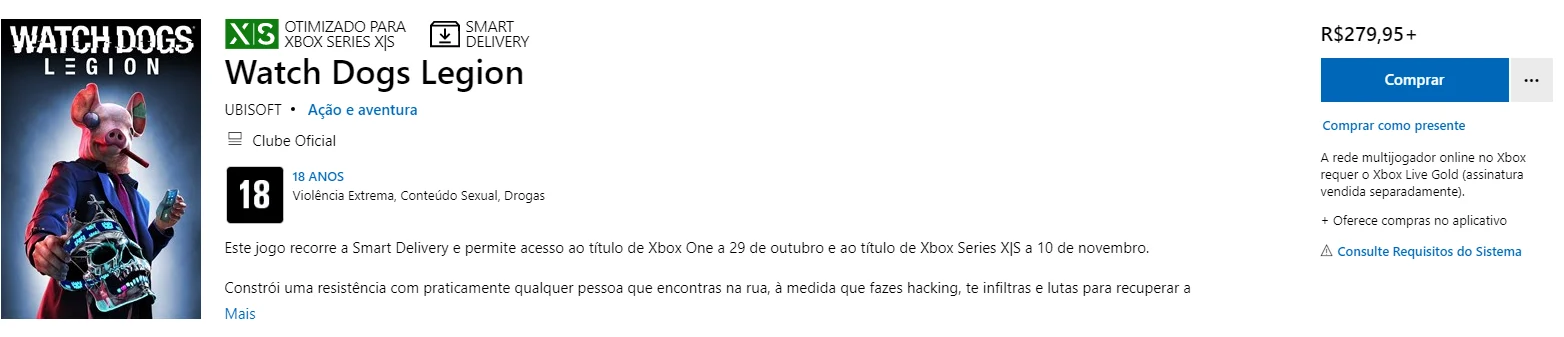
- The test was done on Watch Dogs Legion, where the Standard edition costs R$ 279.95 and the Ultimate edition costs R$ 459.95.
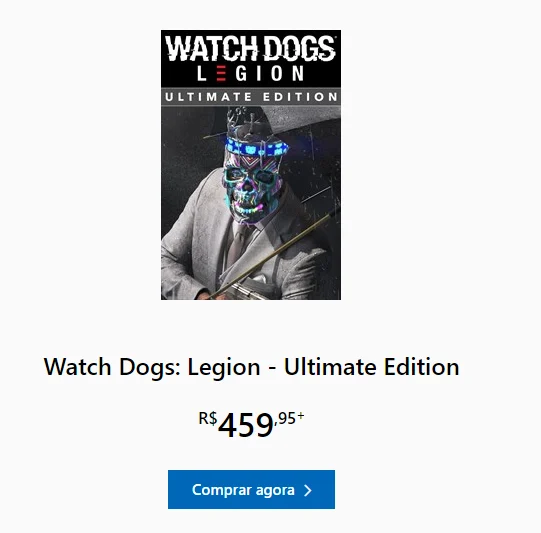
- The Ultimate edition is bought with an invalid card; when the game is released the licence is revoked, and trying to play after release returns the message that the game must be purchased again.
The flaw is that Xbox revokes only the game licence, not the licence for premium content, Season Pass, DLCs and so on. The base game licence is gone, but the licence for all the rest of the premium content remains. To enjoy the Ultimate edition (R$ 459.95), it is enough to buy the Standard version for R$ 279.95, a saving for the buyer and a loss for Microsoft/Ubisoft of R$ 180.00.
Root cause
The common thread is that the store's financial and licensing processes are not tied to a confirmed payment. Invoice generation, the refund/gift path and premium-content licensing each run on their own, so a failed charge does not stop them. The invoice is issued even after the licence is revoked, the refund validation compensates with a gift when the refund cannot reach an invalid card, and licence revocation is scoped to the base game only. The report does not describe the server-side implementation or the exact code-level cause.
Impact
- Invoice fraud: invoices for unpaid games can be redeemed through Nota Fiscal Paulista, with the tax amount paid by Microsoft. The report's own arithmetic gives R$ 510 per R$ 10,000 of games per MSA account, with ten accounts redeeming R$ 5,100, and mentions redeeming against a victim's CPF as well.
- Wallet inflation: repeated refund gifts of R$ 27.00 accumulate as store credit, which can be spent on games (including gifts to other users) and, because the stores are not segregated, on Windows, Office 365 and hardware.
- Edition downgrade: paying the Standard price yields the Ultimate edition's premium content, with the stated R$ 180.00 loss per copy in the Watch Dogs Legion example.
The first two depend on the invoice and refund processes continuing after the charge fails.
Fix
The report does not state which changes Microsoft made. Based on the described behaviour, the fixes would be to gate invoice generation on a settled payment, to stop issuing the R$ 27.00 gift when the refund cannot be delivered, and to revoke premium-content licences together with the base game licence.
Variants to test
- Pre-order flows on other stores: register a card, block it, pre-order, and watch whether the licence survives the failed charge and whether an invoice is still issued. A positive result is an invoice or a playable licence after the charge fails.
- Refund compensation: force a failed purchase that triggers a goodwill credit and repeat it. A positive result is a growing, spendable balance.
- Edition licensing: buy the cheapest edition after a revoked expensive edition and check whether DLC, Season Pass or premium entitlements remain usable. A positive result is premium content working without the base licence.
- Cross-store balance: check whether credit from one storefront can be spent in another (games, software licences, hardware). A positive result is a shared, spendable balance across product categories.
- Tax-incentive programmes in other jurisdictions: any consumer credit scheme tied to invoices is worth testing wherever invoices can be generated without payment.
What happened, in plain words
A security researcher found three separate problems in the way the Microsoft Store handles money and game licences. All three start from the same trick: you can make the store believe you are going to pay for a game, without ever actually paying.
- Problem 1: the store produces an invoice (a tax receipt, called Nota Fiscal in Brazil) for a game you never paid for. In the Brazilian state of São Paulo there is a government programme, Nota Fiscal Paulista, that gives consumers a small credit back from the tax on their purchases. So a scammer can collect invoices for unpaid games and cash in the tax credit, which Microsoft has already paid to the state.
- Problem 2: when a purchase fails and the money cannot be refunded to your card, Microsoft sends a small goodwill credit of R$ 27.00 to your store wallet. Repeat the failed purchase over and over and the wallet keeps growing with free money, which can be spent on games, software or even hardware.
- Problem 3: you can buy the most expensive edition of a game (Ultimate, Deluxe, Definitive) with a card that will fail. When the base game licence is taken away, the extra content (Season Pass, DLCs) stays licensed. You then buy the cheap Standard edition and still get all the premium content, paying R$ 279.95 instead of R$ 459.95 in the example given.
Before going further, a few words on the pieces involved, because the rest of the article uses them constantly.
- Microsoft Store / Xbox store: the online shop where you buy games, subscriptions and, in Microsoft's case, also software licences and hardware. The report notes there is no separation between the two storefronts, so one balance can be spent in both.
- MSA account: a Microsoft Account, the login you use for Xbox Live, the Store and Microsoft's other services. Think of it as the key to your personal shop counter.
- Licence: the digital permission that says "this account is allowed to run this game". It is not the game file itself; it is the right to use it. If the licence is revoked, the game stops working even if it is already downloaded.
- Invoice (Nota Fiscal, NF): the official tax receipt a shop must issue for a sale. In Brazil it is registered with the tax authority, and the tax on the sale is paid by the shop to the state.
- Pre-order: buying a game before it is released. The shop usually charges the card shortly before launch, not at the moment you click buy.
- Logic flaw: a bug that is not about crashing software or breaking encryption, but about the rules of a process being wrong or incomplete. The program does exactly what it was told, but the instructions leave a gap that lets someone do something the designers did not intend. A useful comparison: a vending machine that dispenses the snack before checking whether the coin actually went in.
- Sandbox: an isolated test environment that developers use to try things without touching the real production systems. The report mentions the Microsoft developers' Sandbox in connection with Gamepass subscriptions.
- CPF: the Brazilian individual taxpayer number. It identifies a person for tax purposes, and the Nota Fiscal Paulista credit is tied to it.
- ICMS: a Brazilian state tax on goods. The Nota Fiscal Paulista programme returns a share of it to consumers.
A summary of the steps for the two bypasses (purchases of infinite games and subscriptions within Microsoft's sandbox) is linked from the report at https://github.com/smarlonfabiano/xbox_xpl.
Vulnerability 1: invoices without purchases
The first problem lets someone generate invoices for Xbox games without buying them, and profit from it through the Nota Fiscal Paulista programme.
The researcher found it after bypassing the payment methods the first time and subscribing to Gamepass through the Microsoft developers' Sandbox. That earlier work led to three other logic flaws in Microsoft's payment processes.
The core observation is that the Microsoft Store generates invoices without any kind of control. You can try to buy games in pre-sale without paying, and even when the game licences are revoked for non-payment, the invoice still arrives as if the purchase had been made. Xbox then pays the tax amount of the game sold, and the scammer can profit up to 30% of the value of the ICMS.
Reproducing the vulnerability
Everything here builds on the first vulnerability the researcher had reported to Microsoft, where it was possible to buy games from the Microsoft Store without paying for them. It is worth walking through it slowly, because all three flaws in this article depend on it.
- A valid card is registered on the Xbox Live or MSA account. This is the normal setup: the shop needs a payment method on file.
- The credit card is then cancelled and blocked at the issuing bank. A PayPal account with no credit card registered, or a prepaid credit card, also works. The point is to have a payment method that looks valid to the store but cannot actually be charged.
- With the invalid card, PayPal account or prepaid card, the games are bought as pre-orders. Because the charge can be made as early as 10 days before launch, the games can be downloaded without the game fee ever being charged. This is the heart of the trick: the download happens before the money is taken.
- The attempted debit of the registered card happens 10 days before launch, and several notifications about the payment failure may arrive. Those notifications are the shop telling you the charge did not go through.
- At that moment the first fault was found: the product licence was not revoked. In other words, the shop noticed the payment failed but still let the account keep the game. After that was fixed and the licence is revoked, access to the product is lost, but the rest of the financial processes continue regardless of whether payment is made.
So when Microsoft revokes the game licence, the MSA account still receives the product invoice without paying for it. The licence fault was fixed, but the invoice is still issued without payment.
Making money from the flaw
- The malicious agent uses the bug to obtain multiple invoices without paying for the games. The example given is an attacker buying R$ 10,000 worth of games using multiple MSA accounts.
- Microsoft generates the invoice and pays R$ 1,700 to São Paulo (the rate is between 17%). This is the tax on the sale, paid by the shop to the state even though the shop never received the money.
- Even if payment for the games is not made, the malicious agent receives the invoices after the game licences are revoked by Microsoft.
- The scammer logs in at
https://www.nfp.fazenda.sp.gov.br/login.aspxand redeems R$ 510 from his own CPF or from the CPF of a victim. The government programme pays the consumer credit back, and the scammer collects it.
The scaling is stated directly in the report:
1 MSA account buying R$ 10,000 will redeem R$ 510 with the Nota Fiscal Paulista

10 MSA account buying R$ 10,000 will redeem R$ 5,100 with the Nota Fiscal Paulista
This block is simply arithmetic: one account that "buys" R$ 10,000 of games and never pays collects R$ 510 in tax credit; ten accounts doing the same collect ten times that, R$ 5,100. The report notes that the minimum wage in Brazil is R$ 1,100, so the scammer can reach almost five times that amount.
Proof of concept screenshots:
References given for the tax side: https://portal.fazenda.sp.gov.br/servicos/nfp, https://portal.fazenda.sp.gov.br/servicos/nfp/Paginas/Como-%C3%A9-feito-o-c%C3%A1lculo-do-cr%C3%A9dito.aspx and https://epocanegocios.globo.com/colunas/Financas-de-Bolso/noticia/2017/01/como-ganhar-dinheiro-com-nota-fiscal-paulista.html.
Vulnerability 2: adding money to the wallet
The second problem lets someone add money to the Microsoft Store wallet without paying for it.
It continues from the same reproduction as before. When the invoices for the purchased games arrive but the purchased game does not, there is a window of 1 to 3 days after release in which the games bought with the bug can still be played. After that the licence is revoked and play stops.
A validation process then checks whether the user who received the invoice also received the game. If the user received the invoice but not the game, the purchase price is refunded to the registered credit card. Since the card is not valid, no refund is received. Think of it as a shop that tries to put your money back on a card that no longer exists: the refund is attempted, but it goes nowhere.
To smooth this over for the customer, Microsoft sends a "gift" of R$ 27.00. That is the goodwill credit mentioned at the start. Repeating the same bug several times in a row accumulates that gift:
So the process can be repeated patiently to receive refund money. A malicious agent could create multiple accounts, add money to their wallets and resell store games. Because games can be bought as a gift, they can be sent or sold to any Xbox Live user. There is also no segregation between the Microsoft Store and the Xbox store, so a balance on the account can buy not only games but licences of Windows, Office 365, keyboards, mice, notebooks and so on. In everyday terms: the free credit is not locked to one shelf of the shop, it works across the whole building.
Vulnerability 3: Ultimate edition for the Standard price
The third problem lets someone buy Ultimate, Deluxe or Definitive games and pay only the price of a Standard game.
It still follows the same logic as the previous bugs. In addition to the two vulnerabilities above, the researcher reported the vulnerability that allows buying Standard Edition games and enjoying the Ultimate Edition.
Reproducing the flaw
- Follow the same steps used to generate invoices without paying for the game, but choose the most expensive version of the game. This works for pre-order games.
- The test was done on Watch Dogs Legion, where the Standard edition costs R$ 279.95 and the Ultimate edition costs R$ 459.95.
- The Ultimate edition is bought with an invalid card; when the game is released the licence is revoked, and trying to play after release returns the message that the game must be purchased again.
The flaw is that Xbox revokes only the game licence, not the licence for premium content, Season Pass, DLCs and so on. The base game licence is gone, but the licence for all the rest of the premium content remains. To enjoy the Ultimate edition (R$ 459.95), it is enough to buy the Standard version for R$ 279.95, a saving for the buyer and a loss for Microsoft/Ubisoft of R$ 180.00. The difference between the two prices is exactly the amount the buyer avoids paying.
Root cause
The common thread is that the store's financial and licensing processes are not tied to a confirmed payment. Invoice generation, the refund/gift path and premium-content licensing each run on their own, so a failed charge does not stop them. The invoice is issued even after the licence is revoked, the refund validation compensates with a gift when the refund cannot reach an invalid card, and licence revocation is scoped to the base game only. The report does not describe the server-side implementation or the exact code-level cause.
Impact
- Invoice fraud: invoices for unpaid games can be redeemed through Nota Fiscal Paulista, with the tax amount paid by Microsoft. The report's own arithmetic gives R$ 510 per R$ 10,000 of games per MSA account, with ten accounts redeeming R$ 5,100, and mentions redeeming against a victim's CPF as well.
- Wallet inflation: repeated refund gifts of R$ 27.00 accumulate as store credit, which can be spent on games (including gifts to other users) and, because the stores are not segregated, on Windows, Office 365 and hardware.
- Edition downgrade: paying the Standard price yields the Ultimate edition's premium content, with the stated R$ 180.00 loss per copy in the Watch Dogs Legion example.
The first two depend on the invoice and refund processes continuing after the charge fails.
Fix
The report does not state which changes Microsoft made. Based on the described behaviour, the fixes would be to gate invoice generation on a settled payment, to stop issuing the R$ 27.00 gift when the refund cannot be delivered, and to revoke premium-content licences together with the base game licence.
Variants to test
- Pre-order flows on other stores: register a card, block it, pre-order, and watch whether the licence survives the failed charge and whether an invoice is still issued. A positive result is an invoice or a playable licence after the charge fails.
- Refund compensation: force a failed purchase that triggers a goodwill credit and repeat it. A positive result is a growing, spendable balance.
- Edition licensing: buy the cheapest edition after a revoked expensive edition and check whether DLC, Season Pass or premium entitlements remain usable. A positive result is premium content working without the base licence.
- Cross-store balance: check whether credit from one storefront can be spent in another (games, software licences, hardware). A positive result is a shared, spendable balance across product categories.
- Tax-incentive programmes in other jurisdictions: any consumer credit scheme tied to invoices is worth testing wherever invoices can be generated without payment.
Glossary
- API: a defined way for one piece of software to talk to another, like a service counter where you make a specific request and get a specific answer.
- CPF: the Brazilian individual taxpayer number, used to identify a person for tax purposes.
- DLC: downloadable content, extra material for a game sold or given separately from the base game.
- Gamepass: Microsoft's subscription service that gives access to a library of games.
- ICMS: a Brazilian state tax on goods, part of which the Nota Fiscal Paulista programme returns to consumers.
- Invoice (Nota Fiscal, NF): the official tax receipt a shop issues for a sale, registered with the tax authority.
- Licence: the digital permission that allows an account to run a product.
- Logic flaw: a bug in the rules of a process rather than in its code execution, letting someone do something the designers did not intend.
- Microsoft Store / Xbox store: Microsoft's online shops for games, software and hardware; the report says they are not segregated.
- MSA account: a Microsoft Account, the login used for Xbox Live and Microsoft services.
- Nota Fiscal Paulista: a São Paulo state programme that gives consumers a credit back from the tax on their purchases.
- Pre-order: buying a product before its release, with the charge usually taken shortly before launch.
- Sandbox: an isolated test environment used by developers.
- Season Pass: a bundle that grants access to a game's future premium content.
- Standard / Deluxe / Definitive / Ultimate edition: different versions of the same game at different prices, with the more expensive ones including extra content.
- Wallet: the store balance on an account, which can be spent on purchases.






