Improper parsing of input could lead to future XSS vulnerabilities in Sequences
The search input on the Sequences page is inserted into HTML without quotes, so parts of the input are parsed as HTML attributes rather than text. An attacker could not exploit this now because characters like =, < and > are filtered, but the report warns it could become an XSS vulnerability if filtering changes.
 Originally disclosed on HackerOne
- Triaged in 7 hours
- Disclosed after 37 hours
Hello, I understand this probably doesn't qualify as a vulnerability, but I figured it would be important to bring to your attention regardless. I ask that if you are to close this, you mark it as informative for the sake of signal, reputation, etc. as I mean no harm with this post, and simply wish to inform you of an incorrect handling of data (that definitely classifies as a bug) but might not necessarily be classified as a vulnerability.
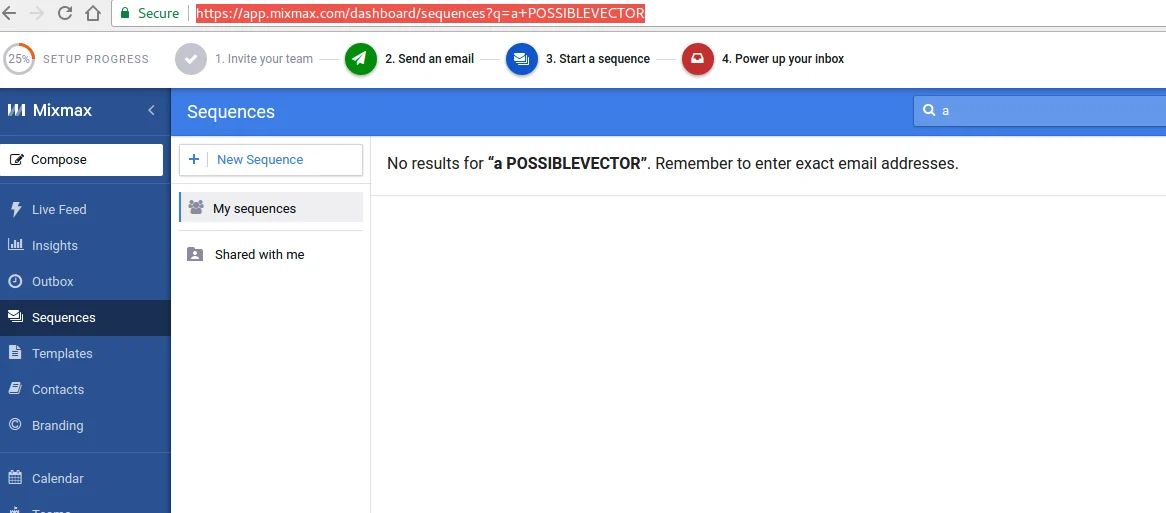
URL: https://app.mixmax.com/dashboard/sequences?q=a+POSSIBLEVECTOR
As you can see from, the first screenshot, if this input is entered into the search, the input bar actually only displays the first part, the letter 'a' and the 'POSSIBLEVECTOR' string is truncated. This is because the input is placed into the HTML without quotes, and therefore, chrome automatically places quotes around the first part of the string, 'a', and the next part is parsed as raw HTML.
A good example of this is with the following query.
URL: https://app.mixmax.com/dashboard/sequences?q=a+readonly
Since "readonly" is interpreted as part of the HTML, it disables changing the input box via the browser.
As I said earlier, this is not in itself a vulnerability, as you guys seem to do a pretty good job of sanitizing the input (=, <, >) are all filtered out. But either way, having this the way it is now can be dangerous for the future.
Attachments

Not written yet. The AI write-up for this report has not been written yet. The Original tab links to the source.
How it worked
Root cause
Likely the search term is concatenated into an HTML attribute without quoting or proper encoding, so parts of it are interpreted as markup.
Impact
No direct exploit is shown; the reporter states that characters such as =, < and > are filtered, so this is a latent risk that could become XSS if sanitisation changes.
What the attacker needed
Access to the Sequences dashboard; ability to set the q search parameter
The fix
The report implies the input should be handled safely, but gives no fix.
How it was found
- Open the Sequences dashboard page with a search query containing a space and a word such as 'readonly'.
- Observe that the search box only shows the first word and the second word is treated as an HTML attribute, making the input read-only.
Explained by bugbounty.wiki with AI from the original and checked against quotes from it; it can still be wrong. Read the original before relying on a detail.
Not written yet. The AI write-up for this report has not been written yet. The Original tab links to the source.
When a website shows what you typed back to you, it must treat it as plain text, not as part of the page's code. Here, the search box was built by pasting the search term directly into the page's HTML without wrapping it in quotes, so a word like 'readonly' was treated as a setting for the input box instead of text. The reporter says this is not exploitable today because dangerous characters are blocked, but it is a risky pattern.
What is XSS?
Script an attacker supplies runs in another user's browser, on the target's origin, with that user's session.




