Blind SSRF due to img tag injection in career form
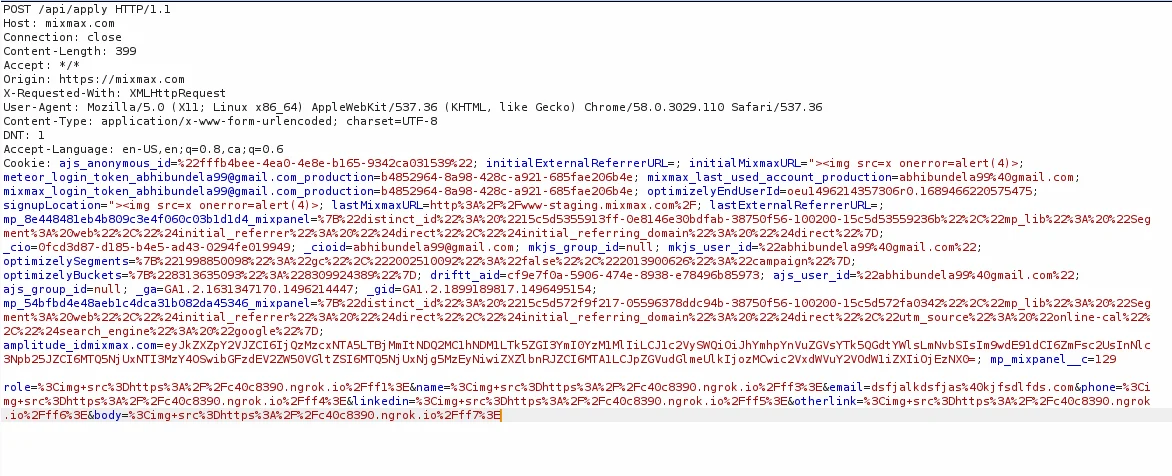
An attacker could inject an image tag into the career application form fields, causing the server to make requests to an attacker-chosen host. The reporter observed requests from a Google IP and user-agent in server logs, indicating a blind server-side request forgery.

- Triaged in 2 days
- Fixed in 45 days
- Disclosed after 45 days
Hi, There is SSRF vulnerability due to img tag injection in career form. Attacker can inject multiple tags and perform multiple requests on remote hosts.
POC
- Visit https://mixmax.com/careers.
- Click on
Apply now. - Insert img tag
<img src=https://your_choice.com>in all the fields. - Click on
Send Application. - Check server logs.
I got the following ip and user-agent headers. IP: 66.249.84.213 User-Agent: Mozilla/5.0 (Windows NT 5.1; rv:11.0) Gecko Firefox/11.0 (via ggpht.com GoogleImageProxy)
Thanks
Attachments

Not written yet. The AI write-up for this report has not been written yet. The Original tab links to the source.
How it worked
Root cause
Likely the application rendered user-supplied form input as HTML without sanitising it, causing the server to fetch remote resources referenced by injected tags.
Impact
An attacker could make the server send requests to remote hosts of their choosing, as shown by the logged requests.
What the attacker needed
Access to the career form; ability to submit the form
How it was found
- Visit the careers page.
- Click the apply now button.
- Insert an image tag pointing to a chosen URL in all fields.
- Submit the application.
- Check the server logs for incoming requests.
Explained by bugbounty.wiki with AI from the original and checked against quotes from it; it can still be wrong. Read the original before relying on a detail.
Not written yet. The AI write-up for this report has not been written yet. The Original tab links to the source.
Server-side request forgery (SSRF) happens when a server is tricked into making a request to a location the attacker chooses. Here, the form accepted an image tag, and when the application processed it, the server fetched the image from the attacker's URL. The attacker cannot see the response, so it is called blind SSRF.
What is SSRF?
The server can be made to fetch an address the attacker chooses, reaching internal services, cloud metadata or other customers' data.





