Account deletion using the /v1/account/destroy API endpoint using account password without 2FA verification
The account destruction endpoint accepted a password-derived value without requiring an authorisation header or a second-factor check. An attacker who already knew a victim's password could therefore delete that user's account without passing 2FA.

- Triaged in 6 days
- Fixed in 8 months
- Paid in 9 days
- Disclosed after 8 months
Summary:
The account deletion endpoint at POST /v1/account/destroy does not check for 2FA and doesn't require an authorization header. Therefore, an unauthenticated attacker who knows the password of a user can delete their account without the need of 2FA.
Steps To Reproduce:
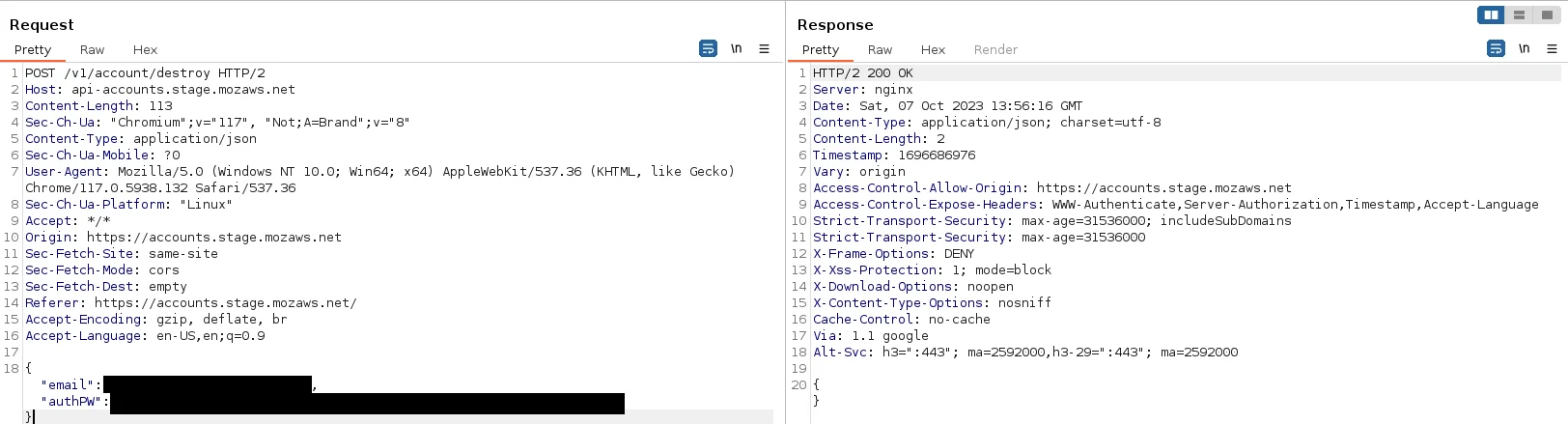
- Send a POST request to https://api-accounts.stage.mozaws.net/v1/account/destroy with the following body (do not include an Authorization header, if it is included and doesn't match the e-mail in the body, the request will fail):
{"email":"<email>","authPW":"<authPW>"}
The authPW can be calculated by the attacker since it is created client-side and the source code is publicly available.
Please refer to (Attachment on the original report: calculate_authpw.ts) to calculate the authPW.
Supporting Material/References:
An example of a successful account deletion:
Impact
Summary:
An unauthenticated attacker can delete Firefox accounts of other users without needing 2FA, if the attacker knows their password.
Not written yet. The AI write-up for this report has not been written yet. The Original tab links to the source.
How it worked
Root cause
Likely the destroy endpoint authenticated solely on the client-computed password-derived value and omitted both the session authorisation header and the second-factor requirement applied elsewhere.
Impact
An unauthenticated attacker who knows a user's password could delete that user's account without needing 2FA.
What the attacker needed
Attacker knows the victim's password; no account or session needed
How it was found
- Send a POST request to the account destroy endpoint with the victim's email and the computed password-derived value.
- Omit the authorisation header, since a mismatched one causes the request to fail.
- Compute the password-derived value using the publicly available client code.
Explained by bugbounty.wiki with AI from the original and checked against quotes from it; it can still be wrong. Read the original before relying on a detail.
Not written yet. The AI write-up for this report has not been written yet. The Original tab links to the source.
When you log in, the server normally checks both your password and a second code from your phone. Here the endpoint that deletes an account only checked the password-derived value, so anyone holding the password could wipe the account without the second code. The password-derived value is computed in the browser, so its recipe is public.
What is Account takeover?
Getting into someone else's account through a flaw in sign-in, password reset, second factor, single sign-on or session handling.


