Subdomain takeover on a subdomain under firefox.com
A subdomain under firefox.com was a CNAME to a host that was no longer registered, so the reporter could claim it and take control of the subdomain. This allowed hosting content on a trusted Mozilla domain, which could be used for malware campaigns or to set large cookies that block access for individual users.

- Triaged in 37 hours
- Fixed in 3 days
- Paid in 45 hours
- Disclosed after 7 months
Summary:
Subdomain takeover via ██████████ of █████
Steps To Reproduce:
The subdomain ████ is a CNAME to www.mozilla.org (which is hosted at ███████), however it was not currently registered at ███████. By claiming it I was able to take it over.
As PoC please visit: ██████
It seems that the CAA records does not allow ████████ to generate an SSL certificate for me.
Supporting Material/References:
Following the documentation of this program I decided to report it:
Domain takeovers supported by a proof of concept for *.mozilla.org, *.mozilla.com, *.mozilla.net, *.firefox.com, *.mozgcp.net and *.mozaws.net in addition to the list of sites in scope. If the domain is pointing to a claimed instance by another company, then the report will not be eligible for bounty.
Impact
Summary:
Given this is a very generic and thrust worthy domain name it is suitable for a malware campaign. Besides that it could maybe read some non-secure cookie but that is not that likely.
We could however, use the domain to block access of individual user by setting some large cookies, see for example www.firefox.com after setting 100kb of cookies via http://████/large-cookies.html
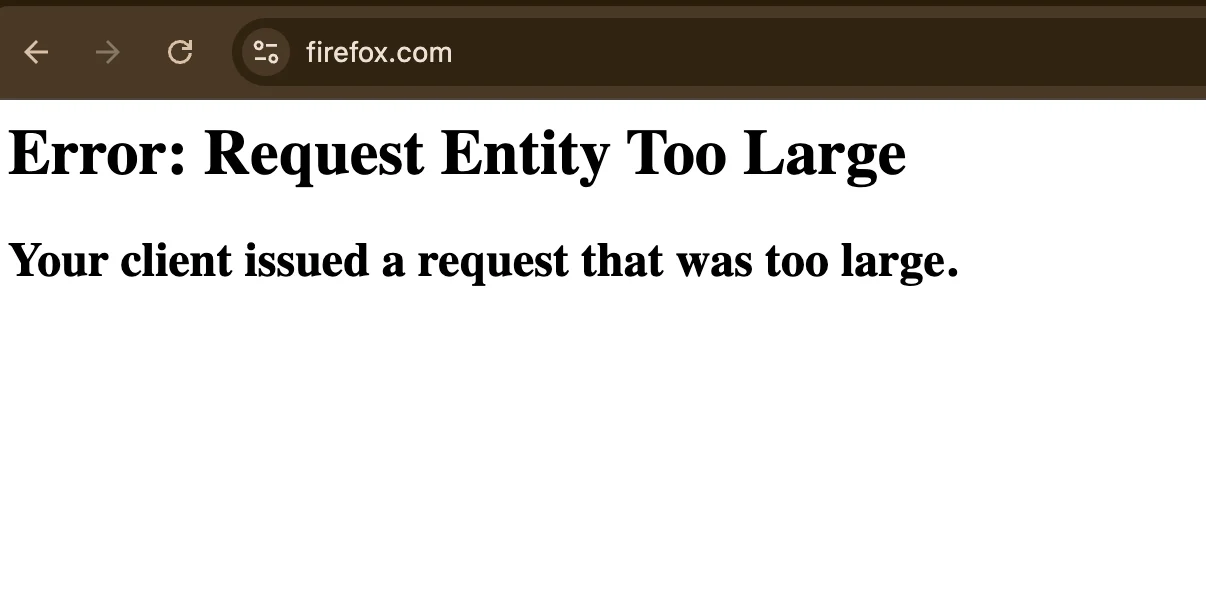
This action can also be performed via eg a tracking pixel.
Context
Mozilla runs a bug bounty programme on HackerOne that explicitly covers domain takeovers. The programme's own documentation, quoted in the report, sets out the scope:
Domain takeovers supported by a proof of concept for *.mozilla.org, *.mozilla.com, *.mozilla.net, *.firefox.com, *.mozgcp.net and *.mozaws.net in addition to the list of sites in scope. If the domain is pointing to a claimed instance by another company, then the report will not be eligible for bounty.
A subdomain takeover happens when a DNS record, typically a CNAME, points at a hostname on a third-party service that is no longer claimed by the organisation. Anyone who can register that hostname on the same service inherits control of the subdomain, and with it anything served from that name.
Setup
No accounts, tools or versions are described in the report. The only precondition that matters is the DNS state of the target subdomain: a CNAME pointing at a hostname on a third-party platform that nobody had registered.
Finding it
The researcher identified a subdomain under firefox.com whose DNS entry is a CNAME to www.mozilla.org, which is hosted at a third-party provider. The hostname at that provider was not currently registered. That combination, a CNAME into a third-party service plus an unclaimed name on that service, is the classic takeover condition.
Exploitation
Step 1: Claim the unregistered hostname
The researcher claimed the unregistered hostname at the third-party provider. Because the subdomain's CNAME pointed there, the subdomain now resolved to infrastructure under the researcher's control.
Step 2: Demonstrate control
The report gives a proof-of-concept URL, redacted in the public text, showing the subdomain serving content from the claimed instance.
Step 3: Attempt TLS
The researcher notes that the CAA records did not allow a certificate to be generated for the name, so no valid certificate was obtained.
Root cause
The mistake is a dangling DNS record: a CNAME under firefox.com pointed at a hostname on a third-party platform that was not currently registered. Nothing in the DNS configuration prevented a third party from registering the name and thereby answering for the subdomain. The CAA records limited the damage by blocking certificate issuance, but they did not stop the takeover itself.
Impact
The researcher's own assessment is measured. The subdomain sits under a generic and trusted domain name, which makes it suitable for a malware campaign. The report also suggests it could maybe read some non-secure cookies, though the researcher considers that unlikely.
The concrete impact demonstrated is denial of service against individual users. By serving a page that sets a large number of cookies for the parent domain, an attacker can make subsequent requests to the real site fail. The researcher set 100kb of cookies via a page on the taken-over host:
http://████/large-cookies.html
After that, visiting www.firefox.com was blocked. The screenshot below shows the resulting browser behaviour.
The same effect can be triggered without a direct visit, for example through a tracking pixel embedded elsewhere.
Fix
The report does not describe the remediation that was applied. The fix implied by the finding is to remove the dangling CNAME, or to re-register the hostname at the third-party provider so that nobody else can claim it.
Variants to test
- Enumerate CNAMEs under in-scope domains that point at third-party platforms (hosting, CDN, status pages, marketing tools) and check whether the target hostname is still registered. A positive result is an unresolvable or unclaimed hostname on the provider that you can register yourself.
- Check CAA records on candidate subdomains before investing time. If issuance is blocked, the takeover may still be reportable, but the impact case has to rest on something other than a trusted certificate, as it did here.
- Test the cookie-flooding angle on any taken-over host: serve a page that sets a large volume of cookies scoped to the parent domain and observe whether the main site becomes unreachable for the victim.
Hunting notes
This class of bug hides in DNS records that outlive the service they pointed at. During recon, resolve every subdomain and look for CNAMEs into third-party platforms; then check each target hostname for the provider's "not found" or "unclaimed" response. The signals are a CNAME to a service you do not recognise as owned by the target, and a provider response indicating the name is available.
The report falls under the programme's explicit domain-takeover scope, and the researcher showed a working proof of concept plus a denial-of-service technique against users of the main site.
What happened, in plain words
Every website name, like firefox.com, is looked up in a system called DNS. DNS is the internet's phone book: you type a name, and DNS tells your browser which computer to talk to. Sometimes a name is not answered directly but is set up as a pointer to another name, called a CNAME. Think of a CNAME as a forwarding note on a door: "this address is handled at the other address, go there instead".
A subdomain is a name that sits under a bigger name, for example something.firefox.com under firefox.com. Mozilla, the organisation behind Firefox, owns firefox.com and runs a bug bounty programme: a scheme where outside researchers who find security problems are paid for reporting them. That programme explicitly accepts reports about "domain takeovers", which is the kind of problem described here.
A subdomain takeover happens when a subdomain's forwarding note points at a name on some outside service, and that outside name is no longer claimed by anyone. If a stranger can register that outside name on the same service, the stranger effectively becomes the owner of the Mozilla subdomain, because all visitors are forwarded to the stranger's space. The researcher found exactly this situation on a subdomain under firefox.com, claimed the unregistered name, and showed what could be done with it. Mozilla paid a bounty of 500.00 USD and rated the issue medium severity (CVSS 6.5).
The rules of the programme
Before doing anything, the researcher checked what the programme allows. Mozilla's documentation, quoted in the report, says:
Domain takeovers supported by a proof of concept for *.mozilla.org, *.mozilla.com, *.mozilla.net, *.firefox.com, *.mozgcp.net and *.mozaws.net in addition to the list of sites in scope. If the domain is pointing to a claimed instance by another company, then the report will not be eligible for bounty.
In plain words: takeovers of names under those domains are in scope, but you must show a proof of concept, meaning a working demonstration that you really control the name. And if the outside name is already claimed by another company, the report will not earn a bounty. This matters because it tells the researcher two things: the target is fair game, and a convincing demonstration is required.
Setting things up
The report does not describe any accounts, tools or software versions. The only thing that had to be true for the bug to exist was the state of the DNS records for the target subdomain: a forwarding note (CNAME) pointing at a name on an outside platform that nobody had registered.
Finding the problem
The researcher found a subdomain under firefox.com whose DNS entry is a CNAME to www.mozilla.org. That name, www.mozilla.org, is itself hosted at a third-party provider, meaning a company that rents out hosting space rather than Mozilla running its own machines for it. The specific name at that provider was not currently registered by anyone.
Put the two facts together and you have the classic takeover condition:
- A subdomain forwards to a name on an outside service.
- That name on the outside service is free to claim.
Anyone who claims the free name inherits the subdomain, because the forwarding note still points there.
Taking it over
Step 1: Claim the unregistered name
The researcher claimed the unregistered hostname at the third-party provider. Because the subdomain's CNAME pointed at that hostname, the subdomain now sent visitors to computers under the researcher's control. No hacking of Mozilla's systems was needed: the DNS configuration did the work.
Step 2: Show that it works
The report gives a proof-of-concept web address, hidden in the public text, where the subdomain served content from the claimed instance. A proof of concept is simply evidence: a page you can visit that proves you control the name, rather than just a claim that you might.
Step 3: Try to get a padlock (and fail)
The researcher notes that the CAA records did not allow the provider to issue an SSL certificate for the subdomain. Two terms need unpacking here. An SSL certificate (more precisely a TLS certificate) is what makes the padlock appear in your browser and encrypts the connection, so visitors can trust that the site is genuine. CAA records are a DNS-based list that says which certificate authorities are allowed to issue certificates for a name. Because the CAA records blocked issuance, the takeover could not be extended to a valid certificate for that name at the time of reporting. The takeover itself still worked; only the trusted padlock was out of reach.
Why it happened
The mistake is called a dangling DNS record: a CNAME under firefox.com pointed at a hostname on a third-party platform that was not currently registered. Nothing in the DNS configuration stopped a third party from registering the name and thereby answering for the subdomain. The CAA records limited the damage by blocking certificate issuance, but they did not prevent the takeover.
What could be done with it
The researcher's own assessment is measured. The subdomain sits under a generic and trusted domain name, which makes it suitable for a malware campaign: people trust a name that ends in a well-known brand, so links to it are more likely to be clicked. The report also suggests it could maybe read some non-secure cookies, though the researcher considers that unlikely.
A cookie is a small piece of data a website asks your browser to store and send back on later visits, often used to keep you logged in. Cookies can be marked "secure", meaning they are only sent over encrypted connections; non-secure ones could in principle leak, but the researcher does not think this is likely here.
The concrete impact demonstrated is denial of service against individual users. Denial of service means making a service unusable for someone, without necessarily breaking into it. The trick works like this: browsers limit how much cookie data they will store and send for a site. If a page sets a very large amount of cookie data for the parent domain, then later requests to the real site carry so much data that the site refuses them. The researcher set 100kb of cookies via a page on the taken-over host:
http://████/large-cookies.html
Line by line: http:// means a plain, unencrypted web request. ████ is the taken-over host, hidden in the public report. /large-cookies.html is the page on that host that does the damage by setting a large number of cookies. Visiting it is enough to fill the browser's cookie allowance for the parent domain.
After that, visiting www.firefox.com was blocked. The screenshot below shows the resulting browser behaviour.
The same effect can be triggered without a direct visit, for example through a tracking pixel embedded elsewhere. A tracking pixel is a tiny, often invisible image placed on a web page; loading the page loads the image, and the image's address can point at the malicious page, so the victim never has to click anything.
The fix
The report does not describe the remediation that was applied. The fix implied by the finding is to remove the dangling CNAME, or to re-register the hostname at the third-party provider so that nobody else can claim it.
Other places to look
- Look for CNAMEs under in-scope domains that point at third-party platforms (hosting, content delivery networks, status pages, marketing tools) and check whether the target hostname is still registered. A positive result is an unresolvable or unclaimed hostname on the provider that you can register yourself.
- Check CAA records on candidate subdomains before investing time. If issuance is blocked, the takeover may still be reportable, but the impact case has to rest on something other than a trusted certificate, as it did here.
- Test the cookie-flooding angle on any taken-over host: serve a page that sets a large volume of cookies scoped to the parent domain and observe whether the main site becomes unreachable for the victim.
Notes for beginners hunting this bug
This class of bug hides in DNS records that outlive the service they pointed at. During reconnaissance (the information-gathering phase before testing), resolve every subdomain and look for CNAMEs into third-party platforms; then check each target hostname for the provider's "not found" or "unclaimed" response. The signals are a CNAME to a service you do not recognise as owned by the target, and a provider response indicating the name is available.
The report falls under the programme's explicit domain-takeover scope, and the researcher showed a working proof of concept plus a denial-of-service technique against users of the main site.
Glossary
- DNS: the internet's naming system that turns a name like
firefox.cominto the address of a computer. - Subdomain: a name that sits under a larger name, such as
something.firefox.comunderfirefox.com. - CNAME: a DNS record that says "this name is handled at another name, go there instead", like a forwarding note.
- DNS record: a single entry in the DNS system describing something about a name.
- Dangling DNS record: a DNS record that still points at a service or name that is no longer claimed, leaving it open to being taken over.
- Subdomain takeover: gaining control of a subdomain by claiming an unregistered name that the subdomain's DNS record points at.
- Third-party provider: an outside company that hosts websites or services on behalf of the organisation.
- Hostname: a specific name of a computer or service on the internet, such as
www.mozilla.org. - Bug bounty programme: a scheme where organisations pay outside researchers for reporting security problems.
- Proof of concept (PoC): a working demonstration that a problem is real, for example a page you can visit.
- SSL/TLS certificate: the data that makes the browser padlock appear and encrypts the connection, proving the site is genuine.
- CAA record: a DNS record listing which certificate authorities are allowed to issue certificates for a name.
- Certificate authority: an organisation trusted to issue certificates.
- Cookie: a small piece of data a website asks your browser to store and send back on later visits, often used to keep you logged in.
- Secure cookie: a cookie that is only sent over encrypted connections.
- Denial of service (DoS): making a service unusable for someone, without necessarily breaking into it.
- Malware campaign: an organised effort to spread harmful software, often using trusted-looking names to lure people.
- Tracking pixel: a tiny, often invisible image on a web page that loads from another address, used to track or trigger something when the page is viewed.
- Reconnaissance: the information-gathering phase before testing, such as listing subdomains and their DNS records.
- CVSS: a standard scoring system for the severity of a security issue.
- Severity: a rating of how serious an issue is, here medium.
- Bounty: the money paid to a researcher for a valid report, here 500.00 USD.
- Remediation: the fix applied to close a security problem.





