HTML injection in email content during registration via FirstName/LastName parameter
The registration form did not sanitise the First Name field, so HTML markup entered there was rendered inside the email sent during sign-up. An attacker could inject arbitrary HTML into that email content.
 Originally disclosed on HackerOne
- Triaged in 6 days
- Fixed in 4 months
- Disclosed after 5 months
Summary:
Hi, I just found an issue when register account in https://mtnmobad.mtnbusiness.com.ng/#/auth/registerUser It allows an attacker to inject malicious text include html code in email content.
Steps To Reproduce:
- Go to https://uat.id.manulife.ca/mortgagecreditor/register?ui_locales=en-CA.
- Use the following payload as your First Name:
- Put the following code as first name:
<h1>Ibrahim</h1>
- Fill other forms and submit
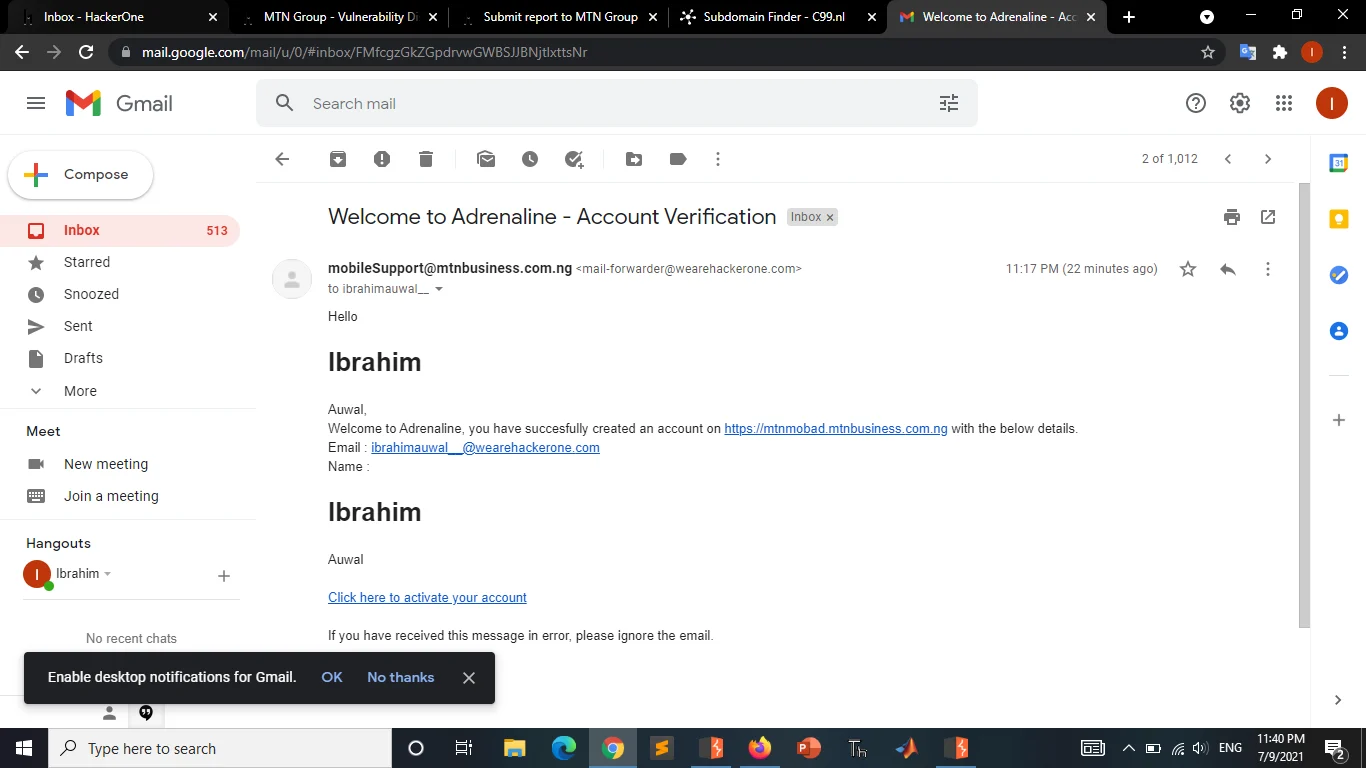
Impact
html code injection
Not written yet. The AI write-up for this report has not been written yet. The Original tab links to the source.
How it worked
Root cause
Likely the First Name value was inserted into the email body without HTML encoding or sanitisation.
Impact
Injected HTML was rendered in the registration email; the report does not show script execution or any further effect.
What the attacker needed
Ability to submit the registration form
How it was found
- Open the registration page.
- Enter HTML markup as the First Name.
- Complete the remaining fields and submit the form.
Explained by bugbounty.wiki with AI from the original and checked against quotes from it; it can still be wrong. Read the original before relying on a detail.
Not written yet. The AI write-up for this report has not been written yet. The Original tab links to the source.
When you type your name into a sign-up form, the site later puts that text into an email. If the site does not clean the text first, someone can type HTML (the code that formats web pages) instead of a plain name, and the email will display it as real formatting rather than as harmless text.
What is XSS?
Script an attacker supplies runs in another user's browser, on the target's origin, with that user's session.