Reflected XSS at dailydeals.mtn.co.za
The category_id parameter on dailydeals.mtn.co.za reflects user input without sanitisation, allowing an attacker to inject a script that executes in a victim's browser. An attacker could convince a victim to visit a crafted URL and steal the victim's cookies.
 Originally disclosed on HackerOne
- Triaged in 8 days
- Fixed in 6 months
- Disclosed after 7 months
Hello MTN Group:
I found reflected XSS vi category_id= parameter .
The server reads data directly from the HTTP request and reflects it back in the HTTP response. Reflected XSS exploits occur when an attacker causes a victim to supply dangerous content to a vulnerable web application, which is then reflected back to the victim and executed by the web browser. The most common mechanism for delivering malicious content is to include it as a parameter in a URL that is posted publicly or e-mailed directly to the victim. URLs constructed in this manner constitute the core of many phishing schemes, whereby an attacker convinces a victim to visit a URL that refers to a vulnerable site. After the site reflects the attacker's content back to the victim, the content is executed by the victim's browser.
Steps To Reproduce:
- visite the https://dailydeals.mtn.co.za
- click on Categories, Then click on any items on it, now you get the
category_idparameter on the URL. - add this payload
3mh8r%3cimg%20src%3da%20onerror%3dalert(1)%3eas a value tocategory_idparameter
you will get popup with vaule 1 as the POC image
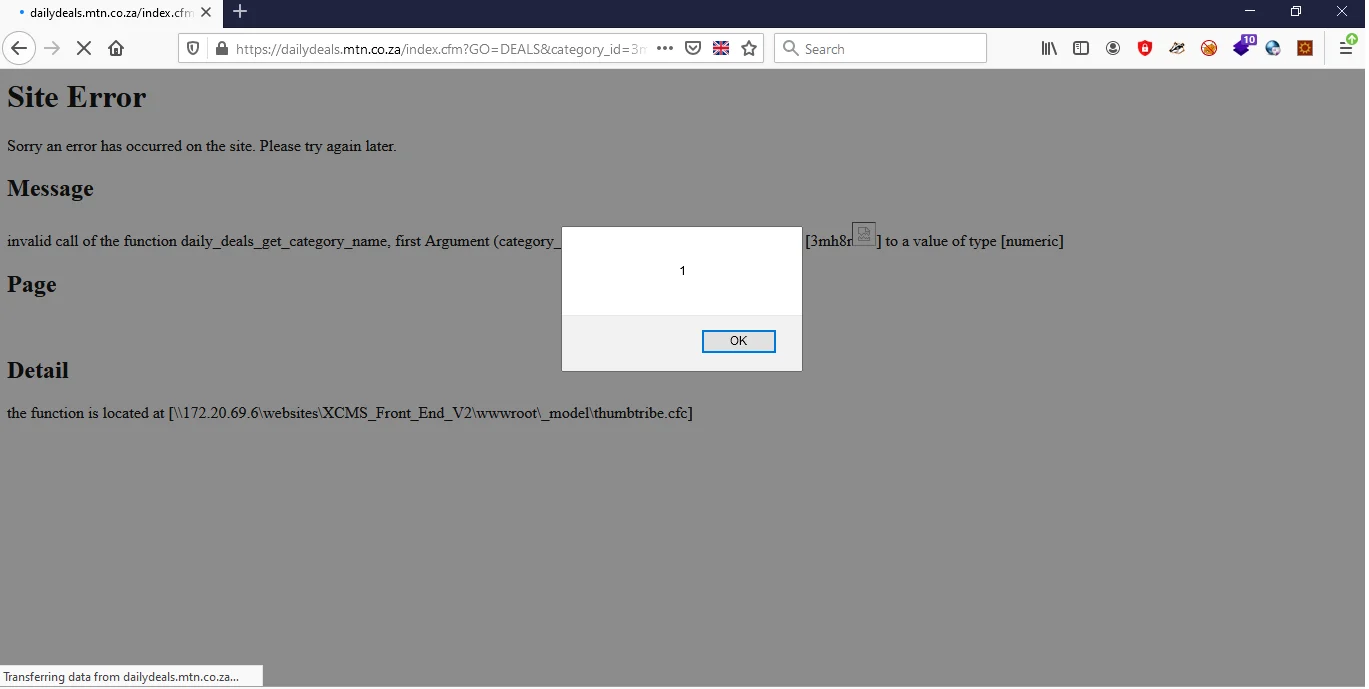
##one link POC: https://dailydeals.mtn.co.za/index.cfm?GO=DEALS&category_id=3mh8r%3Cimg%20src%3da%20onerror%3dalert(1)%3E
##Recommendation: Your script should filter metacharacters from user input.
Impact
attacker convinces a victim to visit a URL & steal users cookies
Not written yet. The AI write-up for this report has not been written yet. The Original tab links to the source.
How it worked
Root cause
Likely the application fails to sanitise or encode the category_id parameter before including it in the HTML response.
Impact
An attacker could convince a victim to visit a crafted URL and steal the victim's cookies.
What the attacker needed
Victim clicks a crafted link
How it was found
- Visit the dailydeals.mtn.co.za website.
- Click on Categories and then click on any item to get the category_id parameter in the URL.
- Add a crafted payload as the value of the category_id parameter to trigger an alert popup.
Explained by bugbounty.wiki with AI from the original and checked against quotes from it; it can still be wrong. Read the original before relying on a detail.
Not written yet. The AI write-up for this report has not been written yet. The Original tab links to the source.
When you type something into a website, the site often sends it back to your browser. If the site does not clean that input, an attacker can send a special link that makes your browser run harmful code. This is called reflected cross-site scripting (XSS), and it can let an attacker steal your login cookies.
What is XSS?
Script an attacker supplies runs in another user's browser, on the target's origin, with that user's session.