Content spoofing in lookup.nextcloud.com
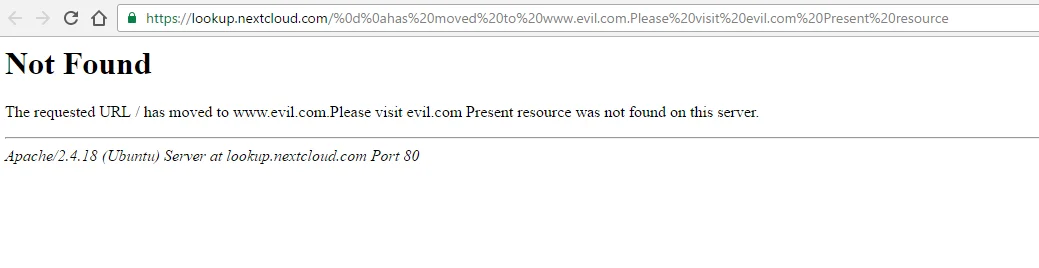
The lookup.nextcloud.com service reflected arbitrary text from the URL path into its error page, allowing an attacker to inject misleading content. An attacker could craft a link that made the official site display a fake message directing victims to a malicious domain.
 Originally disclosed on HackerOne
- Triaged in 2 days
- Fixed in 17 days
- Disclosed after 17 days
Scenerio An attacker can include any arbitrary text using specially crafted nextcloud url. This is done using character /%0d%0a.
Steps
- Attacker distributed the below url by means of spamming or through his website
https://lookup.nextcloud.com/%0d%0ahas%20moved%20to%20www.evil.com.Please%20visit%20evil.com%20Present%20resource 2) Victim see below text
The requested URL / has moved to www.evil.com.Please visit evil.com Present resource was not found on this server. 3) Since the text came from official site so user believes and gets into attacker trap
Resolution Crafted text should not be responded back in the response HTML
Attachments
Not written yet. The AI write-up for this report has not been written yet. The Original tab links to the source.
How it worked
Root cause
Likely the application reflected the raw URL path into the HTML error response without encoding or validation.
Impact
An attacker could trick users into visiting a malicious site by displaying a fake redirect message on the official domain.
What the attacker needed
Victim clicks a crafted link
How it was found
- The attacker distributes a crafted URL containing encoded newline characters and arbitrary text.
- The victim opens the URL and sees the injected text in the error page.
- The victim trusts the message because it comes from the official site and may follow the attacker's instructions.
Explained by bugbounty.wiki with AI from the original and checked against quotes from it; it can still be wrong. Read the original before relying on a detail.
Not written yet. The AI write-up for this report has not been written yet. The Original tab links to the source.
When a website puts part of the web address into its error page without cleaning it, an attacker can make the page say anything they want. Here, the attacker used special characters to add a fake message telling visitors the site had moved to a bad address. Because the message appeared on the real site, people might believe it.
What is XSS?
Script an attacker supplies runs in another user's browser, on the target's origin, with that user's session.








