Desktop client can be tricked into opening/executing local files when clicking a nc://open/ link
The Nextcloud Desktop Client's handling of nc://open/ links passed a user-controlled file path to QDesktopServices::openUrl, which executes files rather than just opening them. An attacker who can upload a file to a shared instance could trick a victim into clicking a link that runs arbitrary code on the victim's machine.
 Originally disclosed on HackerOne
- Triaged in 10 hours
- Fixed in 17 days
- Paid in 39 days
- Disclosed after 4 months
Summary by the program
Security advisory at https://github.com/nextcloud/security-advisories/security/advisories/GHSA-3w86-rm38-8w63
The report
https://github.com/nextcloud/desktop/pull/4771 added support for "local edit", this feature is however implemented in an insecure way.
The code is calling into QDesktopServices::openUrl(QUrl::fromLocalFile(foundFiles.first())); and foundFiled.first() will be the path of the file specified via the deeplink:
    // In case the VFS mode is enabled and a file is not yet hydrated, we must call QDesktopServices::openUrl from a separate thread, or, there will be a freeze.
    // To avoid searching for a specific folder and checking if the VFS is enabled - we just always call it from a separate thread.
    QtConcurrent::run([foundFiles] {
        QDesktopServices::openUrl(QUrl::fromLocalFile(foundFiles.first()));
    });
QDesktopServices::openUrl is however not suited for not trusted user input as it will also execute files directly.
Proof of concept
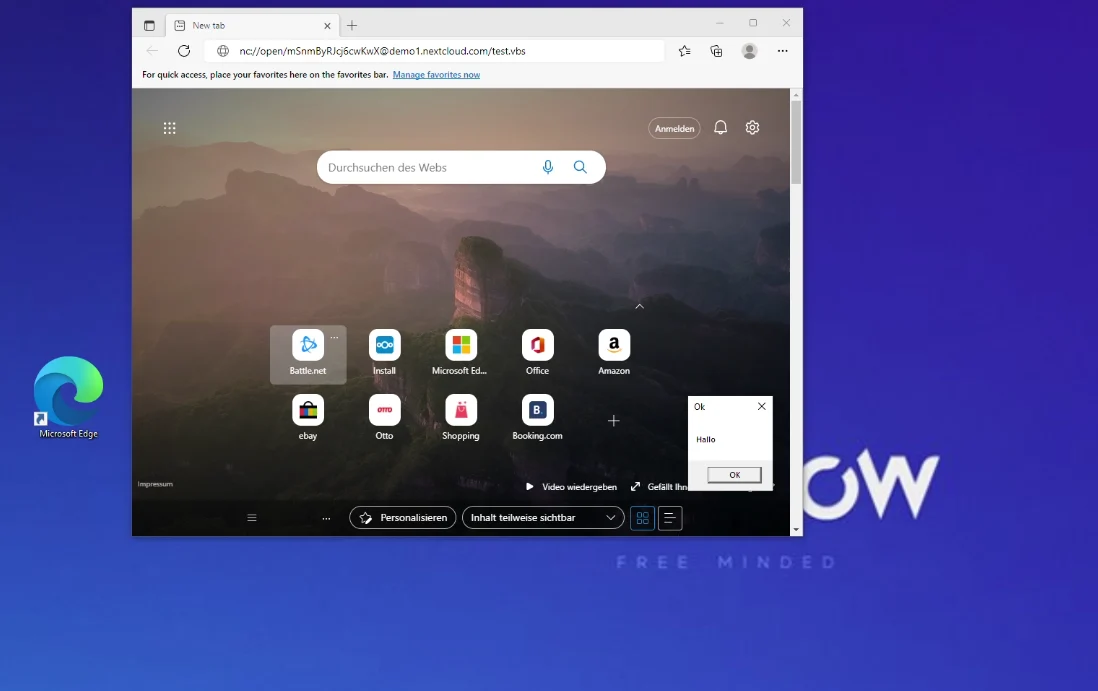
The following proof of concept was performed under Windows 10:
- In the web interface create a
test.vbsfile such asMsgBox "Hallo", VBOKOnly, "Ok". - Open
nc://open/[email protected]/test.vbsin the browser (adjust username and instance path) - The VB Script will be executed and a popup will appear.
Note: This can also be exploited by a remote attacker if they upload a file to the same instance a user has access to.
Recommendations
There are several mitigation recommendations here:
- Add a CSRF token to the
nc://open/link and have the client verify the token on request. - Ensure only safe file types can be opened using a local file viewer.
Disclosure Policy
Please note that all bugs reported by Authentick GmbH will be publicly disclosed within 90 days of vendor notification. In extraordinary cases we may increase that upon request by the vendor.
Impact
The Nextcloud Desktop Client in version 3.6.0 is vulnerable to a Remote Code Execution that can be exploited by anyone that is able to upload files to an instance the user has access to. In many cases this will be everyone due to public chats, files drop upload, etc.
Exploitation just requires the victim to visit a malicious web page (or click a link on an email or anything like that)
Attachments
Not written yet. The AI write-up for this report has not been written yet. The Original tab links to the source.
How it worked
Impact
The vulnerability could lead to remote code execution on the victim's machine, requiring only that the victim visits a malicious page or clicks a link, and the attacker must be able to upload a file to an instance the victim can access.
What the attacker needed
Attacker can upload a file to a shared instance; victim clicks a crafted nc://open/ link
The fix
The report recommends adding a CSRF token to the nc://open/ link and restricting opening to safe file types, but does not state that a fix was applied.
How it was found
- Create a test.vbs file in the web interface.
- Open a crafted nc://open/ link in the browser.
- The VB Script executes and a popup appears.
Explained by bugbounty.wiki with AI from the original and checked against quotes from it; it can still be wrong. Read the original before relying on a detail.
Not written yet. The AI write-up for this report has not been written yet. The Original tab links to the source.
The desktop app had a feature that let links open local files. It used a system function that runs files instead of just showing them. So if someone uploaded a malicious file and sent a special link, clicking it could run that file on your computer.
What is RCE?
Running the attacker's code on the target's servers: through command or code injection, unsafe deserialisation or template injection.



