\OCA\DAV\CardDAV\ImageExportPlugin allows serving arbitrary data with user-defined or empty mimetype
The CardDAV ImageExportPlugin serves the PHOTO property of a vCard with a user-controlled or empty Content-Type, allowing an attacker to upload a vCard containing HTML and have it rendered by the browser. This could enable cross-site scripting, though the report notes that CSP largely mitigates the issue.
 Originally disclosed on HackerOne
- Triaged in under an hour
- Fixed in 46 days
- Disclosed after 3 months
The SabreDAV plugin \OCA\DAV\CardDAV\ImageExportPlugin is used for displaying pictures of a VCF. It registers on a GET request on a CardDAV element and acts when the query parameter photo is sent.
The logic can be seen below:
/**
 * Intercepts GET requests on addressbook urls ending with ?photo.
 *
 * @param RequestInterface $request
 * @param ResponseInterface $response
 * @return bool|void
 */
function httpGet(RequestInterface $request, ResponseInterface $response) {

	$queryParams = $request->getQueryParameters();
	// TODO: in addition to photo we should also add logo some point in time
	if (!array_key_exists('photo', $queryParams)) {
		return true;
	}

	$path = $request->getPath();
	$node = $this->server->tree->getNodeForPath($path);

	if (!($node instanceof Card)) {
		return true;
	}

	$this->server->transactionType = 'carddav-image-export';

	// Checking ACL, if available.
	if ($aclPlugin = $this->server->getPlugin('acl')) {
		/** @var \Sabre\DAVACL\Plugin $aclPlugin */
		$aclPlugin->checkPrivileges($path, '{DAV:}read');
	}

	if ($result = $this->getPhoto($node)) {
		$response->setHeader('Content-Type', $result['Content-Type']);
		$response->setStatus(200);

		$response->setBody($result['body']);

		// Returning false to break the event chain
		return false;
	}
	return true;
}
As can be seen the the content-type is read from $this->getPhoto($node) as well as the body, looking at it's implementation shows that the data is directly read from the vCard:
function getPhoto(Card $node) {
	// TODO: this is kind of expensive - load carddav data from database and parse it
	//       we might want to build up a cache one day
	try {
		$vObject = $this->readCard($node->get());
		if (!$vObject->PHOTO) {
			return false;
		}

		$photo = $vObject->PHOTO;
		$type = $this->getType($photo);

		$val = $photo->getValue();
		if ($photo->getValueType() === 'URI') {
			$parsed = \Sabre\URI\parse($val);
			//only allow data://
			if ($parsed['scheme'] !== 'data') {
				return false;
			}
			if (substr_count($parsed['path'], ';') === 1) {
				list($type,) = explode(';', $parsed['path']);
			}
			$val = file_get_contents($val);
		}
		return [
			'Content-Type' => $type,
			'body' => $val
		];
	} catch(\Exception $ex) {
		$this->logger->logException($ex);
	}
	return false;
}
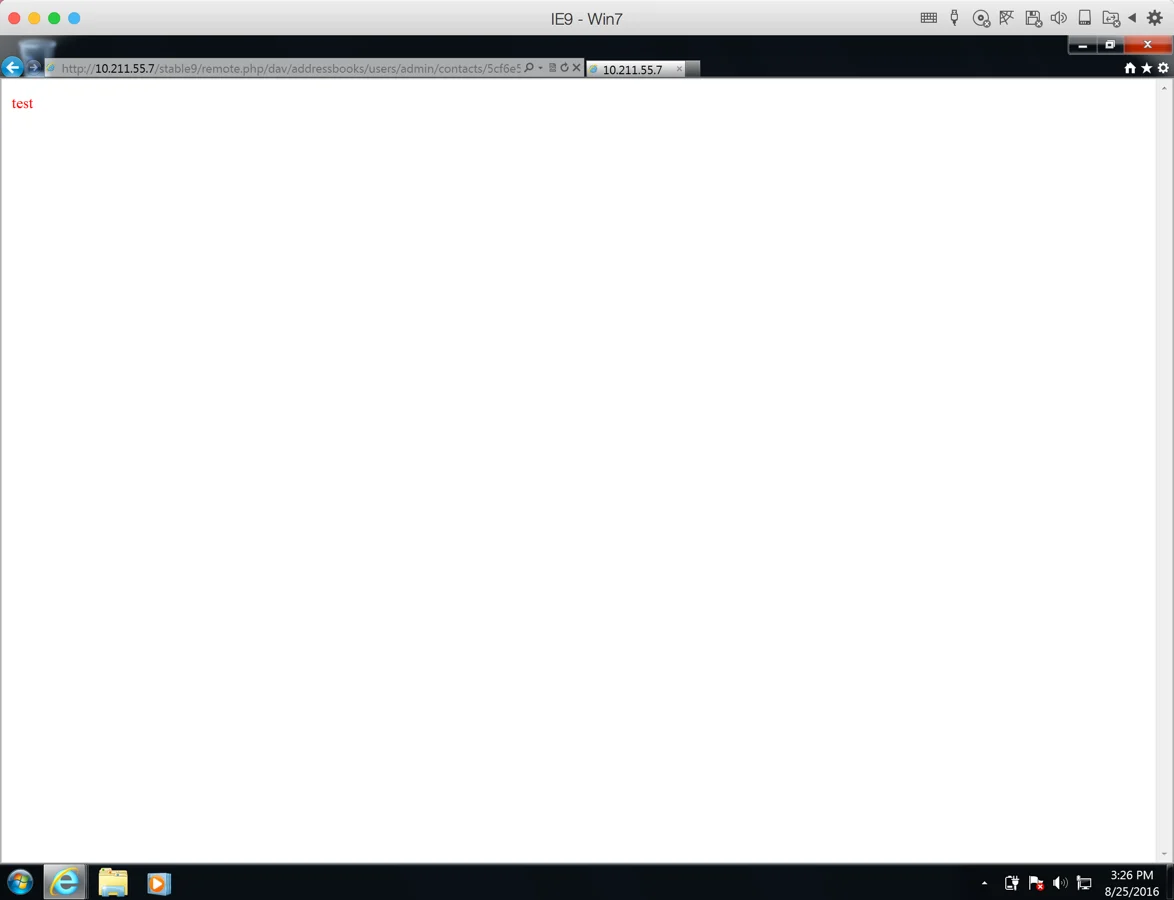
This means if somebody uploads a VCF with the following content this will deliver the content <html><font color="red">test</font></html> with an empty Content-Type. The photo is a base64 encoding of before mentioned string.
BEGIN:VCARD
VERSION:3.0
FN:test
UID:5cf6e5e2-ec37-4798-abb7-3c261eda92c9
PHOTO;ENCODING=b:PGh0bWw+PGZvbnQgY29sb3I9InJlZCI+dGVzdDwvZm9udD48L2h0bWw+
END:VCARD
Then it's sufficient to just access http://10.211.55.7/stable9/remote.php/dav/addressbooks/users/admin/contacts/5cf6e5e2-ec37-4798-abb7-3c261eda92c9.vcf?photo, the easiest to reproduce this is by enabling debug mode and using Internet Explorer since we employ CSP which largely mitigates the issue.
As another remark, we should replace the file_get_contents with another implementation. This seems currently like a too risky implementation for me.
Not written yet. The AI write-up for this report has not been written yet. The Original tab links to the source.
How it worked
Root cause
The plugin takes the Content-Type directly from the vCard's PHOTO property without validating or sanitising it, and serves the raw value as the response body.
Impact
An attacker could have HTML served from the site, though the report notes CSP largely mitigates the issue.
What the attacker needed
Ability to upload a vCard; victim clicks a crafted link
The fix
The report remarks that file_get_contents should be replaced with another implementation.
Explained by bugbounty.wiki with AI from the original and checked against quotes from it; it can still be wrong. Read the original before relying on a detail.
Not written yet. The AI write-up for this report has not been written yet. The Original tab links to the source.
The server does not check the photo's type, so someone can put HTML in the photo field. When another user opens the link, the browser may render that HTML, though CSP largely mitigates the issue.
What is XSS?
Script an attacker supplies runs in another user's browser, on the target's origin, with that user's session.





