SSRF via filter bypass due to lax checking on IPs
The IP filtering function in Nextcloud's SSRF protection could be bypassed using alphanumeric characters that resolve to the AWS metadata IP. An attacker could use this to read cloud metadata if the server is hosted on AWS.

- Triaged in 46 hours
- Fixed in 55 days
- Paid in 4 months
- Disclosed after 5 months
Summary:
Hello,
I was reading up on the recent SSRF bug found on NextCloud which is originally a part of this report by @tomorrowisnew_
I went through the source code again which was highlighted in the report I mentioned and I noticed that filtering for some of the more advanced SSRF payloads were clearly missing. Alphanumeric payloads came to my mind when thinking about the same so I set up a local test environment with my friend @w1redch4d
We primarily focused on the code around the IP checking namely ThowIfLocalIp:
	public function ThrowIfLocalIp(string $ip) : void {
		$localRanges = [
			'100.64.0.0/10', // See RFC 6598
			'192.0.0.0/24', // See RFC 6890
		];
		if (
			(bool)filter_var($ip, FILTER_VALIDATE_IP) &&
			(
				!filter_var($ip, FILTER_VALIDATE_IP, FILTER_FLAG_NO_PRIV_RANGE | FILTER_FLAG_NO_RES_RANGE) ||
				IpUtils::checkIp($ip, $localRanges)
			)) {
			$this->logger->warning("Host $ip was not connected to because it violates local access rules");
			throw new LocalServerException('Host violates local access rules');
		}

		// Also check for IPv6 IPv4 nesting, because that's not covered by filter_var
		if ((bool)filter_var($ip, FILTER_VALIDATE_IP, FILTER_FLAG_IPV6) && substr_count($ip, '.') > 0) {
			$delimiter = strrpos($ip, ':'); // Get last colon
			$ipv4Address = substr($ip, $delimiter + 1);

			if (
				!filter_var($ipv4Address, FILTER_VALIDATE_IP, FILTER_FLAG_NO_PRIV_RANGE | FILTER_FLAG_NO_RES_RANGE) ||
				IpUtils::checkIp($ip, $localRanges)) {
				$this->logger->warning("Host $ip was not connected to because it violates local access rules");
				throw new LocalServerException('Host violates local access rules');
			}
		}
	}
As seen above, the code is more than capable of rooting out most of the SSRF payloads including IPv4 and IPv6 as well as the recently pointed out payload involving the Alibaba metadata IP 100.100.100.200. But as stated above, the filtration technique fails when met with some of the more advanced SSRF payloads like the alphanumeric ones. In our test environment, we edited the code and set up a dummy website to test different payloads. The workflow was simple, if the payload was an invalid attempt at an SSRF, the server will throw an exception but if all the filtrations were bypassed successfully, the server would echo Pass.
Supporting Material/References:
Our dummy code is as follows:
<?php
      require 'vendor/autoload.php';
      use Symfony\Component\HttpFoundation\IpUtils;

      function ThrowIfLocalIp(string $ip) : void {
        $localRanges = [
            '100.64.0.0/10', // See RFC 6598
            '192.0.0.0/24', // See RFC 6890
        ];
        if (
            (bool)filter_var($ip, FILTER_VALIDATE_IP) &&
            (
                !filter_var($ip, FILTER_VALIDATE_IP, FILTER_FLAG_NO_PRIV_RANGE | FILTER_FLAG_NO_RES_RANGE) ||
                IpUtils::checkIp($ip, $localRanges)
            )) {
            throw new Exception('Host violates local access rules');
        }

        // Also check for IPv6 IPv4 nesting, because that's not covered by filter_var
        if ((bool)filter_var($ip, FILTER_VALIDATE_IP, FILTER_FLAG_IPV6) && substr_count($ip, '.') > 0) {
            $delimiter = strrpos($ip, ':'); // Get last colon
            $ipv4Address = substr($ip, $delimiter + 1);

            if (
                !filter_var($ipv4Address, FILTER_VALIDATE_IP, FILTER_FLAG_NO_PRIV_RANGE | FILTER_FLAG_NO_RES_RANGE) ||
                IpUtils::checkIp($ip, $localRanges)) {
                throw new Exception('Host violates local access rules');
            }
        }
        echo "Pass";
    }
    ThrowIfLocalIp($_GET["ip"])
?>
Here are some of the screenshots:
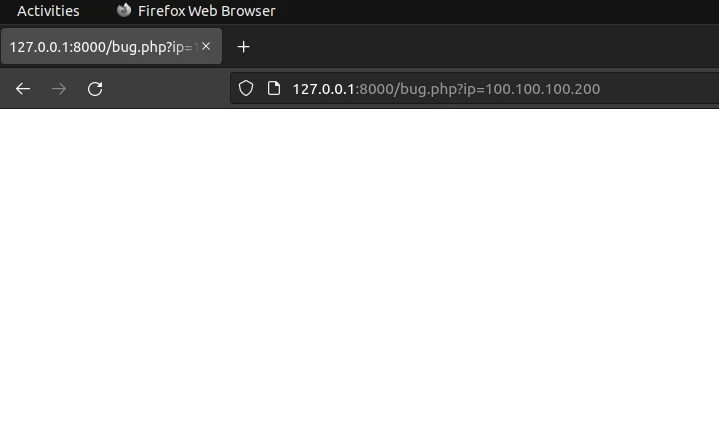
Server catches exception for Alibaba metadata IP and doesn't echo Pass

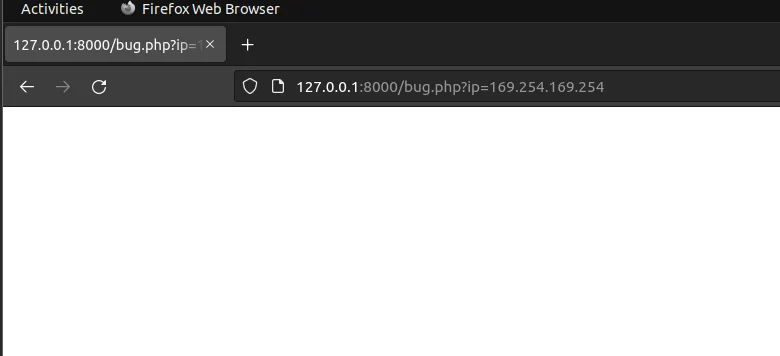
Server catches normal payload for AWS Magic IP and doesn't echo Pass

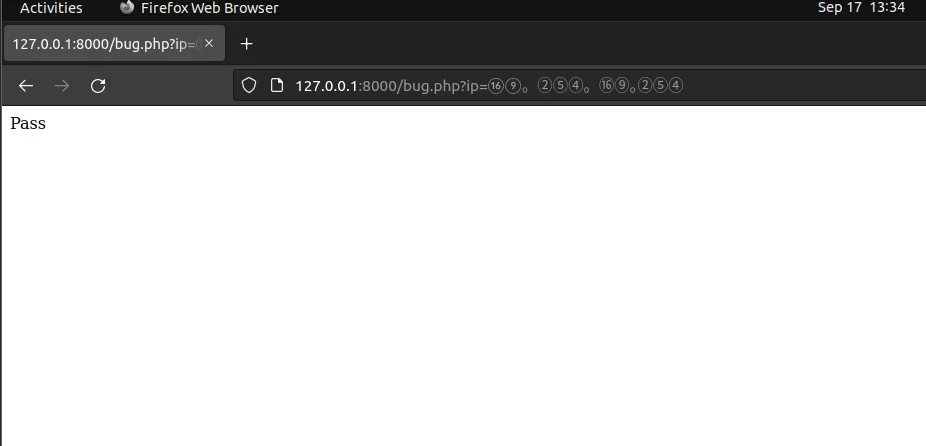
Server passes the Alphanumeric payload for AWS Magic IP and echoes Pass

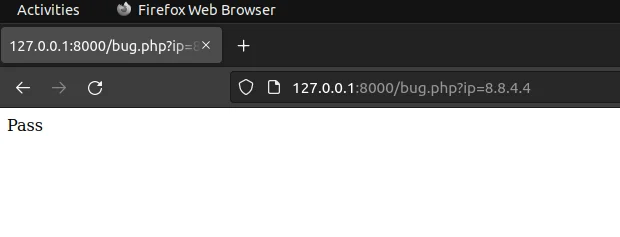
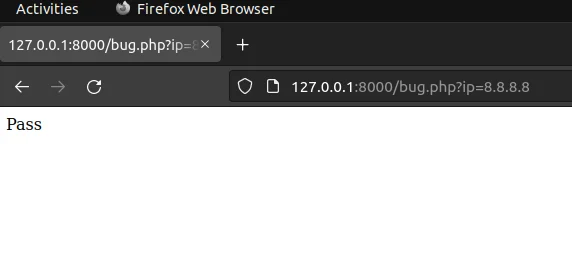
Server passes greenlighted IPs proof with 8.8.8.8 and 8.8.4.4 and echoes Pass
Impact
Attackers can leverage enclosed alphanumeric payloads to bypass IP filters and gain SSRF. An example can be using ⑯⑨。②⑤④。⑯⑨。②⑤④ which would allow an attacker to read crucial metadata if the server is hosted on the AWS platform. The above payload will resolve to the magic IP of AWS namely 169.254.169.254 but bypasses all the filtering present in the code itself.
Not written yet. The AI write-up for this report has not been written yet. The Original tab links to the source.
How it worked
Root cause
Likely the IP validation only checked standard numeric IP formats and did not normalise or reject alphanumeric representations that resolve to the same IP.
Impact
An attacker could bypass IP filters and perform SSRF to read cloud metadata if the server is hosted on AWS.
What the attacker needed
Server hosted on AWS; ability to supply IP address to vulnerable function
How it was found
- Set up a local test environment with the vulnerable code.
- Send a request with an alphanumeric payload representing the AWS metadata IP.
- Observe that the server echoes 'Pass' instead of throwing an exception.
Explained by bugbounty.wiki with AI from the original and checked against quotes from it; it can still be wrong. Read the original before relying on a detail.
Not written yet. The AI write-up for this report has not been written yet. The Original tab links to the source.
SSRF (Server-Side Request Forgery) is when an attacker tricks a server into making requests to internal systems. The code tried to block private IP addresses, but it didn't account for alternative ways of writing IP addresses using special characters. This allowed bypassing the filter and reaching sensitive internal addresses like cloud metadata.
What is SSRF?
The server can be made to fetch an address the attacker chooses, reaching internal services, cloud metadata or other customers' data.



