The application uses basic authentication.
Direct file URLs prompt for HTTP Basic authentication, and the browser sends the username and password Base64-encoded in a request header. Basic authentication makes brute-force attacks easier and faster.

- Disclosed after 43 hours
Basic authentication is enabled on file access requests
Description
Basic authentication is enabled on the server if we request for the direct URL of a file. The issues of using Basic Authentication can be read here -> OWASP: Basic Authentication. Though your threat model considers brute-forcing as an acceptable risk, it is also worth noting that use of basic authentication makes the brute-force attacks much easier and faster.
Detailed Steps
Step 1: Open the browser and request for the direct URL of a file. Eg: (http://nc.hostiso.cloud/remote.php/webdav/Photos/Squirrel.jpg)
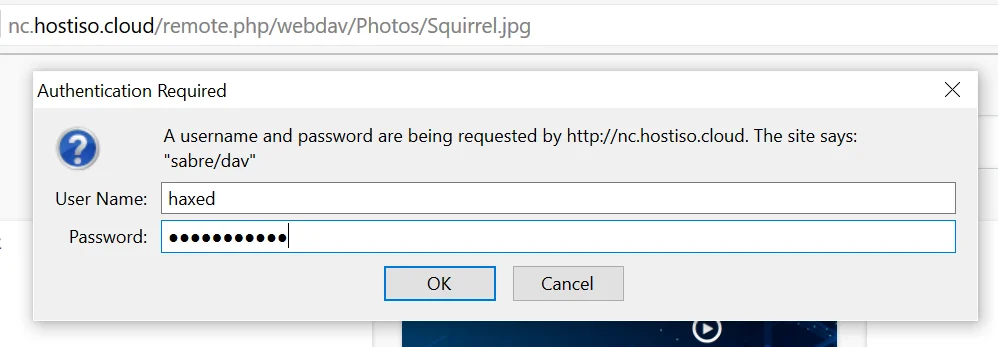
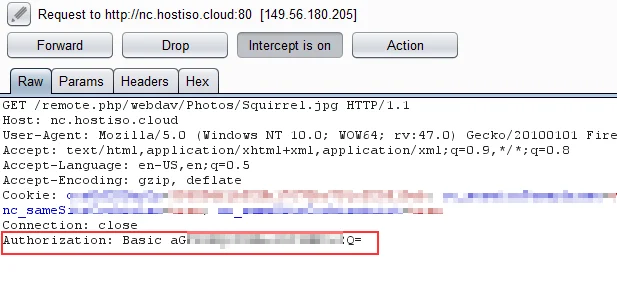
Step 2: Enter the username and password and capture the request in a proxy tool. Step 3: It can be observed that the header with Base64 encoded username password is being sent in the request to server.
Not written yet. The AI write-up for this report has not been written yet. The Original tab links to the source.
How it worked
Root cause
Likely the file access endpoint relies on HTTP Basic authentication, which transmits reusable credentials with each request and is easy to brute-force.
Impact
Credentials are sent with every request, and basic authentication makes brute-force attacks easier and faster.
What the attacker needed
Direct file URL known
How it was found
- Open the browser and request the direct URL of a file.
- Enter the username and password and capture the request in a proxy tool.
- Observe that a header with the Base64-encoded username and password is sent to the server.
Explained by bugbounty.wiki with AI from the original and checked against quotes from it; it can still be wrong. Read the original before relying on a detail.
Not written yet. The AI write-up for this report has not been written yet. The Original tab links to the source.
Basic authentication is a simple login method where the browser sends the username and password with every request, encoded in a header. The report notes this login prompt appears when you open a file's direct link, and that basic authentication makes brute-forcing easier.
What is Account takeover?
Getting into someone else's account through a flaw in sign-in, password reset, second factor, single sign-on or session handling.