[meta-git] RCE via insecure command formatting
The meta-git command-line tool builds a shell command by inserting user-supplied input without validation, so a crafted argument can run extra commands. An attacker who can influence that argument could execute arbitrary commands on the victim's machine.

- Triaged in 25 hours
- Fixed in 2 months
- Disclosed after 2 months
I would like to report a RCE issue in the meta-git module.
It allows to execute arbitrary commands remotely inside the victim's PC
Module
module name: meta-git
version: 1.1.2
npm page: https://www.npmjs.com/package/meta-git
Module Description
git plugin for meta
Module Stats
[~60] downloads in the last day [429] downloads in the last week [~2k] downloads in the last month
Vulnerability Description
The issue occurs because a user input is formatted inside a command that will be executed without any check. The issue arises here: https://github.com/mateodelnorte/meta-git/blob/master/lib/metaGitUpdate.js#L49
Steps To Reproduce:
- Create a new directory and insert some test files:
mkdir tests
cd tests
touch test
touch secret
touch files
- Check there aren't files called
HACKED - Execute the following commands in another terminal:
npm i meta-git -g # Install affected module
meta-git clone 'sss||touch HACKED' # *HACKED* file is created
- Recheck the files: now
HACKEDhas been created :)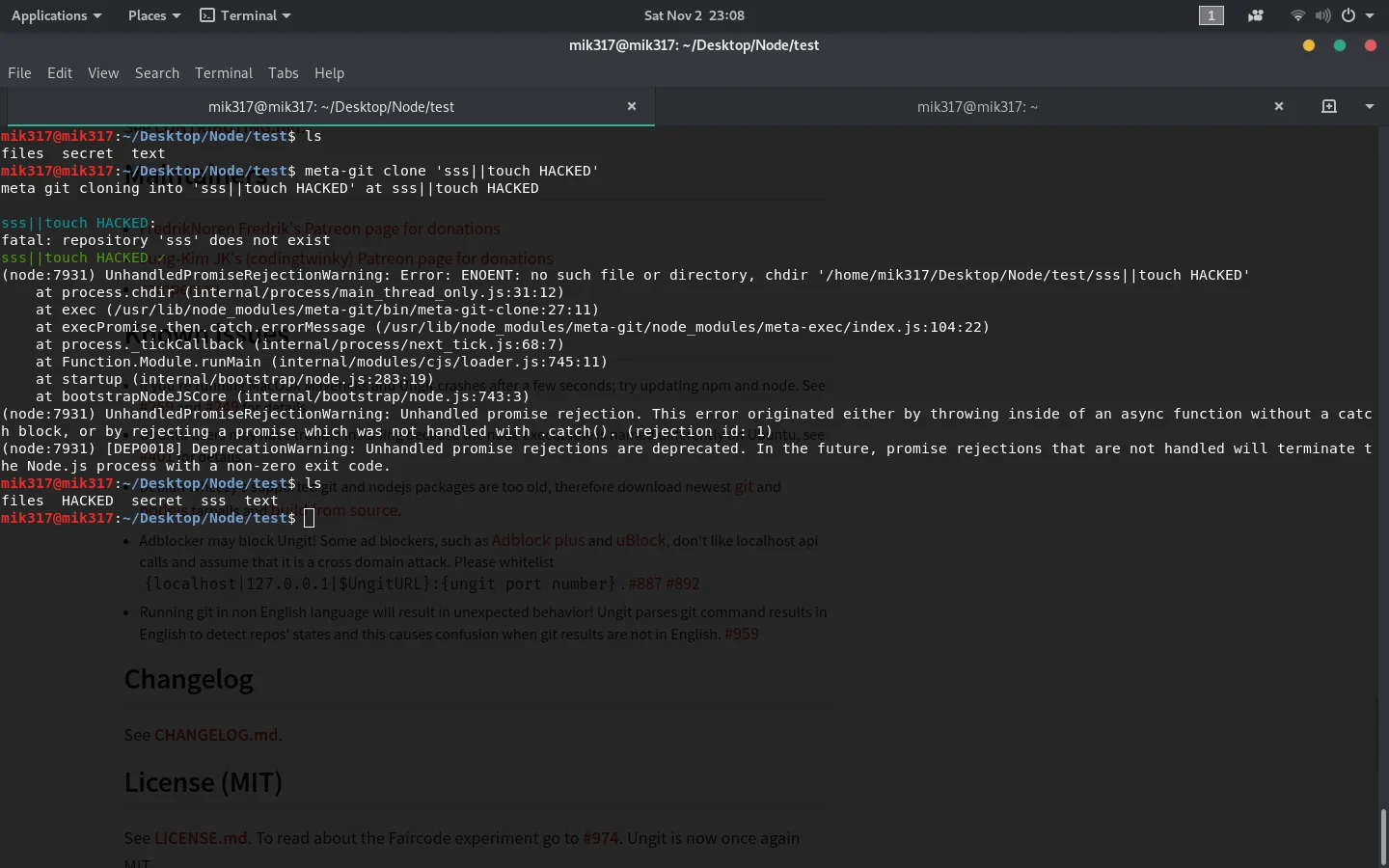
Screenshot_from_2019-11-02_23-08-42.png From the original on HackerOne
Patch
Don't format
commandsusing insecureuser's inputs:)
Supporting Material/References:
- [OPERATING SYSTEM VERSION]: Kali Linux
Wrap up
- I contacted the maintainer to let them know: [N]
- I opened an issue in the related repository: [N]
Impact
RCE via command formatting on meta-git
Not written yet. The AI write-up for this report has not been written yet. The Original tab links to the source.
How it worked
Root cause
User input is concatenated into a shell command string that is executed without sanitisation, allowing shell metacharacters to inject extra commands.
Impact
An attacker could execute arbitrary commands remotely on the victim's PC through the crafted argument.
What the attacker needed
Meta-git installed; attacker controls the clone argument
The fix
The module should stop building shell commands from unvalidated user input, for example by passing arguments safely rather than formatting them into a command string.
How it was found
- Create a new directory and add some test files.
- Confirm no file named HACKED exists.
- Install the affected meta-git module globally.
- Run the clone command with a crafted argument.
- Check the directory again and see the HACKED file was created.
Explained by bugbounty.wiki with AI from the original and checked against quotes from it; it can still be wrong. Read the original before relying on a detail.
Not written yet. The AI write-up for this report has not been written yet. The Original tab links to the source.
This tool takes text you type on the command line and pastes it into a system command that the computer then runs. Because it does not clean that text first, someone can add extra instructions that the computer also runs, such as creating a file. That means an attacker could run their own programs on your machine.
What is RCE?
Running the attacker's code on the target's servers: through command or code injection, unsafe deserialisation or template injection.