HTML injection in email content
The registration form accepted HTML markup in the first and last name fields, and that markup was rendered inside the emails the service sent. An attacker could therefore send emails from the official address containing their own links and formatting, which could be used for phishing.

- Triaged in 17 days
- Fixed in 3 months
- Disclosed after 6 months
Summary:
Hi,
I just found an issue when register account in https://app.bitwala.com/onboarding/preliminary. It allow hacker injection malicious text include html code in email content.
Steps To Reproduce:
Make request register below with payload html in ==firstName== and ==lastName== parameter:
POST /graphql HTTP/1.1
Host: api.app.bitwala.com
User-Agent: Mozilla/5.0 (Windows NT 10.0; Win64; x64; rv:72.0) Gecko/20100101 Firefox/72.0
Accept: */*
Accept-Language: en-US,en;q=0.5
Accept-Encoding: gzip, deflate
content-type: application/json
Authorization: null
Origin: https://app.bitwala.com
Content-Length: 1188
Connection: close

{"operationName":"createIneligibleUser","variables":{"ineligibleUser":{"email":"[email protected]","firstName":"https://abc.comxxxxxxxxxxxxxxxxxxxxeeeeeeeeeeaaaaaaaaaaaaa%20%22<b>hello</b><h1>hacker</h1><a href='abc.com'>XXXX</a>abc.comxxxxxxxxxxxxxxxxxxxxeeeeeeeeeeaaaaaaaaaaaaacxcccc","lastName":"https://abc.comxxxxxxxxxxxxxxxxxxxxeeeeeeeeeeaaaaaaaaaaaaa%20%22<b>hello</b><h1>hacker</h1><a href='abc.com'>XXXX</a>abc.comxxxxxxxxxxxxxxxxxxxxeeeeeeeeeeaaaaaaaaaaaaacxcccc","addressCountry":"US","marketing":true,"locale":"en","token":"03AOLTBLRo4xtiJjci3-KF9cyHrmtCDjr-BORRjZT58NooOV6fkr4VLeRL2SqgVeXdX1NiJQCI6BHk97El0aKwJBuc9iUmtuxvZdvISyEZ4rYVgm3lEG8XxBBuhJzh0L_vUNBdbiOLGjoZyJgGf4R_Y6unX-dg7Wn4kjWDYkE25QIaGFNxS3YzDmp0e3GmN47UhZjpp14KIlfP9dpUqqleJytN2nJs068HfMjZM9d-7Etfv3YG0brkyVP_nMxXouKZARX9d1o7AXMGyykqDWVeB8e0iIuuFHpNkjEIqDVi6Af6Ch87fM5gXwDgr86PAzKyA-vrUZoahuhKhG71N-soh8gn_XsEiqCSGyS76ox20kr40diSu7Hh8Hzt_hKeZ_sMQd_yHqjpbBxkFO_jWSzkpcExmpBb4qHlFW_JrDNEi5gVXeGA3ZJ8CKk","identificationDocumentType":"DE:PASSPORT_ID_CARD"}},"query":"mutation createIneligibleUser($ineligibleUser: CreateIneligibleUserInput!) {\n  createIneligibleUser(ineligibleUser: $ineligibleUser)\n}\n"}
POC:
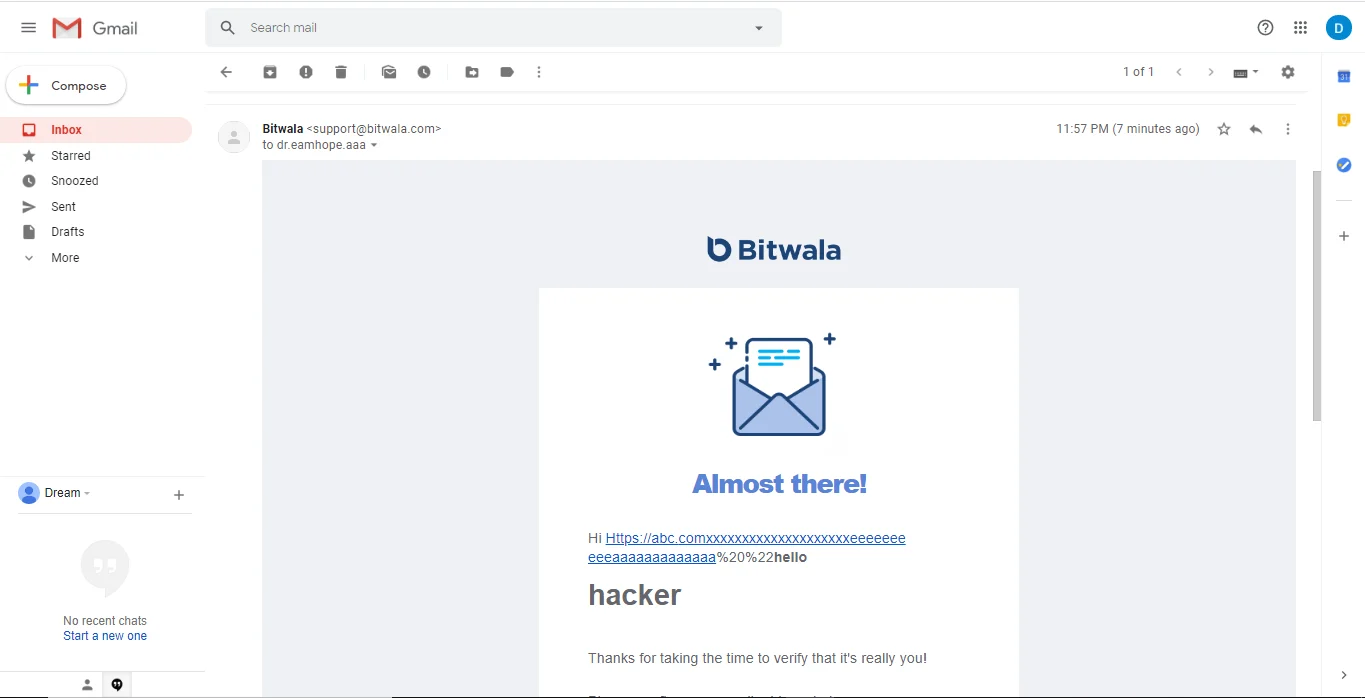
Impact
HTML injection, Phishing attacks This vulnerability can lead to the reformatting/editing of emails from an official email address, which can be used in targeted phishing attacks. This could lead to users being tricked into giving logins away to malicious attackers.
Not written yet. The AI write-up for this report has not been written yet. The Original tab links to the source.
How it worked
Root cause
Likely the name fields were inserted into the email template without HTML-encoding, so markup in the input was rendered rather than shown as text.
Impact
Emails from the official address could be reformatted and made to contain attacker links, which could trick users into handing over their logins.
What the attacker needed
No account needed; attacker can submit the registration form
Explained by bugbounty.wiki with AI from the original and checked against quotes from it; it can still be wrong. Read the original before relying on a detail.
Not written yet. The AI write-up for this report has not been written yet. The Original tab links to the source.
When a website puts user-supplied text into an email without cleaning it, any HTML tags in that text are treated as real formatting by the email client. Here the name fields were placed into emails as-is, so an attacker could add headings and links that look like they came from the company. That makes a convincing phishing email, because the sender address is genuine.
What is XSS?
Script an attacker supplies runs in another user's browser, on the target's origin, with that user's session.