Content spoofing
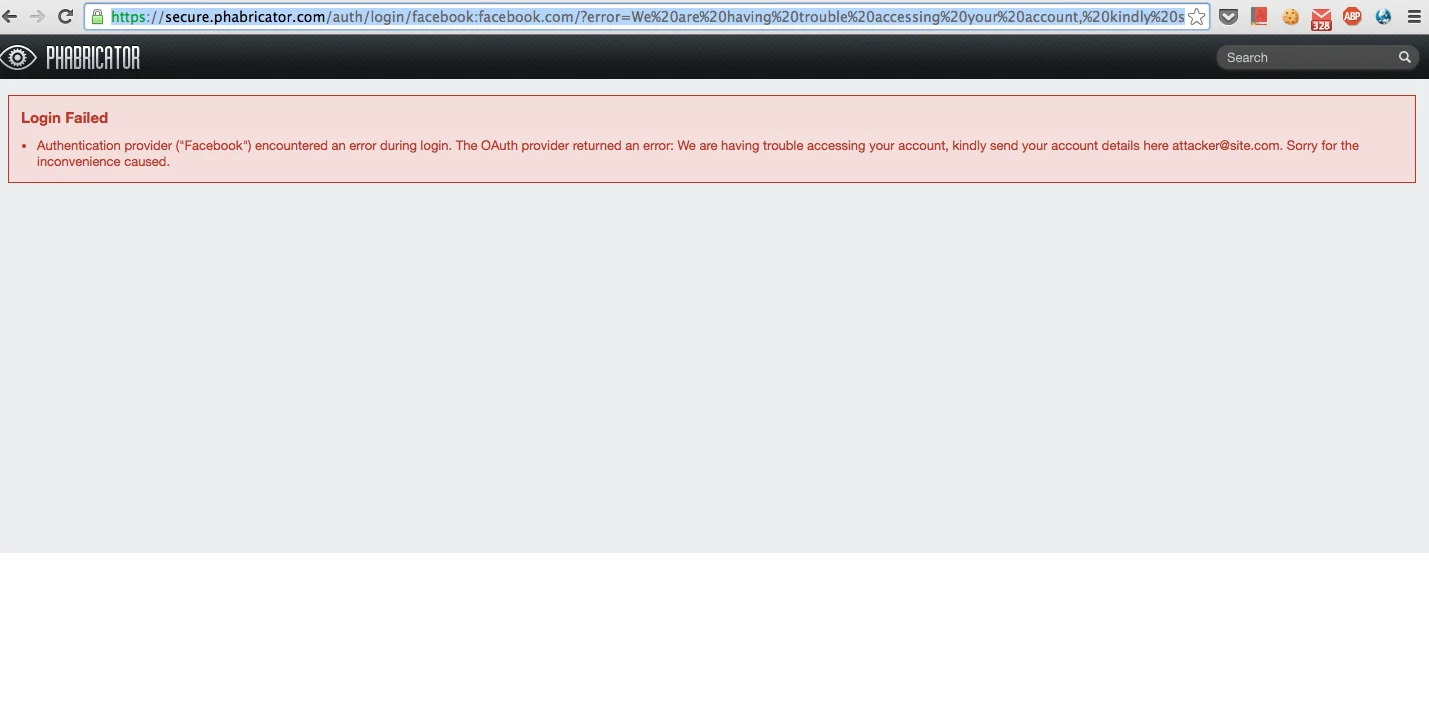
The login page reflected an error message supplied in the URL query string, so an attacker could craft a link that displayed arbitrary text on the legitimate site. This could be used for phishing by showing a message asking the victim to send account details to an attacker-controlled address.

- Disclosed after 48 hours
Hi,
I'm Dheeraj and I have found a content spoofing vulnerability in your system.
Description :
Using the following link : https://secure.phabricator.com/auth/login/facebook:facebook.com/?error=<Spoofed Content> Attacker can perform phishing attack.
Attack Example :
Regards Dheeraj @dheerajhere
Attachments
Not written yet. The AI write-up for this report has not been written yet. The Original tab links to the source.
How it worked
Root cause
Likely the application reflected the 'error' query parameter into the page without validating or encoding it, allowing arbitrary content to be displayed.
Impact
An attacker could use the legitimate site to display a convincing phishing message, potentially tricking users into sending account details to the attacker.
What the attacker needed
Victim clicks a crafted link
Explained by bugbounty.wiki with AI from the original and checked against quotes from it; it can still be wrong. Read the original before relying on a detail.
Not written yet. The AI write-up for this report has not been written yet. The Original tab links to the source.
A website sometimes shows messages based on what is in the web address. Here, the login page took text from the address and displayed it as if it were the site's own error message. An attacker could send a link that makes the real site show a fake message, which is useful for tricking people into giving away their details.
What is XSS?
Script an attacker supplies runs in another user's browser, on the target's origin, with that user's session.





