Cross-site Scripting (XSS)
The application name field on the Uber login applications page did not sanitise user input, allowing a stored cross-site scripting payload to execute when the app was deleted. An attacker could run arbitrary JavaScript in the context of a victim who viewed or deleted the malicious app.

- Fixed in under an hour
- Disclosed after 42 days
Summary by the researcher
This issue was originally reported via email [email protected]
The report
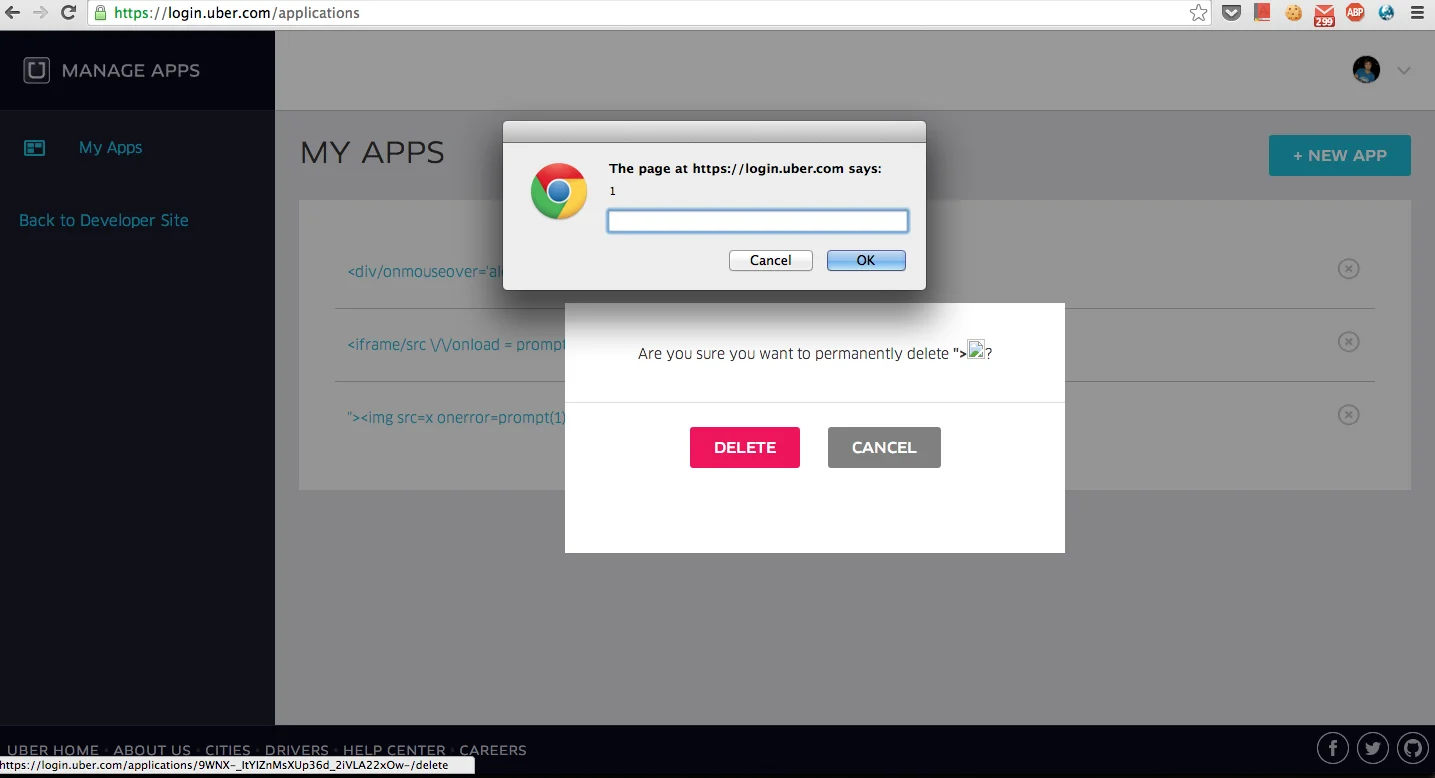
The website located at https://login.uber.com/applications suffers from a stored Cross-site Scripting (XSS) vulnerability.
Reproduction Steps: Create a new application with name as the following vector, and try to delete the same app.
Vector : "><img src=x onerror=prompt(1)>
Note that the XSS payload has fired.
Possible Scenarios:
- Attacker gets added as an admin or developer for an app
- Adds an app with an XSS vector as a name
- Victim sees the unusual app and attempts to delete it.
Or:
- Attacker creates an app with XSS-y name
- Adds victim as an admin
- Victim joins the app and attempts to delete it
I’ve tested this in the latest Firefox and Chrome. Attached to this report is the screenshot of this issue occurring in Chrome.
Attachments
Not written yet. The AI write-up for this report has not been written yet. The Original tab links to the source.
How it worked
Root cause
Likely the application name was inserted into the page as raw HTML without output encoding or sanitisation.
Impact
An attacker could run JavaScript in a victim's browser when the victim viewed or deleted a malicious app.
What the attacker needed
Attacker can create an app; victim views or deletes the app
How it was found
- Create a new application with a name containing an XSS payload.
- Attempt to delete the application.
- Observe that the XSS payload fires.
Explained by bugbounty.wiki with AI from the original and checked against quotes from it; it can still be wrong. Read the original before relying on a detail.
Not written yet. The AI write-up for this report has not been written yet. The Original tab links to the source.
Cross-site scripting (XSS) is when a website displays user-supplied text without cleaning it, so that text can include code that runs in another user's browser. Here, the app name was shown as raw HTML, so a name containing an image tag with an error handler ran a script when the app was deleted. This could let an attacker act as the victim inside the site.
What is XSS?
Script an attacker supplies runs in another user's browser, on the target's origin, with that user's session.




