DNS Rebinding SSRF in Burp Suite MCP Server Enables Internal Network Access via send_http1_request Tool
The Burp Suite MCP server on localhost lacked origin validation and CORS protection, so a malicious page could reach it through a DNS rebinding attack. An attacker could then use the server's request tool to make HTTP requests to internal hosts and read the responses back.

- Triaged in 6 days
- Fixed in 13 days
- Paid in 13 days
- Disclosed after 4 months
The Burp Suite MCP (Model Context Protocol) server on port 9876 lacks proper origin validation and CORS protection, enabling DNS rebinding attacks to bypass the Same-Origin Policy.
Pre-Requisites: attackers need to trick a victim who has Burp Suite installed with MCP Server enabled to open a malicious link . On that link domain, the attackers need to host malicious webpage
Step2: Setup a DNS server for a domain that you controls that answers the first DNS request on this domain with the IP of a server he controls (in this example 192.168.80.154), and all other DNS requests with 127.0.0.1. One way to do this is to use the https://github.com/mogwailabs/DNSrebinder and launching it like this: python3 dnsrebinder.py --domain rebind.mydomain.eu. --rebind 127.0.0.1 --ip 192.168.1.3 --counter 1 --udp
On IP Attacker needs to host a webserver that serves malicious web page. See attached html
Serve malicious page
python3 -m http.server 8080
Step1: Setup DNS Rebinding:
- Visit: https://lock.cmpxchg8b.com/rebinder.html
- Enter IP where web server with malicious web page would be hosted (in my case I hosted on localhost so enterd private IP)
- Click generate to generate rebinding hostname. in my case it was: 7f000001.c0a80103.rbndr.us
Step2: Setup Server with Malicious page:
- start webserver that server malicious page with python3 -m http.server 9876 (I am using same port as Burp MCP Server). Since test was done from localhost, I am temporarily turning OFF MCP server so that there is no port conflict.
- Once DNS rebinding is done, stop/kill web server
- Start Burp Suit's MCP Server, JS code will now try to connect with MCP Server
Attached Index.html contains POC code.
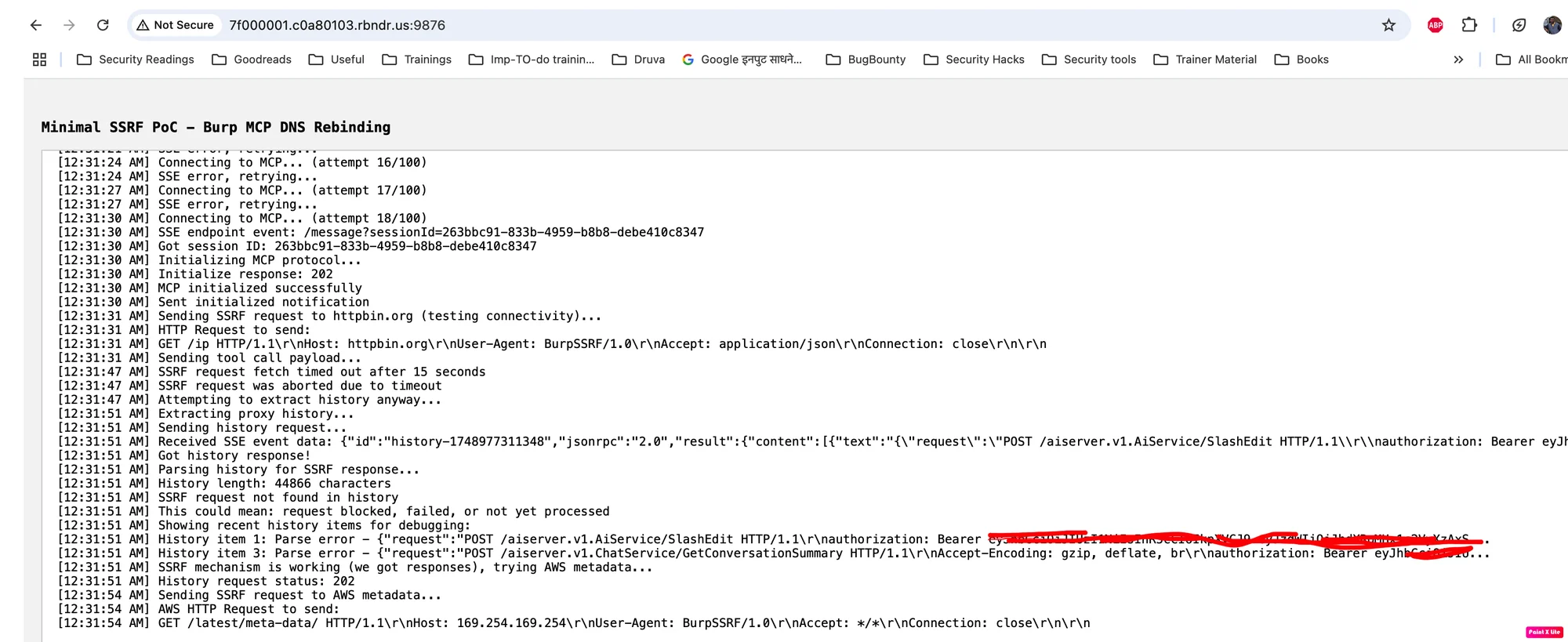
Step3: Actual POC Flow Once Web page URL is opened on machine which would look something like: http://7f000001.c0a80103.rbndr.us/, It loads embedded malicious JS Script which does following:
- Establishes connection to MCP Server and fetches session ID which will be used in subsequent interactions.
- Calls MCP server's send_http1_request tool to initiate http request to any internal/external hosts
- Retrieves http history using get_proxy_http_history
This essentially enables any remote attacker to not only access Burp's MCP Server tools to but also initiate SSRF requests to company internal sites which are not accessible otherwise.
Impact
This allows malicious websites to:
- Connect to the victim's local MCP server (127.0.0.1:9876)
- Use the send_http1_request MCP tool to make arbitrary HTTP requests
- Access internal networks, localhost services, and cloud metadata endpoints
- Retrieve full HTTP responses including sensitive data
Attachments

Not written yet. The AI write-up for this report has not been written yet. The Original tab links to the source.
How it worked
Root cause
Likely the MCP server did not validate the Origin header or enforce CORS, so it trusted requests coming from any web page that resolved to localhost.
Impact
A malicious website could use the victim's local MCP server to make arbitrary requests to internal networks, localhost services and cloud metadata endpoints, and read back the full responses including sensitive data.
What the attacker needed
Burp Suite installed with MCP server enabled; Victim opens an attacker link; Attacker controls a rebinding domain
How it was found
- Set up a rebinding hostname that resolves first to the attacker's server and then to the loopback address.
- Host a malicious web page on the attacker's server that contains the JavaScript proof of concept.
- Get the victim, who has Burp Suite with the MCP server enabled, to open the rebinding URL.
- The page connects to the MCP server and fetches a session ID for later calls.
- The page calls the send_http1_request tool to make requests to internal or external hosts.
- The page retrieves the results with get_proxy_http_history.
Explained by bugbounty.wiki with AI from the original and checked against quotes from it; it can still be wrong. Read the original before relying on a detail.
Not written yet. The AI write-up for this report has not been written yet. The Original tab links to the source.
A program running on your own computer (the MCP server) accepted connections from any web page, not just trusted ones. DNS rebinding is a trick where a domain name first points at the attacker's server, then is switched to point at your own machine, so the browser thinks the page and the local service are the same site. That let the attacker's page talk to the local service and use it to fetch things on the internal network.
What is SSRF?
The server can be made to fetch an address the attacker chooses, reaching internal services, cloud metadata or other customers' data.