Denial of service via cache poisoning
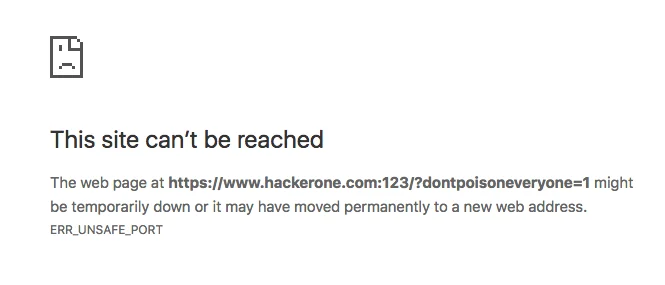
The web cache could be poisoned via the X-Forwarded-Port or X-Forwarded-Host headers, causing redirects to point to an invalid port. An attacker could persistently block access to any or all redirects on the site.
 Originally disclosed on HackerOne
- Triaged in 36 hours
- Fixed in 40 days
- Paid in 8 days
- Disclosed after 3 months
An attacker can persistently block access to any/all redirects on www.hackerone.com by using cache poisoning with the X-Forwarded-Port or X-Forwarded-Host headers to redirect users to an invalid port.
To replicate:
curl -H 'X-Forwarded-Port: 123' https://www.hackerone.com/index.php?dontpoisoneveryone=1
Then try to load https://www.hackerone.com/index.php?dontpoisoneveryone=1 in your browser.
This attack can also be done using the X-Forwarded-Host header:
curl -H 'X-Forwarded-Host: www.hackerone.com:123' https://www.hackerone.com/index.php?dontpoisoneveryone=1
For more information on the theory behind this attack, check out https://portswigger.net/blog/practical-web-cache-poisoning
Impact
An attacker can persistently block access to any/all redirects on www.hackerone.com
Attachments
Not written yet. The AI write-up for this report has not been written yet. The Original tab links to the source.
How it worked
Root cause
Likely the cache key did not include the X-Forwarded-Port and X-Forwarded-Host headers, so attacker-controlled values were cached and served to other users.
Impact
An attacker could persistently block access to any or all redirects on the site, causing a denial of service for those redirects.
What the attacker needed
Ability to send HTTP requests with custom headers; target URL is cacheable
How it was found
- Send a request with a crafted X-Forwarded-Port header to a cacheable URL.
- Load the same URL in a browser and observe the poisoned redirect.
- Repeat using a crafted X-Forwarded-Host header instead.
Explained by bugbounty.wiki with AI from the original and checked against quotes from it; it can still be wrong. Read the original before relying on a detail.
Not written yet. The AI write-up for this report has not been written yet. The Original tab links to the source.
A web cache stores copies of pages so they load faster for everyone. Here, the server trusted special headers that tell it which port or host to use when building a redirect, and it saved that bad redirect in the cache. So every visitor got sent to a broken address, effectively taking those redirects offline.
What is Cache bugs?
A cache and the origin disagree about a request, so a poisoned response is served to everyone or a private page is stored as public.



