Stored XSS on developer.uber.com via admin account compromise
Anyone could become an administrator on the readme.io project behind developer.uber.com by sending a crafted invite acceptance request with a known project ID. An attacker could then inject JavaScript into documentation pages, leading to stored XSS and potential account hijacking.
 Originally disclosed on HackerOne
- Fixed in 9 days
- Paid in 16 days
- Disclosed after 25 days
Hi,
Anyone can add themselves as an administrator on the readme.io uber project that powers developer.uber.com/documentation
To replicate this, first fetch https://uber.readme.io/inactiveand and grab Uber's project ID from the source: 578cd33dc27ce20e004e397b
Then, using this ID, create a normal account on readme.io, verify the email address, log in, and send the following HTTP request:
POST /api/accept-invite/5617f98f7f74330d00dfd86d HTTP/1.1 Host: dash.readme.io Connection: close Content-Length: 2 Accept: application/json, text/plain, / X-NewRelic-ID: XQEHWF5UGwYHXVlSDgY= Origin: https://dash.readme.io X-XSRF-TOKEN:<your token here> User-Agent: Mozilla/5.0 (Windows NT 10.0; Win64; x64) AppleWebKit/537.36 (KHTML, like Gecko) Chrome/51.0.2704.103 Safari/537.36 DNT: 1 Referer: https://dash.readme.io/ Accept-Encoding: gzip, deflate, br Accept-Language: en-GB,en-US;q=0.8,en;q=0.6 Cookie: <your cookies here>
The server will respond with "Invite doesn't exist". However, if you go to dash.readme.io you will find that you can now access uber as an administrator. After logging in, I went straight to the users page, took a screenshot as evidence (attached) and removed myself as an administrator.
Administrators are able to inject arbitrary JavaScript into documentation pages by design, so this could be used for a stored XSS attack on developer.uber.com to hijack developer accounts.
Attachments
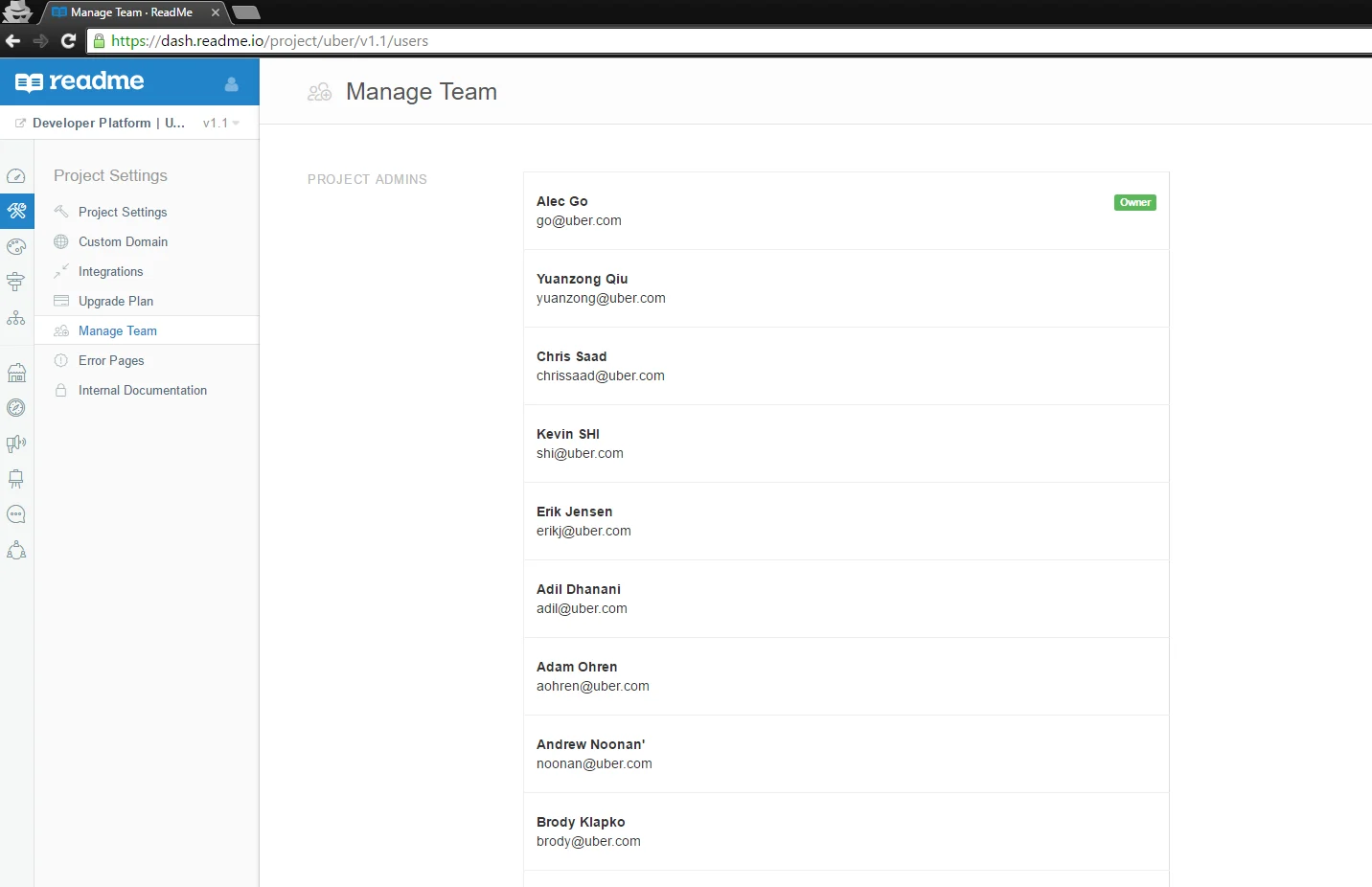
Not written yet. The AI write-up for this report has not been written yet. The Original tab links to the source.
How it worked
Root cause
Likely the invite acceptance endpoint did not properly verify that the user was authorised to accept the invite for that project, allowing anyone with a valid account and the project ID to become an admin.
Impact
An attacker could inject arbitrary JavaScript into documentation pages, potentially hijacking developer accounts, though the report only states this as a possibility.
What the attacker needed
A readme.io account; email verification; knowledge of the project ID
How it was found
- Fetch the inactive readme.io page and extract Uber's project ID from the source.
- Create a normal account on readme.io and verify the email address.
- Log in and send a POST request to the accept-invite endpoint.
- Despite an error response, access the dashboard and confirm administrator access to the Uber project.
Explained by bugbounty.wiki with AI from the original and checked against quotes from it; it can still be wrong. Read the original before relying on a detail.
Not written yet. The AI write-up for this report has not been written yet. The Original tab links to the source.
The documentation site used a third-party service where administrators can edit pages and add JavaScript. The service's invite system had a flaw that let any logged-in user join as an administrator by sending a special request. Once an admin, they could insert malicious code that runs in visitors' browsers.
What is Access control?
A user can do something their role should not allow: reach an admin function, act on a feature they have not paid for, or skip a permission check. IDOR is the special case where the object belongs to someone else.




