Getting New Invitations without Leaving Programs
The leave-program questionnaire request accepted a program handle supplied by the client, so a user could submit it for a program they had not left. This let the attacker accumulate extra pending invitations to private programs without giving up existing memberships.

- Disclosed after 9 days
Summary by the researcher
Be creative :)
https://twitter.com/alicanact60
The report
Hello there, I hope all is well!
#Description When you leave the private program, you get a chance to get a new invitation. But using this vulnerability, I can get new invitations without leaving private programs.
Steps:
- Go to any private bug bounty program.
- Click
Leave Programbutton - Click
Confirmbutton - Then you will see a questionnaire form. You can see this text:
When you fill out this questionnaire, we will fast track you for the next invite batch.
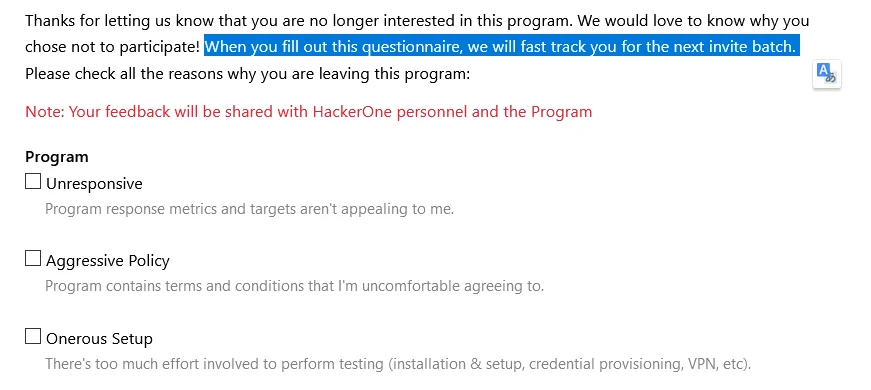
- Click any reason (for example:
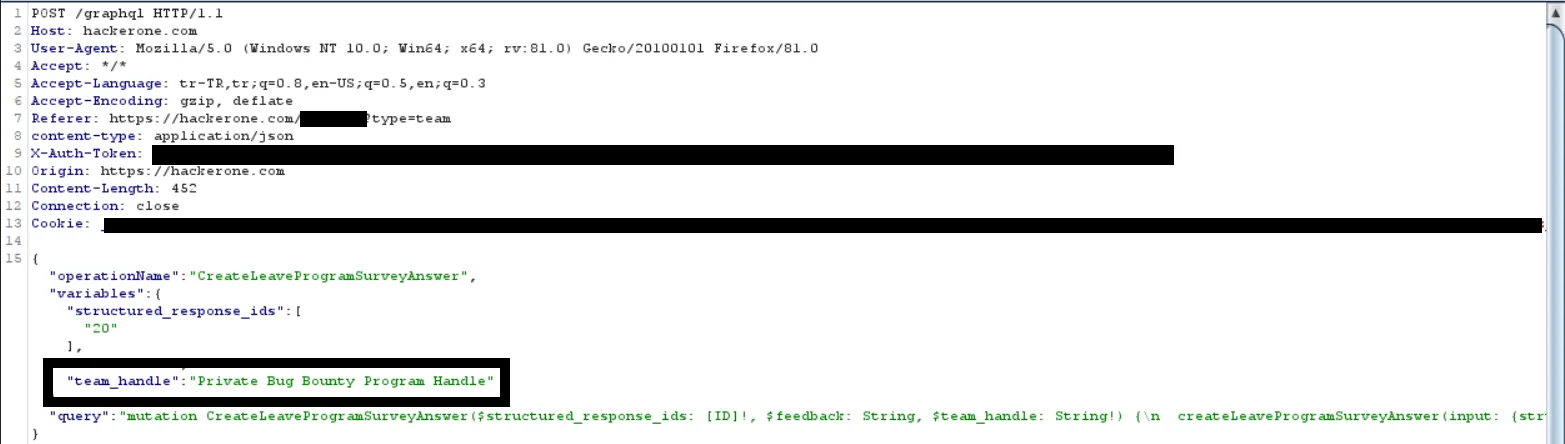
Unresponsive) and clickSubmitbutton - Return to Burp Suite and catch the request:
- Now, send the request to
Repeaterand forward the request. - Go to repeater and change the
team_handleparameter with another private program handle which you have. - Send the request and you will see
"was_successful":true
So you didn't leave the 2nd program but you got a new pending invitation.
Note: Sometimes, I see "was_successful":true in response but to be honest, I don't know why.
Yesterday, I sent about 25-30 request with different private programs and I asked how much pending invitations do I have? to [email protected] and they said It looks like you currently have 19 pending invitations at this time..
That's why I wanted to report it.
Impact
Users can get invitations without leaving programs.
Not written yet. The AI write-up for this report has not been written yet. The Original tab links to the source.
How it worked
Root cause
Likely the questionnaire endpoint trusted the client-supplied team_handle and did not verify that the user had actually left that program.
Impact
A user could gain extra pending invitations to private programs without leaving the ones they were already in, though the reporter notes the success response was not always consistent.
What the attacker needed
A HackerOne account; membership in at least two private programs; ability to intercept requests
How it was found
- Open a private program and start leaving it.
- Confirm leaving and reach the questionnaire form.
- Pick a reason and submit, catching the request in a proxy.
- Send the request to Repeater and forward it.
- Change the team_handle parameter to another private program you belong to.
- Send it again and observe a successful response.
Explained by bugbounty.wiki with AI from the original and checked against quotes from it; it can still be wrong. Read the original before relying on a detail.
Not written yet. The AI write-up for this report has not been written yet. The Original tab links to the source.
Bug bounty platforms sometimes reward people who leave a program by putting them in a faster queue for new invitations. Here the request that records why you left trusted a program name sent by the browser, so a user could name a different program they were still in and still get the reward. That meant extra invitations without actually leaving anything.
What is Business logic?
The application works as coded but not as intended: a negative price, a skipped payment step, a limit that can be crossed.








