Harvesting all private invites using leave program fast-tracked invitation and security@ email forwarding feature
The leave-program feature on HackerOne granted a fast-tracked invitation when a user left a private program, and the security@ email forwarding feature automatically sent an invitation to any sender. By repeatedly leaving and re-joining via the security@ address, an attacker could accumulate many private program invitations without user interaction.

- Triaged in 5 days
- Fixed in 11 days
- Paid in 5 days
- Disclosed after 12 days
Summary by the researcher
The report
Hi HackerOne,
Summary:
I have found a way that it is possible to harvest all private invitation using the new Leave Program feature together with the security@ email forwarding feature without any user interaction.
Description:
First, when the program activated the security@ email forwarding on hackerone and the hacker sent an email to [email protected] which is activated, hackerone system will send an invite to hackers and this invite will allow hackerone to become a participants of private program.
Now, hackers can choose to leave to the program in exchange of another automated invite when the hackers filled-up the leave program survey form using the new Leave Program functionality. (see image below)
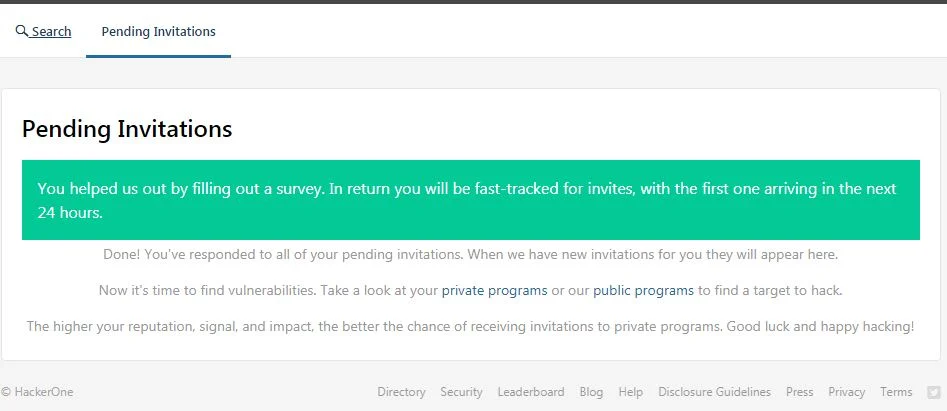
Now how to exploit it ? , very easy.. hackerone will do it for you fully automated without any user interaction
Steps To Reproduce
Assumes that you don't have any invites (as in 0 invites)
- First step you have to find program with
security@email forwarding enabled on hackerone, this is easy just go to https://hackerone.com/bug-bounty-programs, click all the program and send a test email to their declaredsecurity atemail on their public page, if you received a response to submit your bug, then that meanssecurity@is activated in hackerone.
███████
- Lets take
███████, send a test mail to that address - You will received an invitation email via
security@email forwarding feature. - Click the Submit Vulnerability , you are now a participants.
- Now leave the program and fill-up the leave survey then confirm leave.
- You'll be fast-tracked for invites, invitation will come most likely arriving in the next 24 hours as stated.
- REPEAT STEP 2 to 7 after getting a new invite came from fast-tracked invites.
NOTE: Ask more information if you are having trouble understanding my submission.__
But this is easy to exploit, just send an email to: ██████ > get invites > leave to ██████████ > get new invites came from fast-tracked > repeat
Impact
An attacker can harvest all private invitation without any user interaction, in a matter of few months you can have 100+ private invitation by just daily repeating the steps i provided above.
INVITES ALL YOU CAN
Let me know if you need more information.
Cheers Japz
Context
HackerOne runs bug bounty programmes, some of them private: a programme can be visible only to invited researchers, and participation is granted through an invitation. Two features sit on top of that model.
The first is security@ email forwarding. When a programme enables it on HackerOne, an email sent to the programme's [redacted] address is handled by HackerOne, and the system sends an invitation to the sender. Accepting that invitation makes the researcher a participant of the private programme.
The second is the Leave Program feature. A participant who leaves a programme fills in a leave survey and confirms the leave. The report states that leaving in exchange for another automated invite is part of this flow, and that the researcher is then fast-tracked for invitations, which most likely arrive within the next 24 hours.
The researcher's claim is that these two features can be combined to harvest private invitations with no user interaction at all.
Setup
The only precondition stated is that the attacker starts with no invitations at all (0 invites). No particular account type, tool or version is mentioned. The workflow relies on the public programme directory at https://hackerone.com/bug-bounty-programs and on ordinary email.
Finding it
The researcher noticed that the security@ forwarding feature hands out an invitation to anyone who emails the programme address, and that the Leave Program feature hands out a fast-tracked invitation in exchange for leaving. Each feature is reasonable on its own. Chained, they form a loop: an invitation obtained through email forwarding can be spent by leaving the programme, and leaving produces a new fast-tracked invitation, which can be spent on the next programme, and so on. Because both halves are automated by HackerOne, the loop needs no action from the programme or from any other person.
Exploitation
The researcher describes the whole chain as fully automated by HackerOne, without any user interaction.
Step 1: find a programme with security@ forwarding enabled
Go to https://hackerone.com/bug-bounty-programs, open each programme, and send a test email to the security at address declared on its public page. If you receive a response inviting you to submit your bug, then security@ is activated in HackerOne for that programme.
The image shows the leave program survey form used in the next steps.
Step 2: email the programme
Take a programme with forwarding enabled and send a test mail to that address. The report redacts the specific programme and address.
Step 3: receive the invitation
The invitation email arrives through the security@ email forwarding feature.
Step 4: accept and become a participant
Click Submit Vulnerability in the invitation. You are now a participant of the private programme.
Step 5: leave the programme
Leave the programme, fill in the leave survey, then confirm the leave.
Step 6: wait for the fast-tracked invitation
You are fast-tracked for invitations, and the invitation will most likely arrive within the next 24 hours, as stated in the flow.
Step 7: repeat
Repeat steps 2 to 7 once the new invitation from the fast-tracked queue arrives.
The researcher summarises the loop as:
██████ > get invites > leave to ██████████ > get new invites came from fast-tracked > repeat
Each iteration uses a programme's security@ forwarding to get an invitation, then leaves the programme to receive a new fast-tracked invitation.
Root cause
This is a business logic flaw rather than a memory or injection bug. The invitation from security@ forwarding can be spent by leaving the programme, and leaving produces a new fast-tracked invitation, so the cycle can repeat. Leaving a programme is rewarded with a new invitation, so the cost of spending an invitation is effectively zero. The report does not describe any rate limit, eligibility check or cap that would break the loop; the only stated limit is the 24-hour wait for the fast-tracked invitation.
Impact
An attacker can harvest private invitations without any user interaction. The researcher estimates that by repeating the steps daily, 100+ private invitations can be collected in a matter of months. The impact is that an attacker can harvest private invitations without any user interaction. The estimate of 100+ invitations is the researcher's own projection, not a measured result.
Fix
The report does not describe any fix or the changes made after disclosure.
Variants to test
- Check whether the fast-track invitation can be earned repeatedly from the same programme, rather than only once per leave. A positive result is a second fast-tracked invitation after rejoining and leaving the same programme again.
- Check whether the
security@invitation can be obtained repeatedly from the same programme address. A positive result is a fresh invitation for each email sent to an address you have already used. - Check whether other automated invitation sources (for example, other email aliases or programme contact addresses) feed the same pool. A positive result is any second source whose invitation can be spent by leaving a programme.
- Check whether the leave survey accepts submissions without a genuine participation, which would remove the need to accept the first invitation at all. A positive result is a fast-tracked invitation after a leave request for a programme you never joined.
Hunting notes
This kind of bug hides where two features each grant a scarce resource and the grants are not bound to the entity that issued them. During recon, look for invitation, referral or credit systems with more than one source, and for any flow that rewards an action such as leaving, cancelling or completing a survey. The signal is a reward that arrives automatically after an action the user can repeat at will. The researcher described the full loop, the absence of user interaction, and a volume estimate over time.
What happened, in plain words
HackerOne is a website where companies (called programmes) offer rewards to people who find security problems in their software. Some of those programmes are private: they are not listed publicly, and you can only take part if you receive an invitation. The invitation is the key that unlocks the programme.
The researcher found that two ordinary HackerOne features, each sensible on its own, could be combined into a loop. One feature hands out an invitation when you email a programme's security@ address. The other feature hands out a fast-tracked invitation when you leave a programme. Spend one invitation by leaving, and you get another one back. Repeat, and invitations pile up without anyone at the programme doing anything.
The two features involved
Before the steps make sense, you need to know what the two features do.
security@ email forwarding. Every company has a security contact address, something like [redacted]. Normally that mailbox is run by the company itself. HackerOne offers to handle it instead: when a programme switches forwarding on, an email sent to that address is processed by HackerOne, and HackerOne automatically sends an invitation back to whoever sent the email. Accept the invitation and you become a participant of that private programme.
Leave Program. A participant who no longer wants to take part can leave. Leaving involves filling in a short survey and confirming. According to the report, leaving in exchange for another automated invitation is part of this flow, and the person is then fast-tracked for invitations, which most likely arrive within the next 24 hours.
Neither feature is wrong by itself. The problem is that the invitation from the first feature can be spent on the second, and the second gives a new invitation back.
What the researcher claimed
The claim is simple: by combining the two features, an attacker can collect private invitations with no user interaction at all. "No user interaction" means nobody else has to click anything, approve anything or notice anything. HackerOne's own automation does all the work.
Before you start
The only precondition the report states is that the attacker begins with no invitations at all (0 invites). No particular account type, tool or software version is mentioned. Everything runs through the public programme directory at https://hackerone.com/bug-bounty-programs and ordinary email.
How the loop works
Each feature is reasonable on its own. Chained, they form a cycle:
- An invitation obtained through email forwarding is spent by joining a programme.
- Leaving that programme produces a new fast-tracked invitation.
- That new invitation is spent on the next programme.
- The next leave produces another invitation, and so on.
Because both halves are automated by HackerOne, the loop needs no action from the programme and no action from any other person.
Step by step
Step 1: find a programme with security@ forwarding enabled
Go to https://hackerone.com/bug-bounty-programs, open each programme, and send a test email to the security at address declared on its public page. If you receive a response inviting you to submit your bug, then security@ is activated in HackerOne for that programme.
Why this step: you cannot use the forwarding feature unless the programme has switched it on, and the only way to tell from outside is to send a message and see whether HackerOne answers with an invitation.
The image shows the leave program survey form used in the next steps.
Step 2: email the programme
Take a programme with forwarding enabled and send a test mail to that address. The report redacts the specific programme and address, so they are not shown here.
Why this step: this is the action that triggers HackerOne to issue the first invitation.
Step 3: receive the invitation
The invitation email arrives through the security@ email forwarding feature. You do not need to know anyone at the company; HackerOne generates the invitation because the message reached the forwarded address.
Step 4: accept and become a participant
Click Submit Vulnerability in the invitation. You are now a participant of the private programme.
Why this step: the invitation only counts once accepted. Accepting turns the email into actual membership of the private programme.
Step 5: leave the programme
Leave the programme, fill in the leave survey, then confirm the leave.
Why this step: this is where the second feature pays out. The leave flow is what triggers the fast-tracked invitation.
Step 6: wait for the fast-tracked invitation
You are fast-tracked for invitations, and the invitation will most likely arrive within the next 24 hours, as stated in the flow. The report gives no other timing detail.
Step 7: repeat
Repeat steps 2 to 7 once the new invitation from the fast-tracked queue arrives. Each pass through the loop turns one programme's security@ forwarding into one private invitation, and the leave step returns an invitation to your pool so the next pass can begin.
The researcher summarises the loop as:
██████ > get invites > leave to ██████████ > get new invites came from fast-tracked > repeat
Reading the line left to right: you email a programme (its name is redacted), you get invitations, you leave the programme (its name is redacted), you get new invitations from the fast-tracked queue, and you repeat. The redactions are the researcher's, to keep the specific programmes out of the public report.
Why this is a security problem
This is a business logic flaw, not a memory or injection bug. A business logic flaw means the software does exactly what it was programmed to do, but the rules themselves are wrong: the pieces fit together in a way the designers did not intend. Nothing crashes and no malicious input is needed.
The invitation from security@ forwarding can be spent by leaving the programme, and leaving produces a new fast-tracked invitation, so the cycle can repeat. Leaving a programme is rewarded with a new invitation, so the cost of spending an invitation is effectively zero. The report does not describe any rate limit, eligibility check or cap that would break the loop; the only stated limit is the 24-hour wait for the fast-tracked invitation.
Impact
An attacker can harvest private invitations without any user interaction. The researcher estimates that by repeating the steps daily, 100+ private invitations can be collected in a matter of months. That figure is the researcher's own projection, not a measured result.
The impact is that an attacker can harvest private invitations without any user interaction.
Fix
The report does not describe any fix or the changes made after disclosure.
Variants to test
These are follow-up checks in the same spirit, for anyone who wants to probe the same area:
- Check whether the fast-track invitation can be earned repeatedly from the same programme, rather than only once per leave. A positive result is a second fast-tracked invitation after rejoining and leaving the same programme again.
- Check whether the
security@invitation can be obtained repeatedly from the same programme address. A positive result is a fresh invitation for each email sent to an address you have already used. - Check whether other automated invitation sources (for example, other email aliases or programme contact addresses) feed the same pool. A positive result is any second source whose invitation can be spent by leaving a programme.
- Check whether the leave survey accepts submissions without a genuine participation, which would remove the need to accept the first invitation at all. A positive result is a fast-tracked invitation after a leave request for a programme you never joined.
Hunting notes
This kind of bug hides where two features each grant a scarce resource and the grants are not bound to the entity that issued them. During recon (the early phase of looking around a target), look for invitation, referral or credit systems with more than one source, and for any flow that rewards an action such as leaving, cancelling or completing a survey. The signal is a reward that arrives automatically after an action the user can repeat at will.
The researcher described the full loop, the absence of user interaction, and a volume estimate over time.
Glossary
-
Programme: a company's bug bounty offering on HackerOne; a private programme is visible only to invited researchers.
-
Invitation: the key that grants access to a private programme.
-
security@email forwarding: a HackerOne feature that handles a programme's security contact address and sends an invitation to anyone who emails it. -
Leave Program: the HackerOne feature for leaving a programme, which involves a survey and confirmation.
-
Fast-tracked invitation: an invitation that the report says arrives quickly, most likely within 24 hours, after leaving a programme.
-
User interaction: any action by a person, such as clicking or approving; the report stresses that none is needed here.
-
Business logic flaw: a bug where the software works as programmed but the rules allow an unintended outcome.
-
Rate limit: a cap on how often an action can be performed in a period of time.
-
Recon: the early phase of exploring a target to find things worth testing.
-
Redacted: deliberately hidden, as with the programme names and addresses replaced by blocks in this report.




