Hacker can bypass 2FA requirement and reporter blacklist through embedded submission form
A program's embedded submission form did not enforce the 2FA requirement that the main submission form enforced, allowing a user without 2FA to submit reports. The same investigation also revealed a separate flaw where an attacker could access other users' attachments during report writing.

- Triaged in 41 hours
- Fixed in 22 days
- Paid in 42 hours
- Disclosed after 28 days
Summary by the program
The hacker submitted a vulnerability to us that allowed any user to bypass multiple program restrictions, such as the 2FA requirement, report rate limit, and internal abuse limits. The severity for this vulnerability was set to medium (CVSS 5.0). This vulnerability was awarded $2,500.
When we looked into the root cause of the vulnerability, we stumbled upon another vulnerability, which had a higher CVSS score (7.1). The second vulnerability that we identified allowed an attacker to gain access to other users' attachments who were writing a report at the same time. Because we identified this vulnerability due to @japz' report, we decided to award him an additional $7,500. The report itself contains an in-depth explanation of where the vulnerability originated from.
We determined that neither of the vulnerabilities have been abused.
Here's a link to @japz's own blog post about the vulnerability: https://medium.com/japzdivino/bypass-hackerone-2fa-requirement-and-reporter-blacklist-46d7959f1ee5.
We'd like to thank @japz and @mga_bobo for bringing this to our attention, this was a great find!
The report
Hi Team,
Summary:
A program owner can enforce the hackers to setup the two-factor authentication before submitting new reports to their program here: https://hackerone.com/parrot_sec/submission_requirements (see below image)

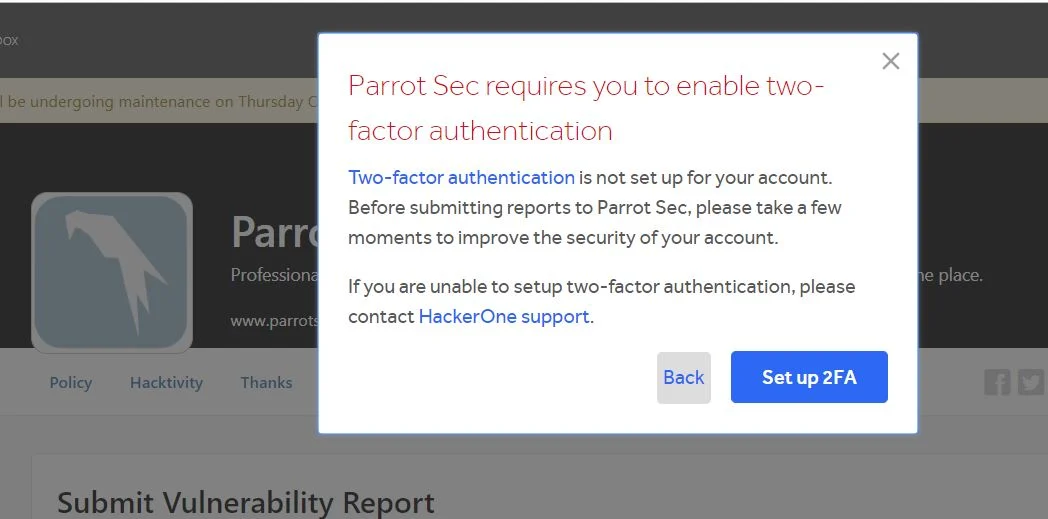
The Parrot Sec program has this feature enabled to enforce the hackers to setup 2FA before submitting reports. I removed my 2FA to test and it is good that i was block from submitting new reports (see below image)
BYPASS 2FA Requirements using Embedded Submission:
Now i was able to bypass this 2FA setup requirements by using the Parrot Sec program Embedded Submission Form.
Steps to reproduce:
- Login to your account and remove your 2FA on your account (if you already setup it)
- Now go to https://hackerone.com/parrot_sec and hit
Submit Reportbutton, observed that you cannot submit report unless you will enable your 2FA. - BYPASS: Get the
Embedded SubmissionURL on their policy page: i get this ->> https://hackerone.com/0a1e1f11-257e-4b46-b949-c7151212ffbb/embedded_submissions/new - Now submit report using that embedded submission form and you can submit reports without setting-up your 2FA, despite the program enforce the user to setup the 2FA before submitting new reports.
- 2FA requirements successfully bypassed!
Impact
Bypassing the enabled protection/feature of the program.
Let me know if anything else is needed.
Regards Japz
Context
HackerOne lets a program owner enforce extra conditions on the hackers who submit to it. One of those conditions is a two-factor authentication requirement: the owner can require that a hacker has 2FA set up before the hacker can submit new reports to the program. The setting lives on the program's submission requirements page, for example:
https://hackerone.com/parrot_sec/submission_requirements
The image shows the submission requirements configuration with the 2FA requirement enabled.
Separately, a program can offer an embedded submission form. This is a URL that a program can place on its own site so that researchers can submit reports without leaving that site. The form posts into HackerOne's submission flow.
The report describes the Parrot Sec program, which had the 2FA requirement enabled and also had an embedded submission form.
Setup
The researcher used an ordinary hacker account. The precondition was simply that the account had 2FA enabled at some point, because the test required removing it. No special role, tool or version is mentioned in the report.
Finding it
The researcher removed 2FA from their own account and then tried to submit a report to the Parrot Sec program through the normal route. The submission was blocked, which is the expected behaviour when the program enforces 2FA:
The image shows the block that appears when a hacker without 2FA tries to submit a report to a program that requires it.
That block is applied on the normal submission path. The embedded submission form is a different entry point into the same submission flow.
Exploitation
Step 1: remove 2FA
Log in to the account and remove 2FA, if it was set up. This puts the account in the state the program is supposed to reject.
Step 2: confirm the block on the normal path
Go to the program page:
https://hackerone.com/parrot_sec
Press Submit Report. The normal submission flow refuses to let the hacker submit unless 2FA is enabled. This confirms the requirement is active for the account.
Step 3: obtain the embedded submission URL
The embedded submission URL is published on the program's policy page. In this case it was:
https://hackerone.com/0a1e1f11-257e-4b46-b949-c7151212ffbb/embedded_submissions/new
The UUID in the path identifies the program's embedded submission form. The URL was obtained from the program's policy page.
Step 4: submit through the embedded form
Submit the report using that embedded submission form. The submission succeeds even though the account has no 2FA and the program enforces the requirement on the normal path.
Step 5: result
The 2FA requirement is bypassed. The report could be submitted through the embedded form with no 2FA configured on the account.
Root cause
The 2FA requirement is enforced on the standard submission path but not on the embedded submission path. The embedded form is a second entry point into report submission, and it appears not to run the same authorisation check against the program's submission requirements. The report does not include the server-side code, so the exact location of the missing check is not shown; .
The existing defence, the 2FA gate, was effective only for the route it was wired into.
Impact
A hacker can bypass the protections a program has enabled, specifically the 2FA requirement, by submitting through the embedded form instead of the normal submission flow. The report frames the impact as bypassing the enabled protection or feature of the program. The report does not describe any further consequence beyond the bypass itself.
In the program's summary, the same vulnerability is described as allowing any user to bypass multiple program restrictions: the 2FA requirement, the report rate limit and internal abuse limits. The program set the severity to medium (CVSS 5.0) and awarded $2,500 for this report.
While investigating the root cause, the program found a second vulnerability with a higher CVSS score (7.1). That one allowed an attacker to gain access to other users' attachments when those users were writing a report at the same time. Because the second issue was identified thanks to this report, the program awarded an additional $7,500, for $10,000 in total. The program states that neither vulnerability was abused.
Fix
The report does not describe the fix that was applied. What follows from the finding is that the embedded submission path should enforce the same program submission requirements as the normal submission path, including the 2FA requirement, the report rate limit and the internal abuse limits, so that every entry point into report submission runs the same authorisation checks.
Variants to test
- Other submission entry points. Look for any route that creates a report other than the main submission flow, such as embedded forms, API endpoints or integrations, and try submitting with the requirement unmet. A positive result is a report created while the normal path still blocks the account.
- Other enforced requirements. Repeat the test with requirements other than 2FA, such as a report rate limit or an abuse limit, through the alternate entry point. A positive result is a submission that succeeds where the normal path would refuse it.
- Requirement changes after the form is issued. Enable or change a program requirement and then use an embedded form URL obtained earlier. A positive result is a submission that ignores the current requirement.
- Direct access to the embedded form. Reach the embedded submission URL directly rather than through the program's site. A positive result is the form rendering and accepting a submission for an account that the normal path rejects.
Hunting notes
This kind of bug hides wherever a feature has more than one way in. The signal during recon is a program that publishes an embedded submission form, or any alternate submission route, while also enforcing conditions on the main flow. The 2FA requirement, rate limits and abuse limits are all candidates, because each is a check that has to be applied on every path.
The researcher showed enough impact by demonstrating the block on the normal path first, then completing the same action through the embedded form with the same account. That before-and-after comparison makes the bypass unambiguous without needing to escalate it further. The program's own follow-up shows the value of the report went beyond the bypass: the root cause investigation surfaced a second, more severe issue.
A blog post by the researcher about the vulnerability is linked from the program's summary:
https://medium.com/japzdivino/bypass-hackerone-2fa-requirement-and-reporter-blacklist-46d7959f1ee5
What happened, in plain words
HackerOne is a website where companies (called "programs") ask security researchers to find bugs in their software. Programs can set rules for the researchers who submit reports to them. One rule is that a researcher must have two-factor authentication (2FA) turned on before they can send a report. 2FA is an extra login step, like a code from your phone, so that a stolen password alone is not enough to get into an account.
A researcher found that this 2FA rule could be skipped. The program Parrot Sec had the 2FA rule turned on. It also had a special "embedded submission form": a report form that the program can put on its own website so researchers can submit without leaving that site. The normal way of submitting a report checked for 2FA and blocked the researcher when 2FA was removed from the account. But the embedded form did not check. The researcher could submit a report through the embedded form even without 2FA. That is the bypass.
The program's summary says the same flaw also let a user get around other restrictions: the report rate limit (how many reports you can send in a period) and internal abuse limits. The program rated this medium severity (CVSS 5.0) and paid $2,500. While looking into why the bug existed, the program found a second, more serious bug (CVSS 7.1) that let an attacker see other users' attachments when those users were writing a report at the same time. Because the report led them to it, they paid an extra $7,500, for $10,000 in total. The program says neither bug was abused.
Below is the full story, step by step, explained for someone who has never done security testing.
Context
HackerOne lets a program owner enforce extra conditions on the hackers who submit to it. One of those conditions is a two-factor authentication requirement: the owner can require that a hacker has 2FA set up before the hacker can submit new reports to the program. The setting lives on the program's submission requirements page, for example:
https://hackerone.com/parrot_sec/submission_requirements
The image shows the submission requirements configuration with the 2FA requirement enabled.
What is 2FA? When you log in with a password, that is one factor: something you know. 2FA adds a second factor, usually something you have, like a phone that shows a changing code. If someone steals your password, they still cannot log in without the second factor. A program can decide that anyone submitting a report must have this second lock on their account, because reports can contain sensitive information and the program wants submissions to come from well-protected accounts.
Separately, a program can offer an embedded submission form. This is a URL that a program can place on its own site so that researchers can submit reports without leaving that site. The form posts into HackerOne's submission flow. Think of it like a suggestion box that a shop puts in its own lobby: the box is physically in the shop, but the notes go into the same back office as the main website's contact form. The embedded form is a second door into the same room.
The report describes the Parrot Sec program, which had the 2FA requirement enabled and also had an embedded submission form.
Setup
The researcher used an ordinary hacker account. The precondition was simply that the account had 2FA enabled at some point, because the test required removing it. No special role, tool or version is mentioned in the report.
In plain terms: you do not need to be an administrator or have any special software. You need a normal HackerOne account and the ability to turn 2FA on and off in your own settings. The test is about what the website does when your account does not meet a rule, so you first make your account fail the rule on purpose.
Finding it
The researcher removed 2FA from their own account and then tried to submit a report to the Parrot Sec program through the normal route. The submission was blocked, which is the expected behaviour when the program enforces 2FA:
The image shows the block that appears when a hacker without 2FA tries to submit a report to a program that requires it.
That block is applied on the normal submission path. The embedded submission form is a different entry point into the same submission flow.
Why suspect the embedded form? Because a rule only works if every door checks it. If the main door has a guard who asks for your 2FA, but the side door has no guard, then the rule is only as strong as the weakest door.
Exploitation
Step 1: remove 2FA
Log in to the account and remove 2FA, if it was set up. This puts the account in the state the program is supposed to reject.
Why: you cannot test whether a rule blocks you unless you first fail the rule. Removing 2FA makes your account exactly the kind that the program says should not be allowed to submit. If you left 2FA on, the normal path would let you through and you would learn nothing.
Step 2: confirm the block on the normal path
Go to the program page:
https://hackerone.com/parrot_sec
Press Submit Report. The normal submission flow refuses to let the hacker submit unless 2FA is enabled. This confirms the requirement is active for the account.
Why: this is the control experiment. Before you claim that a rule can be bypassed, you show that the rule is actually turned on and actually blocks you in the ordinary case. The block message is the evidence that the program enforces 2FA. Without this step, someone could say the rule was never active in the first place.
Step 3: obtain the embedded submission URL
The embedded submission URL is published on the program's policy page. In this case it was:
https://hackerone.com/0a1e1f11-257e-4b46-b949-c7151212ffbb/embedded_submissions/new
The UUID in the path identifies the program's embedded submission form. The URL was obtained from the program's policy page.
What is a UUID? It is a long string of letters and numbers, like 0a1e1f11-257e-4b46-b949-c7151212ffbb, used as an identifier. It is not a secret password; it is more like a serial number that names a particular form. So finding the URL is not the vulnerability; the vulnerability is what happens when you use it.
Step 4: submit through the embedded form
Submit the report using that embedded submission form. The submission succeeds even though the account has no 2FA and the program enforces the requirement on the normal path.
Why this matters: the same account, in the same state (no 2FA), is rejected at one door and accepted at another. That difference is the bug. The embedded form is supposed to be another way into the same submission process, so it should apply the same rules. It did not.
Step 5: result
The 2FA requirement is bypassed. The report could be submitted through the embedded form with no 2FA configured on the account.
In everyday terms: the program put a lock on the front door, but the side door was open. Anyone who knew the side door existed could walk in without the key.
Root cause
The 2FA requirement is enforced on the standard submission path but not on the embedded submission path. The embedded form is a second entry point into report submission, and it appears not to run the same authorisation check against the program's submission requirements. The report does not include the server-side code, so the exact location of the missing check is not shown; .
What is a route or controller? A website is built from pieces of code that handle different URLs. A "route" is the mapping from a URL to the code that runs when someone visits it. A "controller" is that code. If the 2FA check is written inside the controller for the normal submission page, then any other controller (like the one for the embedded form) will not have the check unless someone copied it there too. This is a common pattern: a security check is added in one place and forgotten in another.
The existing defence, the 2FA gate, was effective only for the route it was wired into.
Impact
A hacker can bypass the protections a program has enabled, specifically the 2FA requirement, by submitting through the embedded form instead of the normal submission flow. The report frames the impact as bypassing the enabled protection or feature of the program. The report does not describe any further consequence beyond the bypass itself.
In the program's summary, the same vulnerability is described as allowing any user to bypass multiple program restrictions: the 2FA requirement, the report rate limit and internal abuse limits. The program set the severity to medium (CVSS 5.0) and awarded $2,500 for this report.
What is CVSS? It is a scoring system for the severity of a security bug, from 0 to 10. A higher number means more serious. Medium is a middle range. The program also mentions a rate limit: a cap on how many reports you can send in a certain time, meant to stop spam and abuse. Internal abuse limits are similar safeguards. The summary says the same bypass let a user get around those too, not just 2FA.
While investigating the root cause, the program found a second vulnerability with a higher CVSS score (7.1). That one allowed an attacker to gain access to other users' attachments when those users were writing a report at the same time. Because the second issue was identified thanks to this report, the program awarded an additional $7,500, for $10,000 in total. The program states that neither vulnerability was abused.
What are attachments? Files that you upload with a report, such as screenshots or logs. The second bug let someone see files that other people were uploading at the same moment. That is a different problem from the 2FA bypass, but it was found while the program looked into why the bypass was possible. This shows that a small-looking bypass can lead to bigger discoveries.
Fix
The report does not describe the fix that was applied. What follows from the finding is that the embedded submission path should enforce the same program submission requirements as the normal submission path, including the 2FA requirement, the report rate limit and the internal abuse limits, so that every entry point into report submission runs the same authorisation checks.
In plain words: the guard at the side door should ask the same questions as the guard at the front door. The check should live in a shared place that every submission route uses, not be copied into one route and forgotten in another.
Variants to test
-
Other submission entry points. Look for any route that creates a report other than the main submission flow, such as embedded forms, API endpoints or integrations, and try submitting with the requirement unmet. A positive result is a report created while the normal path still blocks the account.
What is an API endpoint? An API is a way for software to talk to software, like a waiter taking orders between you and the kitchen. An endpoint is a specific URL where that conversation happens. If a program has an integration that creates reports through an API, that is another door to check.
-
Other enforced requirements. Repeat the test with requirements other than 2FA, such as a report rate limit or an abuse limit, through the alternate entry point. A positive result is a submission that succeeds where the normal path would refuse it.
Why: the bug is not really about 2FA specifically. It is about a check that is applied in one place but not another. Any check can have the same problem.
-
Requirement changes after the form is issued. Enable or change a program requirement and then use an embedded form URL obtained earlier. A positive result is a submission that ignores the current requirement.
Why: if the form URL is like a ticket that was printed before a new rule was announced, does the door still accept the old ticket? If yes, then changing the rules does not help until the old tickets expire.
-
Direct access to the embedded form. Reach the embedded submission URL directly rather than through the program's site. A positive result is the form rendering and accepting a submission for an account that the normal path rejects.
Why: the embedded form is meant to be used inside the program's site, but the URL itself is public. If you can paste it into your browser and use it directly, then the program's site is not adding any protection; the form is open to anyone who knows the URL.
Hunting notes
This kind of bug hides wherever a feature has more than one way in. The signal during recon is a program that publishes an embedded submission form, or any alternate submission route, while also enforcing conditions on the main flow. The 2FA requirement, rate limits and abuse limits are all candidates, because each is a check that has to be applied on every path.
What is recon? It is the information-gathering phase: reading program pages, policies and settings to see what features exist and what rules are turned on. You are looking for a mismatch between what is protected and what is not.
The researcher showed enough impact by demonstrating the block on the normal path first, then completing the same action through the embedded form with the same account. That before-and-after comparison makes the bypass unambiguous without needing to escalate it further. The program's own follow-up shows the value of the report went beyond the bypass: the root cause investigation surfaced a second, more severe issue.
A blog post by the researcher about the vulnerability is linked from the program's summary:
https://medium.com/japzdivino/bypass-hackerone-2fa-requirement-and-reporter-blacklist-46d7959f1ee5
Glossary
- 2FA (two-factor authentication): A login method that requires two different proofs of identity, usually a password plus a code from a phone or app.
- API: A way for one piece of software to send requests to another, like a waiter between you and the kitchen.
- API endpoint: A specific URL where an API accepts requests.
- Attachment: A file, such as a screenshot or log, uploaded together with a report.
- Authorisation check: Code that decides whether the current user is allowed to do the requested action.
- Bypass: Getting around a security rule or restriction without satisfying it.
- Controller: The part of a web application's code that handles a particular request.
- CVSS: A scoring system from 0 to 10 that rates the severity of a security vulnerability.
- Embedded submission form: A report form that a program can place on its own website, which sends reports into HackerOne's submission flow.
- Entry point: Any way into a system, such as a web page, a form or an API.
- Policy page: The page where a program describes its rules and scope.
- Rate limit: A cap on how many actions, such as report submissions, a user can perform in a given time.
- Recon: The information-gathering phase of security testing, where you learn what features and rules exist.
- Route: The mapping in a web application from a URL to the code that handles it.
- Severity: How serious a vulnerability is, often expressed with a CVSS score.
- Submission requirements: Conditions a program sets that a hacker must meet before submitting a report, such as having 2FA enabled.
- UUID: A long identifier made of letters and numbers, used to name something uniquely; not a secret.
- Vulnerability: A weakness in software that can be used to break a security rule.

