Program profile_metrics.json contains time to triage for deptofdefense even it's turned off
A program's profile metrics endpoint returned a mean time to triage value even though the response efficiency section was hidden on the public program page. An attacker could read that hidden metric through the JSON endpoint.

- Triaged in 38 hours
- Fixed in 38 hours
- Paid in 38 hours
- Disclosed after 15 days
Hello Hackerone Security Team,
#Summary
- Well, in your previous report, it was revealing about
Time to Triagefor WordPress which you fixed it.
- However, the program US dept of defense doesn't have profile metrics which we can't display any certain info. But, still profile_metrics.json leaks the
time to triageparameter for US DEPT OF DEFENSE though it disabled from the side of Profile Metrics (Response Efficiency).
#Step to Reproduce
- Go To
https://hackerone.com/deptofdefense.
2)Note: you can see there is no response efficiency.
- Now, use the profile_metrics.json at the end of program parameter.
https://hackerone.com/deptofdefense/profile_metrics.json
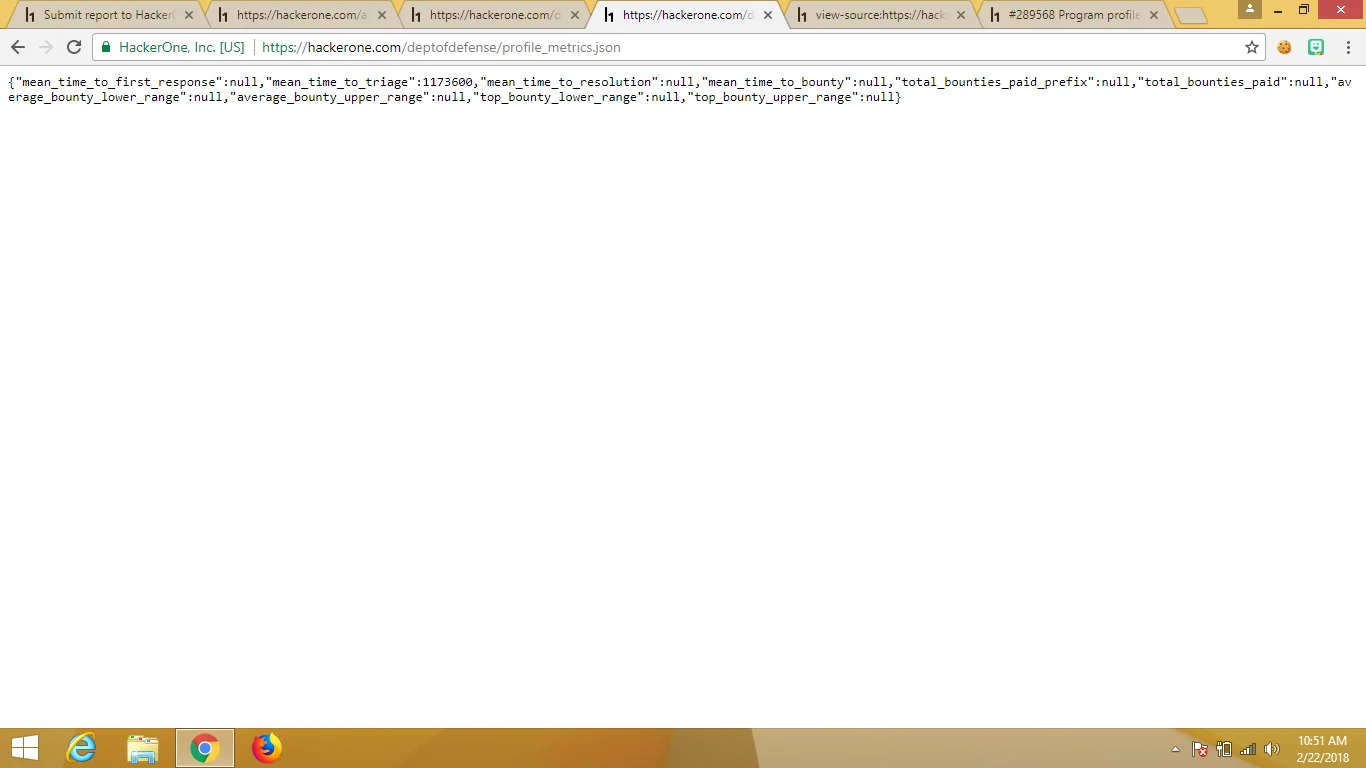
- The response is
{"mean_time_to_first_response":null,"mean_time_to_triage":1173600,"mean_time_to_resolution":null,"mean_time_to_bounty":null,"total_bounties_paid_prefix":null,"total_bounties_paid":null,"average_bounty_lower_range":null,"average_bounty_upper_range":null,"top_bounty_lower_range":null,"top_bounty_upper_range":null}
The parameter mean_time_to_triage has been leaked even though it should be set to null.
As this is the case of deptofdefense, then this type of parameters should always be set to null and be private.
Thanks Kunal
(Attaching with POC)
F265751
Impact
An attacker can gain information regarding deptofdefense (Triage time) even though it's turned off.
Attachments
Context
HackerOne exposes a per-program metrics endpoint, profile_metrics.json, that returns aggregate figures about a program's responsiveness: mean time to first response, mean time to triage, mean time to resolution, mean time to bounty, and a set of bounty range figures. The same figures are normally surfaced on a program's public page under a "Response Efficiency" section.
The researcher had previously reported that this endpoint revealed Time to Triage data for the WordPress program, and that issue was fixed. This report concerns the US Department of Defence program at https://hackerone.com/deptofdefense, where the Response Efficiency section is not displayed at all, yet the JSON endpoint still returned a triage time.
Setup
No account, role or special tooling is described. The only precondition is that the program page for deptofdefense is publicly reachable and that its Response Efficiency section is disabled, which the researcher confirms by visiting the page.
Finding it
The researcher compared two things: what the program page shows, and what the underlying JSON endpoint returns. On the page there is no response efficiency information. The JSON endpoint, however, still contains a populated mean_time_to_triage value. The reasoning is that if the metric is turned off for display, the endpoint should return null for it, as it does for the other metrics in the same response.
Exploitation
Step 1: Visit the program page
https://hackerone.com/deptofdefense
The researcher notes that there is no response efficiency section on this page.
Step 2: Request the metrics endpoint
Appending profile_metrics.json to the program path returns the metrics document:
https://hackerone.com/deptofdefense/profile_metrics.json
Step 3: Read the response
{"mean_time_to_first_response":null,"mean_time_to_triage":1173600,"mean_time_to_resolution":null,"mean_time_to_bounty":null,"total_bounties_paid_prefix":null,"total_bounties_paid":null,"average_bounty_lower_range":null,"average_bounty_upper_range":null,"top_bounty_lower_range":null,"top_bounty_upper_range":null}
Every field is null except mean_time_to_triage, which is 1173600. The researcher's point is that this parameter has been leaked even though it should be set to null, and that for a program such as deptofdefense this kind of parameter should always be null and private.
The attached screenshot shows the proof of concept for the request and response above.
Root cause
The report does not describe the implementation. What it establishes is a mismatch between the display setting and the data returned by the endpoint: the Response Efficiency section is disabled for the program, but the metrics document still serialises a real value for mean_time_to_triage instead of null. The report does not describe the implementation; it only establishes the mismatch between the disabled section and the populated JSON field.
Impact
An attacker can learn the triage time for deptofdefense even though that information is turned off on the program page. The exposure is limited to the metric itself: in this response only mean_time_to_triage is populated, and the remaining fields are null. The researcher frames the issue as information disclosure of a value the program intended to keep private.
Fix
The expectation set out in the report is that parameters of this kind for a program such as deptofdefense should be set to null in the endpoint, matching the disabled state of the Response Efficiency section.
Variants to test
- Request
profile_metrics.jsonfor other programs whose Response Efficiency section is hidden and check whether any field is non-null. A positive result is a populated metric where the page shows nothing. - Compare each field in the JSON against what the program page displays. A positive result is any value present in the JSON but absent from the page.
- Re-check programs covered by earlier fixes of the same kind, such as the WordPress case mentioned in the report, to confirm the fix holds across the whole endpoint rather than a single field.
Hunting notes
This kind of bug hides where a UI feature has a visibility toggle and a separate JSON or API endpoint serves the same data. During recon, look for pages that deliberately show less than the underlying data model, then request the machine-readable version of the same resource and diff the two. The signal is a field that is null for some programs and populated for others whose UI hides it. The researcher demonstrated impact by showing the page without response efficiency and the endpoint response containing mean_time_to_triage.
What happened, in plain words
HackerOne is a website where companies (called "programs") invite security researchers to look for problems in their systems and report them. Each program has a public page that shows some statistics about how quickly the company responds to reports. One of those statistics is called "time to triage": the average time it takes the company to look at a new report and decide what to do with it.
A program can choose to hide these statistics. When the statistics are hidden, the public page simply does not show a "Response Efficiency" section. But the website also has a second way of handing out the same information: a machine-readable file (a JSON document) that a browser or a script can fetch directly. The researcher found that for the US Department of Defence program, the public page showed no response efficiency at all, yet the machine-readable file still contained a real triage time. In other words, the information was hidden on the page but still available to anyone who asked for the file.
This kind of problem is called information disclosure: data that was meant to stay private can be read by someone who should not see it. It is not about breaking into anything; it is about a door that was supposed to be locked being left slightly open.
Background you need
What a program page is
On HackerOne, every company that runs a bug bounty has a page, for example https://hackerone.com/deptofdefense. That page is what a visitor sees in a normal browser: a description of the program, its rules, and some statistics. The statistics section is called "Response Efficiency" and it summarises how responsive the company is.
What an API and a JSON endpoint are
A web page is made for humans: it has colours, buttons and text laid out for reading. An API (application programming interface) is the same service made for machines: it returns raw data in a structured format that a program can read easily. A common format is JSON (JavaScript Object Notation), which looks like a list of names and values inside curly brackets, for example {"name":"value"}.
A useful everyday comparison: a restaurant menu with photos is the web page, and the printed price list the kitchen uses internally is the API. Both describe the same dishes, but the internal list is not meant for customers. If the internal list is reachable from outside, customers can read things the menu did not show.
An endpoint is simply a specific address on a website that returns data. Here the endpoint is the program page address with profile_metrics.json added at the end. The .json ending is a hint that the answer will be in JSON format rather than a normal web page.
What null means
In JSON, null means "no value". It is the way a program says "this field is empty on purpose". If a statistic is turned off, the natural thing for the endpoint to return is null, so that anyone reading the data understands there is nothing to show.
What the vulnerability class means
Information disclosure means private or hidden information can be obtained by someone who was not supposed to have it. It can be serious or minor depending on what leaks. Here the leaked item is a single timing figure, which is why the impact is limited, but the principle is the same: the program decided to hide something and the hiding did not work everywhere.
The earlier report
The researcher mentions that in a previous report they had shown the same kind of problem for the WordPress program: the Time to Triage figure was revealed through this endpoint. That earlier issue was fixed. This report is about a different program, the US Department of Defence, where the same kind of leak still happened.
Finding it
The researcher did something simple and effective: they compared two views of the same information.
- They opened the program page in a browser and looked at what it showed. There was no Response Efficiency section.
- They requested the machine-readable version of the same data and looked at what it contained. The triage time was there.
The reasoning is straightforward: if a statistic is switched off for display, the endpoint that serves the same statistic should return null for it, exactly as it does for the other statistics in the same answer. A value that is hidden in one place but present in another is a mismatch, and that mismatch is the bug.
Reproducing it step by step
Step 1: Visit the program page
https://hackerone.com/deptofdefense
This is the public page of the US Department of Defence program. The researcher opened it to confirm the starting point: the page shows no response efficiency information. This step matters because it establishes what the program intended visitors to see. Without it, there would be nothing to compare the endpoint against.
Step 2: Request the metrics endpoint
The same address with profile_metrics.json appended returns the metrics document:
https://hackerone.com/deptofdefense/profile_metrics.json
This is the machine-readable version of the statistics. The researcher requested it because the page and the endpoint are supposed to describe the same thing. If the page hides a statistic, the endpoint should hide it too. Typing this address into a browser's address bar is enough; no special tool is needed.
Step 3: Read the response
{"mean_time_to_first_response":null,"mean_time_to_triage":1173600,"mean_time_to_resolution":null,"mean_time_to_bounty":null,"total_bounties_paid_prefix":null,"total_bounties_paid":null,"average_bounty_lower_range":null,"average_bounty_upper_range":null,"top_bounty_lower_range":null,"top_bounty_upper_range":null}
Line by line, in plain words:
mean_time_to_first_responseisnull: the average time until the company first replies is not shown.mean_time_to_triageis1173600: this is the leaked value. It is a number of seconds, and it is the only field in the whole answer that is notnull.mean_time_to_resolutionisnull: the average time until a report is resolved is not shown.mean_time_to_bountyisnull: the average time until a bounty is paid is not shown.total_bounties_paid_prefix,total_bounties_paid,average_bounty_lower_range,average_bounty_upper_range,top_bounty_lower_rangeandtop_bounty_upper_rangeare allnull: none of the bounty figures are shown.
The researcher's point is that mean_time_to_triage has been leaked even though it should be null. For a program such as deptofdefense, this kind of parameter should always be null and private.
The attached screenshot is the proof of concept: it shows the request and the response described above.
Why it happens
The report does not describe how the website is built internally. What it establishes is a mismatch between the display setting and the data returned by the endpoint: the Response Efficiency section is disabled for the program, but the metrics document still contains a real value for mean_time_to_triage instead of null. The report does not explain how the website is built internally; it only establishes the mismatch between the disabled section and the populated JSON field. This is an inference about the cause, not something the report states.
Impact
An attacker can learn the triage time for deptofdefense even though that information is turned off on the program page. The exposure is limited to that one figure: in this response only mean_time_to_triage is populated and every other field is null. The researcher frames the issue as information disclosure of a value the program intended to keep private.
Fix
The expectation it sets out is that parameters of this kind for a program such as deptofdefense should be set to null in the endpoint, matching the disabled state of the Response Efficiency section.
Variants to test
- Request
profile_metrics.jsonfor other programs whose Response Efficiency section is hidden and check whether any field is notnull. A positive result is a populated statistic where the page shows nothing. - Compare each field in the JSON against what the program page displays. A positive result is any value present in the JSON but absent from the page.
- Re-check programs covered by earlier fixes of the same kind, such as the WordPress case mentioned in the report, to confirm the fix holds across the whole endpoint rather than for a single field.
Hunting notes
This kind of bug hides where a user interface feature has a visibility toggle and a separate JSON or API endpoint serves the same data. During recon, look for pages that deliberately show less than the underlying data model, then request the machine-readable version of the same resource and compare the two. The signal is a field that is null for some programs and populated for others whose interface hides it. The researcher demonstrated impact by showing the page without response efficiency and the endpoint response containing mean_time_to_triage.
Glossary
- API: a way for programs to talk to a website and get raw data back, instead of a page designed for people to read.
- Bug bounty program: a scheme where a company invites researchers to report security problems, often paying a reward for valid ones.
- Endpoint: a specific web address that returns data, such as a page address with a file name added at the end.
- Information disclosure: a problem where information meant to be private or hidden can be read by someone who should not have it.
- JSON: a text format for structured data, made of names and values inside curly brackets, easy for programs to read.
mean_time_to_triage: the average time it takes a company to look at a new report and decide what to do with it, expressed as a number of seconds in this response.null: in JSON, the value that means "nothing here", used when a field is deliberately left empty.- Program page: the public page on HackerOne describing a company's bug bounty, including its statistics.
- Proof of concept (POC): a demonstration, often a screenshot or a short set of steps, showing that a problem really exists.
- Recon: the exploratory phase of security work, where you look around a target to understand what it exposes.
- Response Efficiency: the section on a program page that shows statistics about how quickly the company responds to reports.
- Triage: the first review of a report, where the company decides whether it is valid and how to handle it.




