Cross-origin resource sharing misconfig
The server reflected the Origin header and allowed credentials, so a malicious site may be able to make credentialed cross-origin requests and read responses, potentially performing privileged actions.
 Originally disclosed on HackerOne
- Disclosed after 39 days
Description An HTML5 cross-origin resource sharing (CORS) policy controls whether and how content running on other domains can perform two-way interaction with the domain that publishes the policy. The policy is fine-grained and can apply access controls per-request based on the URL and other features of the request. Trusting arbitrary origins effectively disables the same-origin policy, allowing two-way interaction by third-party web sites. Unless the response consists only of unprotected public content, this policy is likely to present a security risk. If the site specifies the header Access-Control-Allow-Credentials: true, third-party sites may be able to carry out privileged actions and retrieve sensitive information. Even if it does not, attackers may be able to bypass any IP-based access controls by proxying through users' browsers.
POC1 Request GET /socket.io/?EIO=3&transport=polling&t=M5Ni0Fs HTTP/1.1 Host: mentions.semrush.com User-Agent: Mozilla/5.0 (Windows NT 10.0; WOW64; rv:58.0) Gecko/20100101 Firefox/58.0 Accept: / Accept-Language: ru,en-US;q=0.7,en;q=0.3 Accept-Encoding: gzip, deflate Referer: https://www.semrush.com/projects/?1517589649 Origin: https://evil.com Cookie: io=IAU18qXkXe-If7YJKWLc; ref_code=default; usertype=Free-User; marketing=%7B%22user_cmp%22%3A%22%22%2C%22user_label%22%3A%22%22%7D; localization=%7B%22locale%22%3A%22en%22%7D; db=us; _ga=GA1.2.825109836.1509826800; userdata=%7B%22tz%22%3A%22GMT+5%22%2C%22ol%22%3A%22ru%22%7D; wp13557=UWYYADDDDDDHHKYHHMV-LYXV-XVCW-CMYX-CIXBZKAZVAUVDXVZLAJAB-BCHK-XJKX-CJVC-HVBXKVBTXYTCDlLtkNlo_Jht; visit_first=1509826800000; referer_purchase=https%3A%2F%2Fmentions.semrush.com%2Fen%2F; __insp_uid=1996669760; exp__cid=0ef68d9d-5e88-4ef5-bb86-b4f5a34fe13b; referer_url=http%3A%2F%2Fburp%2F; referer_register=https%3A%2F%2Fmentions.semrush.com%2Fen%2F; __cfduid=d432a9bbe54424efa84dbb3f77c11c1d11515707368; _gid=GA1.2.22716635.1517579789; _bizo_bzid=f15471c2-3666-49b8-8404-4ca3b049bb62; _bizo_cksm=1F4E1C8613F59F3C; _bizo_np_stats=155%3D3579%2C; ██████; n_userid=LuWkz1p0bgI3nWHoBFUPAg==; _gat=1; _uetsid=_uet49e7f290; __insp_wid=1632961932; __insp_slim=1517594581797; __insp_nv=false; __insp_targlpu=aHR0cHM6Ly93d3cuc2VtcnVzaC5jb20vcHJvamVjdHMvPzE1MTc1ODk2NDkj; __insp_targlpt=U0VNcnVzaA%3D%3D; __insp_norec_sess=true DNT: 1 Connection: close
Response: HTTP/1.1 200 OK Server: nginx Date: Fri, 02 Feb 2018 19:25:11 GMT Content-Type: application/octet-stream Content-Length: 101 Connection: close Access-Control-Allow-Credentials: true Access-Control-Allow-Origin: https://evil.com Set-Cookie: io=iSEF-IpwSxryLwaTKW_-
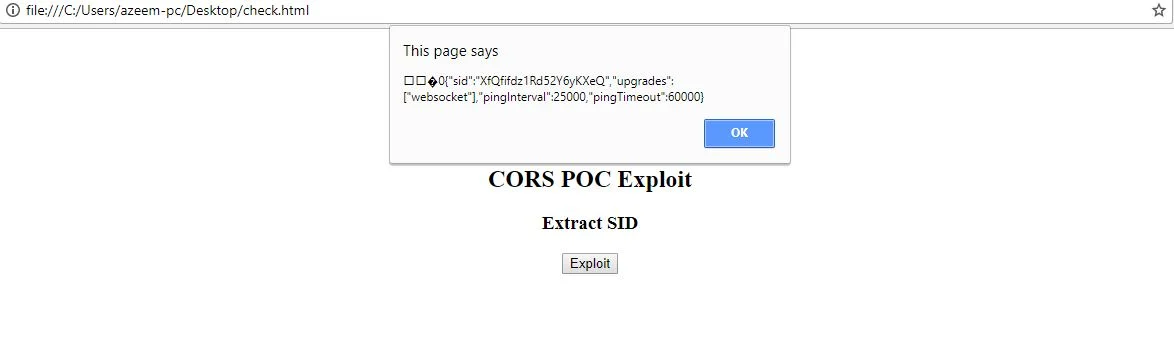
"██████","upgrades":["websocket"],"pingInterval":25000,"pingTimeout":60000
Impact
Take note from request I inject a header Origin: https://evil.com then from response it returns Access-Control-Allow-Origin: https://evil.com, Which mean there is CORS misconfig here.
Attachments
Not written yet. The AI write-up for this report has not been written yet. The Original tab links to the source.
How it worked
Root cause
Likely the server dynamically reflects the Origin header into Access-Control-Allow-Origin without validating it against an allowlist, and also sets Access-Control-Allow-Credentials to true.
Impact
A malicious site could make credentialed cross-origin requests and read responses, potentially carrying out privileged actions and retrieving sensitive information.
What the attacker needed
Victim visits a malicious page; victim is logged in
How it was found
- Send a request to the socket.io endpoint with an Origin header set to an attacker-controlled domain.
- Observe that the response includes Access-Control-Allow-Origin with the same attacker domain and Access-Control-Allow-Credentials: true.
Explained by bugbounty.wiki with AI from the original and checked against quotes from it; it can still be wrong. Read the original before relying on a detail.
Not written yet. The AI write-up for this report has not been written yet. The Original tab links to the source.
CORS lets a site say which other sites may read its responses. Here the site echoed the origin and allowed cookies, so a malicious site may be able to read private data if the victim visits it while logged in.
What is CORS?
A permissive cross-origin policy lets another site read responses with the user's credentials.




