Reflected XSS using Header Injection
The application echoed the Referer header value into its response without proper encoding, allowing an attacker to inject JavaScript. An attacker could craft a request that executes script in a victim's browser within the site's session.

- Triaged in 6 days
- Fixed in 7 days
- Paid in 13 days
- Disclosed after 37 days
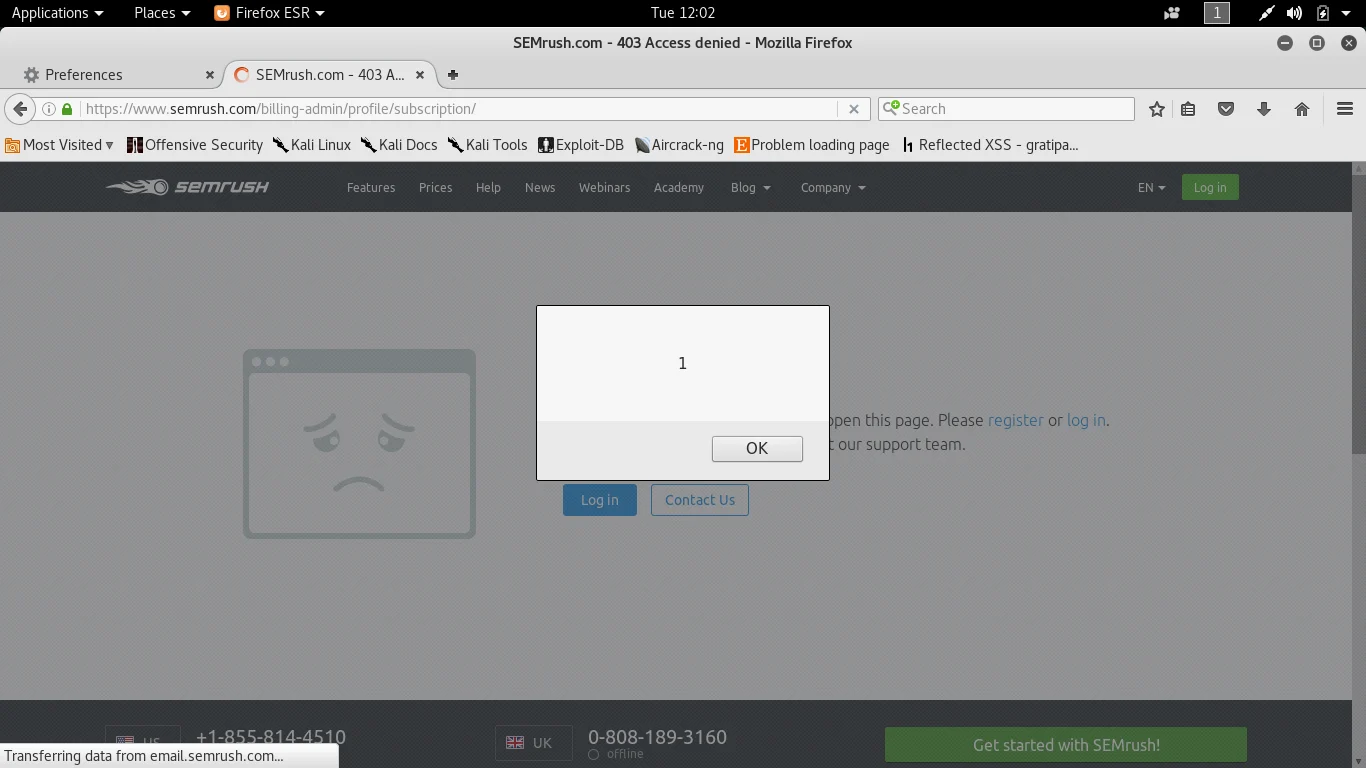
Host : www.semrush.com
Path : /billing-admin/profile/subscription/?l=de
Payload : c5obc'+alert(1)+'p7yd5
Steps to reproduce :
Request Header :
GET /billing-admin/profile/subscription/?l=de HTTP/1.1 Host: www.semrush.com Accept: / Accept-Language: en User-Agent: Mozilla/5.0 (compatible; MSIE 9.0; Windows NT 6.1; Win64; x64; Trident/5.0) Connection: close Referer: http://www.google.com/search?hl=en&q=c5obc'+alert(1)+'p7yd5
Overview :
The payload c5obc'+alert(1)+'p7yd5 was submitted in the Referer HTTP header. Payload is copied from a request and echoed into the application's immediate response in an unsafe way.
Impact
Reflected cross-site scripting vulnerabilities arise when data is copied from a request and echoed into the application's immediate response in an unsafe way. An attacker can use the vulnerability to construct a request that, if issued by another application user, will cause JavaScript code supplied by the attacker to execute within the user's browser in the context of that user's session with the application.
Attachments
Not written yet. The AI write-up for this report has not been written yet. The Original tab links to the source.
How it worked
Impact
An attacker could construct a request that, if issued by another user, would cause attacker-supplied JavaScript to execute in that user's browser within the context of their session with the application.
What the attacker needed
Victim issues a request with the crafted Referer header
Explained by bugbounty.wiki with AI from the original and checked against quotes from it; it can still be wrong. Read the original before relying on a detail.
Not written yet. The AI write-up for this report has not been written yet. The Original tab links to the source.
When you visit a website, your browser sends a 'Referer' header telling the site where you came from. This site took that header value and put it directly into the page without cleaning it. That means an attacker could make a link that, when clicked, runs malicious JavaScript in the victim's browser as if it came from the site itself.
What is XSS?
Script an attacker supplies runs in another user's browser, on the target's origin, with that user's session.





