Cross-site Scripting (XSS) possible at https://sifchain.finance// via CVE-2019-8331 exploitation
The site uses an outdated version of the Bootstrap JavaScript library (4.0.0) that is known to be vulnerable to cross-site scripting through the data-template, data-content and data-title attributes of tooltips and popovers. An attacker could exploit this to run malicious script in a victim's browser, though the report does not demonstrate a working exploit on this specific site.
 Originally disclosed on HackerOne
- Disclosed after 16 days
Summary:
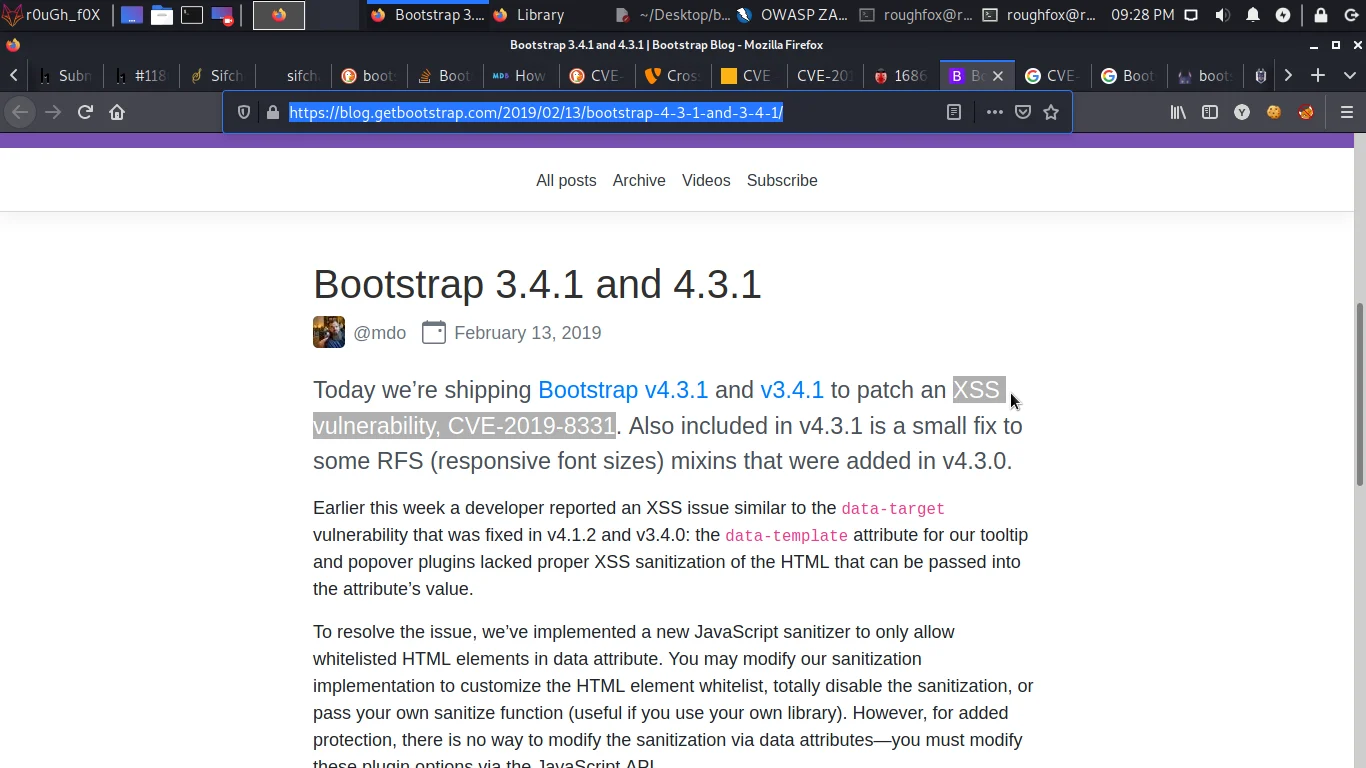
https://sifchain.finance is using Bootstrap framework version 4.0.0 which is <3.4.1 || >=4.0.0 <4.3.1 . In Bootstrap before 3.4.1 and 4.3.x before 4.3.1, cross-site scripting is possible in the tooltip or popover data-template attribute.
Steps To Reproduce:
Affected versions of Bootstrap package are vulnerable to Cross-site Scripting (XSS) in data-template, data-content and data-title properties of tooltip/popover.
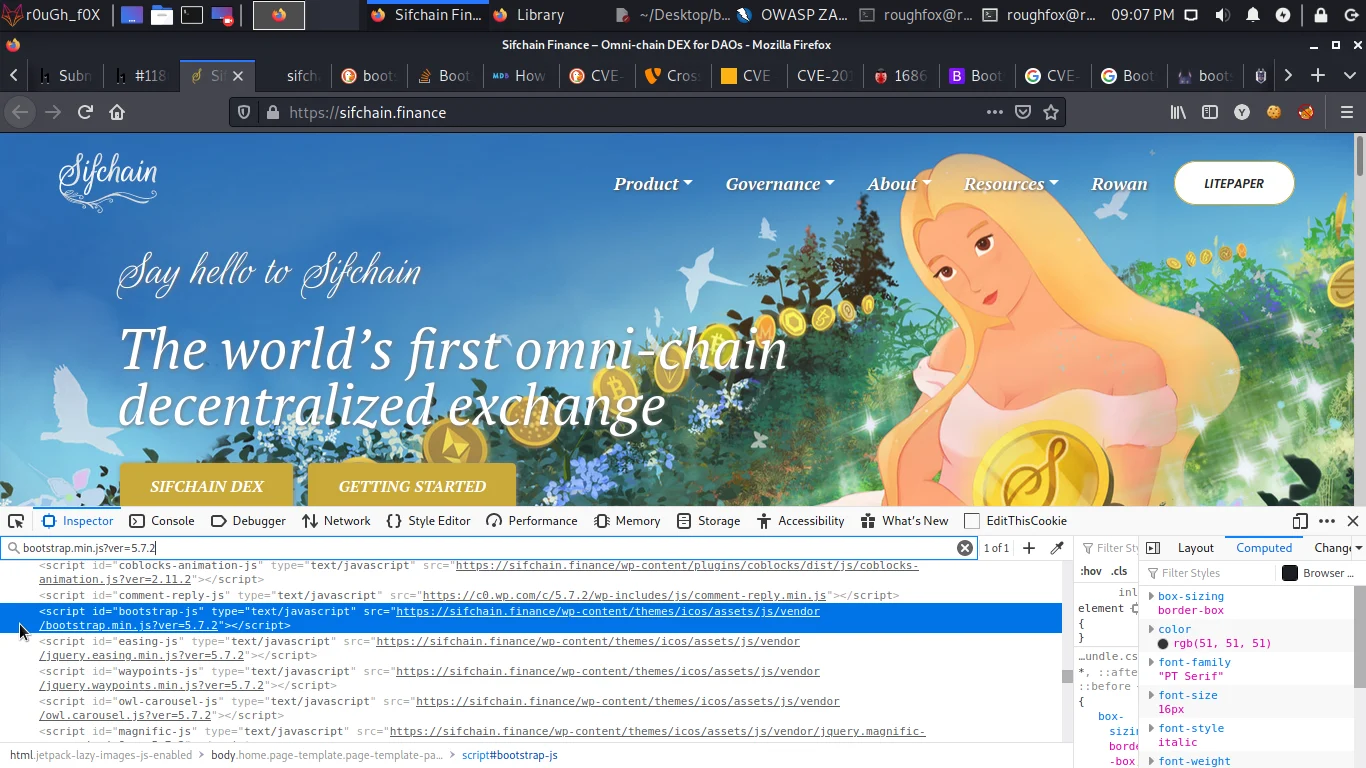
- Inspect Home Page (https://sifchain.finance)
- Search for bootstrap.min.js
- You'll find <script type="text/javascript" src="https://sifchain.finance/wp-content/themes/icos/assets/js/vendor/bootstrap.min.js?ver=5.7.2" id="bootstrap-js"></script>
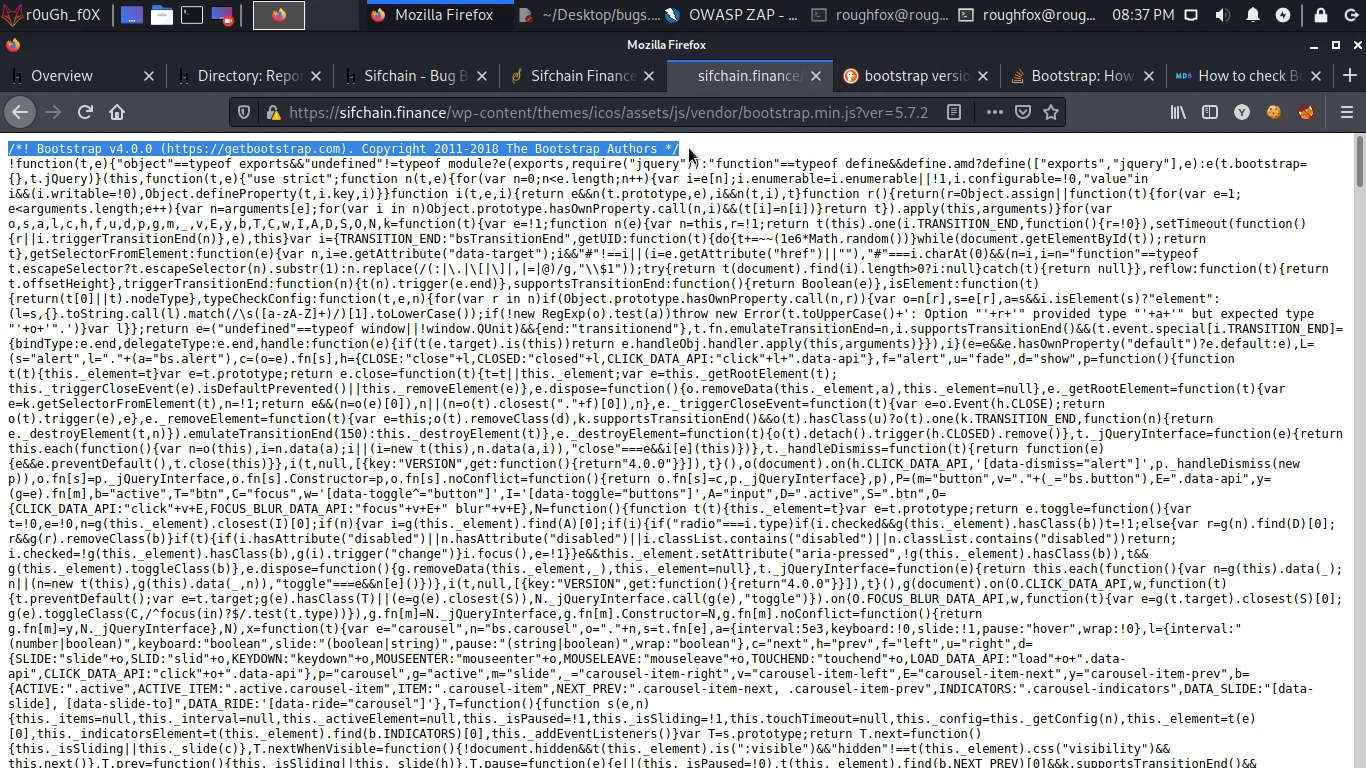
- Visit https://sifchain.finance/wp-content/themes/icos/assets/js/vendor/bootstrap.min.js?ver=5.7.2
- You'll get the Bootstrap Version, Which is v4.0.0 and its vulnerable to Cross-site Scripting (XSS)
##Details about Bug: A cross-site scripting attack occurs when the attacker tricks a legitimate web-based application or site to accept a request as originating from a trusted source.
This is done by escaping the context of the web application; the web application then delivers that data to its users along with other trusted dynamic content, without validating it. The browser unknowingly executes malicious script on the client side (through client-side languages; usually JavaScript or HTML) in order to perform actions that are otherwise typically blocked by the browser’s Same Origin Policy.
Injecting malicious code is the most prevalent manner by which XSS is exploited; for this reason, escaping characters in order to prevent this manipulation is the top method for securing code against this vulnerability.
Escaping means that the application is coded to mark key characters, and particularly key characters included in user input, to prevent those characters from being interpreted in a dangerous context. For example, in HTML, < can be coded as < and > can be coded as > in order to be interpreted and displayed as themselves in text, while within the code itself, they are used for HTML tags. If malicious content is injected into an application that escapes special characters and that malicious content uses < and > as HTML tags, those characters are nonetheless not interpreted as HTML tags by the browser if they’ve been correctly escaped in the application code and in this way the attempted attack is diverted.
The most prominent use of XSS is to steal cookies (source: OWASP HttpOnly) and hijack user sessions, but XSS exploits have been used to expose sensitive information, enable access to privileged services and functionality and deliver malware.
##Types of attacks: There are a few methods by which XSS can be manipulated: -Stored Xss -Reflected Xss -DOM-based Xss -Mutated Xss
##Affected environments: The following environments are susceptible to an XSS attack: -Web servers -Application servers -Web application environments
Supporting Material/References:
2)Cvedetails : https://www.cvedetails.com/cve/CVE-2019-8331/ 3) Snyk Vulnerability Database: https://snyk.io/vuln/SNYK-JS-BOOTSTRAP-173700 4) Red Hat Bugzilla: https://bugzilla.redhat.com/show_bug.cgi?id=1686454
Prevention:
This section describes the top best practices designed to specifically protect your code: -Sanitize data input in an HTTP request before reflecting it back, ensuring all data is validated, filtered or escaped before echoing anything back to the user, such as the values of query parameters during searches. -Convert special characters such as ?, &, /, <, > and spaces to their respective HTML or URL encoded equivalents. -Give users the option to disable client-side scripts. -Redirect invalid requests. -Detect simultaneous logins, including those from two separate IP addresses, and invalidate those sessions. -Use and enforce a Content Security Policy (source: Wikipedia) to disable any features that might be manipulated for an XSS attack. -Read the documentation for any of the libraries referenced in your code to understand which elements allow for embedded HTML.
##Remediation: Upgrade bootstrap to version 3.4.1, 4.3.1 or higher.
Impact
- The malicious code is inserted in the application (usually as a link) by the attacker. The code is activated every time a user clicks the link. [Stored XSS]
- The attacker delivers a malicious link externally from the vulnerable web site application to a user. When clicked, malicious code is sent to the vulnerable web site, which reflects the attack back to the user’s browser. [Reflected XSS]
- The attacker forces the user’s browser to render a malicious page. The data in the page itself delivers the cross-site scripting data. [DOM-based]
- The attacker injects code that appears safe, but is then rewritten and modified by the browser, while parsing the markup. An example is rebalancing unclosed quotation marks or even adding quotation marks to unquoted parameters. [Mutated]
Attachments
Not written yet. The AI write-up for this report has not been written yet. The Original tab links to the source.
How it worked
Root cause
Likely the site includes a vulnerable version of the Bootstrap JavaScript library (4.0.0) that does not properly sanitise the data-template, data-content and data-title attributes used by tooltips and popovers.
Impact
If an attacker can control the content passed to a tooltip or popover, they could run script in a visitor's browser, potentially stealing cookies or hijacking a session; the report does not show such an attack working on this site.
What the attacker needed
Attacker can control tooltip/popover attributes; victim visits a page with the crafted content
The fix
The site should upgrade Bootstrap to version 3.4.1, 4.3.1 or later.
How it was found
- Inspect the home page and look for the Bootstrap script file.
- Open the Bootstrap script file directly in the browser.
- Read the version number shown in the file, which is 4.0.0.
Explained by bugbounty.wiki with AI from the original and checked against quotes from it; it can still be wrong. Read the original before relying on a detail.
Not written yet. The AI write-up for this report has not been written yet. The Original tab links to the source.
The website loads an old version of a common design toolkit called Bootstrap. That old version has a known flaw: if a page puts certain content into tooltips or pop-up boxes, a script hidden in that content can run in the visitor's browser. The report only checks the version number; it does not show a real attack working on this site.
What is XSS?
Script an attacker supplies runs in another user's browser, on the target's origin, with that user's session.




