flash content type sniff vulnerability in api.slack.com
A Flash content-type sniffing vulnerability on api.slack.com could allow an attacker to read a user's team authentication tokens from a page that lists them. The attacker could then use those tokens to perform CSRF attacks.

- Triaged in 2 days
- Fixed in 2 days
- Paid in 2 days
- Disclosed after 32 days
Hi,
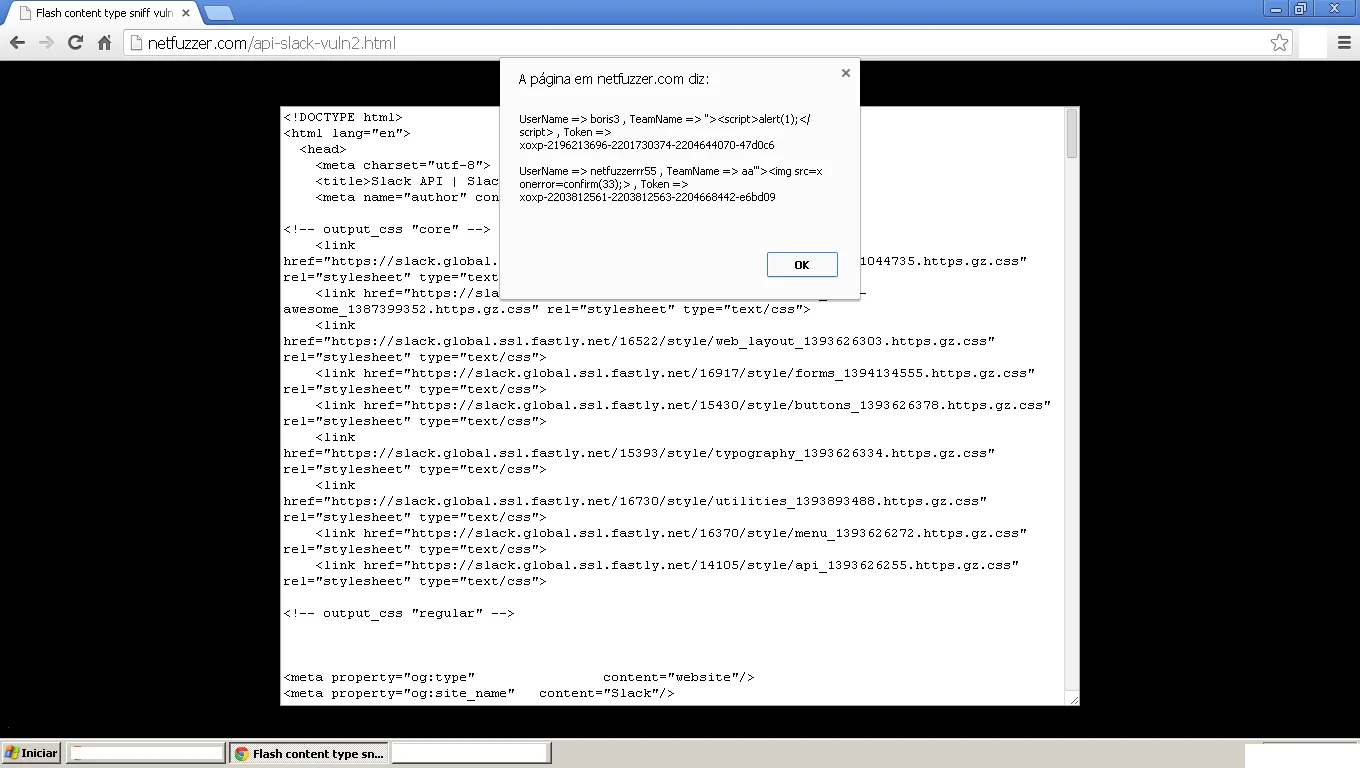
I have found a flash content type sniff vulnerability could allow attackers get user's team auth2 tokens. As the page lists user's teams and its security tokens, this could allow attackers to do csrf attacks.
Steps to reproduce:
- Log in api.slack.com
- after go to http://netfuzzer.com/api-slack-vuln2.html
- wait 5 seconds until the page finish load
- see your team's security tokens.
Cheers, Mario
Attachments
Not written yet. The AI write-up for this report has not been written yet. The Original tab links to the source.
How it worked
Root cause
Likely the server served user-supplied content without a correct Content-Type header or with a type that Flash could sniff, allowing a malicious Flash file to read cross-origin responses.
Impact
An attacker could obtain a user's team authentication tokens and use them to perform CSRF attacks, but the report does not show a full account takeover.
What the attacker needed
Victim is logged in to api.slack.com; victim visits attacker page
How it was found
- Log in to api.slack.com.
- Visit the attacker's test page.
- Wait for the page to finish loading.
- Observe the team's security tokens displayed.
Explained by bugbounty.wiki with AI from the original and checked against quotes from it; it can still be wrong. Read the original before relying on a detail.
Not written yet. The AI write-up for this report has not been written yet. The Original tab links to the source.
If a site mishandles file types, a malicious Flash file may read data from another page. Here that data included team security tokens, which could enable CSRF attacks.
What is CSRF?
Another site makes a signed-in user's browser perform an action they did not intend.


