Bitmoji source code is accessible
The Bitmoji rendering service exposed directory listings and allowed access to .class and .jar files under /WEB-INF/ and /META-INF/, despite the top-level site returning 403 Forbidden. An attacker could download these files and decompile them to obtain the service's source code.

- Triaged in 26 hours
- Fixed in 5 days
- Paid in 2 days
- Disclosed after 3.6 years
Summary by the program
The Bitmoji rendering service provided directory listings and access to .jar and .class files in some of those directories. Although the top level site returned a 403 Forbidden, the access control check was not present on subpaths, allowing directory listings, notably at /WEB-INF/ and /META-INF/.
While not arbitrary file system access on the rendering service, it did provide a directory listing and access to some sensitive files. We thank the reporter for pointing us to this issue.
The report
hi team,
I'm starting my research on snapchat by scanning all sub-domains on all the domains in-scope: snapchat.com, bitmoji.com, etc.
Let's look at one of the urls, https://rendering-service.prod.us-east.bitstrips.com/
When I request GET https://rendering-service.prod.us-east.bitstrips.com/
The response is 403 Forbidden
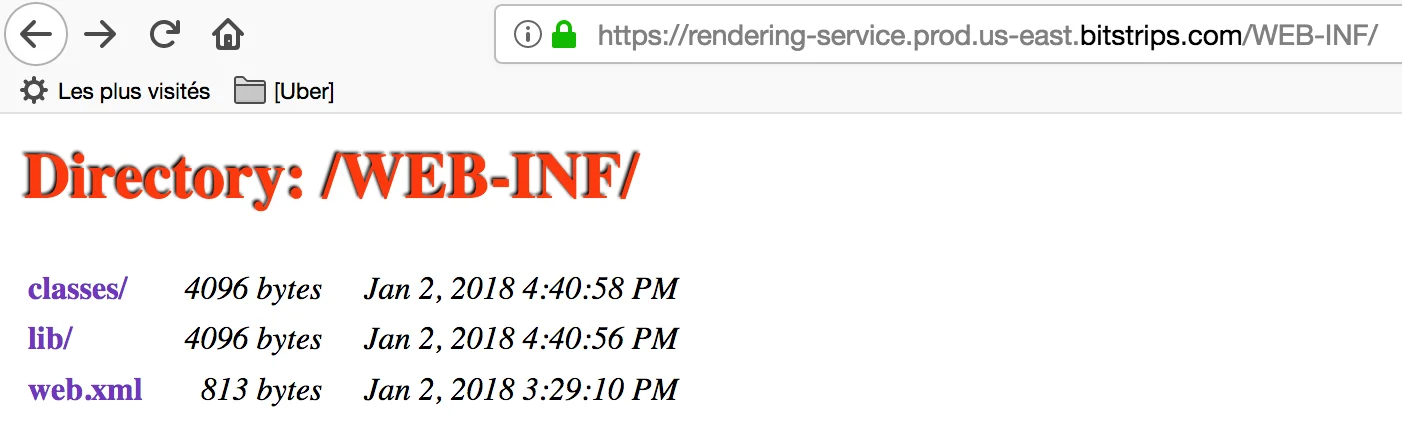
After searching, I've found /WEB-INF/ & /META-INF/ directories, which are accessibles and allow directory listing.
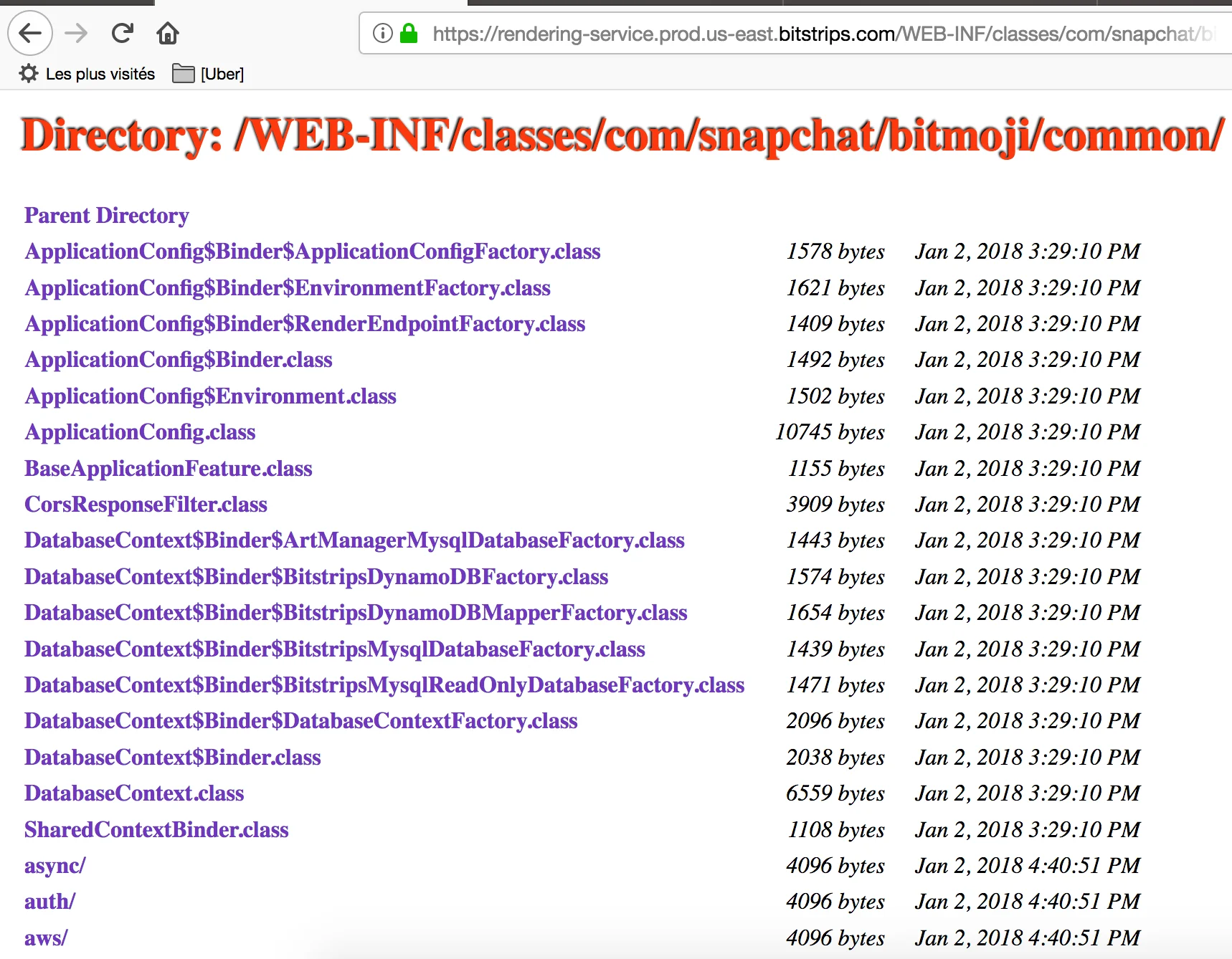
Inside /WEB-INF/ we have all the .class files of bitmoji, we can download all the files.
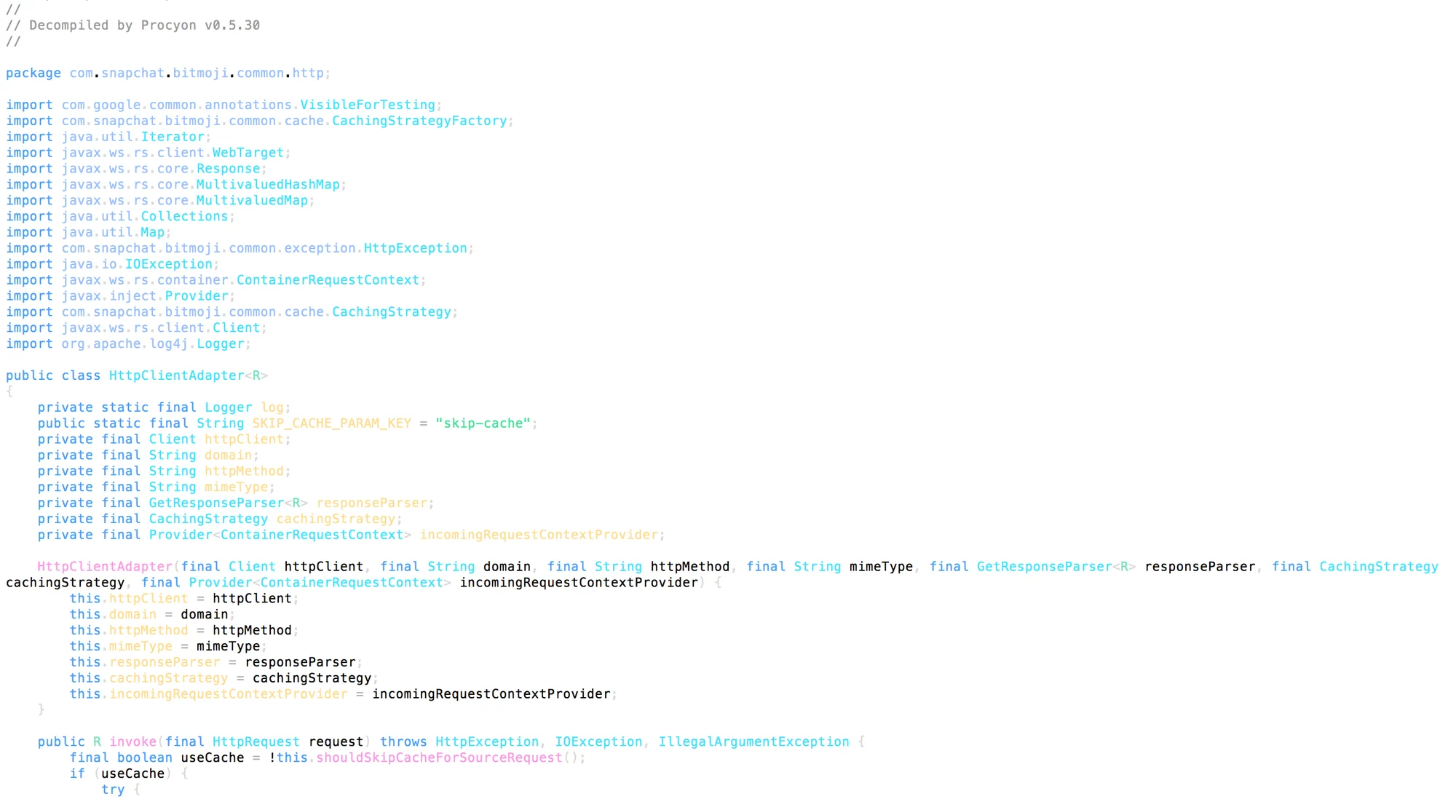
Then by using a java decompiler such as procyon-decompiler we reverse the .class files to make those readable.
best, hermès.
Impact
Source code leaked
Attachments
Context
Bitmoji is Snapchat's avatar product, and the report concerns the Bitmoji rendering service, which serves the assets used to render Bitmoji images. The host in question is rendering-service.prod.us-east.bitstrips.com, part of the bitstrips.com estate that sits alongside snapchat.com and bitmoji.com in the program's scope.
The service is a Java web application: the directories the researcher reached contain .class files and the conventional /WEB-INF/ and /META-INF/ folders of a Java servlet deployment. The program's own summary describes the outcome as directory listings plus access to .jar and .class files in some of those directories.
Setup
The researcher began by enumerating subdomains across every in-scope domain (snapchat.com, bitmoji.com and the rest), which is how the rendering-service host surfaced. No accounts, roles or special configuration are described. The only tool named in the report is a Java decompiler, procyon-decompiler, used after the files were downloaded.
Finding it
Requesting the root of the host returns an access denial:
GET https://rendering-service.prod.us-east.bitstrips.com/
The response is 403 Forbidden. On its own that looks like a correctly locked-down application, but the researcher kept looking and found two paths underneath it that behaved differently: /WEB-INF/ and /META-INF/. Both were reachable and both returned directory listings.
That contrast is the whole signal: the top-level path is denied, yet subpaths of the same application are served. The access check exists, but it is not applied to everything it should cover.
Exploitation
Step 1: confirm the root is denied
GET https://rendering-service.prod.us-east.bitstrips.com/
This returns 403 Forbidden, establishing that some form of access control is in place at the top level.
Step 2: request the Java metadata directories
The researcher found the two standard Java web application directories:
Both were accessible and allowed directory listing. The report includes three screenshots as attachments.
Step 3: download the class files
Inside /WEB-INF/ were the .class files of Bitmoji, and all of them could be downloaded. The report does not enumerate individual file names.
Step 4: decompile
With the compiled classes in hand, the researcher ran them through a Java decompiler:
procyon-decompiler
This turns the .class files back into readable Java source.
Root cause
The program's summary is explicit about the mechanism: the top level site returned 403 Forbidden, but the access control check was not present on subpaths. The access control check was not present on subpaths, so /WEB-INF/ and /META-INF/ were accessible and allowed directory listing.
/WEB-INF/ and /META-INF/ are not meant to be reachable from the web at all; a servlet container normally blocks them. Here they were reachable, and the access control check was not present on subpaths. The report does not describe the specific configuration responsible.
Impact
The report states the impact plainly: source code leaked. The program's summary is more careful, noting that this was not arbitrary file system access on the rendering service, but that it did provide a directory listing and access to some sensitive files. The program's summary notes it was not arbitrary file system access, but did provide a directory listing and access to some sensitive files.
Fix
The report does not describe the remediation that was applied.
Variants to test
- Request
/WEB-INF/and/META-INF/directly on any Java application you find. A positive result is a directory listing. - Compare the root path with subpaths of the same host. If
/is denied but/anything/is not, the check is path-scoped and worth pushing on.
Hunting notes
This bug came out of plain subdomain enumeration across every in-scope domain, followed by requesting each host. The signal to watch for is an inconsistency: a 403 at the root of a host that nonetheless serves content on paths beneath it.
On Java targets, /WEB-INF/ and /META-INF/ are the first paths to try, because they hold configuration and compiled classes and should never be web-reachable. The researcher downloaded the classes and decompiled them with procyon-decompiler.
What happened, in plain words
Snapchat makes Bitmoji, the little cartoon avatars people use in messages. To draw those avatars, Snapchat runs a separate computer (a server) called the Bitmoji rendering service. It is the Bitmoji rendering service.
A security researcher was looking at Snapchat's websites to see what was publicly reachable. He found this rendering server while scanning subdomains. If you asked the server for its front page, it said no: 403 Forbidden, which is the web's way of saying "you are not allowed in here". But if you asked for two particular folders underneath that front page, the server happily answered and showed you a list of the files inside them. Those folders, /WEB-INF/ and /META-INF/, are internal parts of a Java web application and are never supposed to be visible from the internet.
Inside one of them were the compiled program files of Bitmoji. The researcher downloaded them and used a tool to turn them back into readable source code. In other words, the inner workings of the Bitmoji service leaked.
This article walks through the same steps the researcher took, explaining each idea from scratch along the way.
Some background you need first
What a server and a URL are
When you type an address into your browser, you are asking a computer somewhere else for something. That computer is a server, and the address is a URL. A URL has parts:
- The host, the machine you are talking to, for example
rendering-service.prod.us-east.bitstrips.com. - The path, the specific thing you want on that machine, for example
/WEB-INF/. The path starts with a slash and can have several folders in it, like folders on your own computer.
A useful comparison: the host is an office building's address, and the path is which room inside you are asking for. The front desk (the server) decides whether to let you into each room.
What a subdomain is
Big companies own a main domain, like snapchat.com. They put services on subdomains, which are names that sit in front of the main domain, such as rendering-service.prod.us-east.bitstrips.com. Each subdomain can be a completely different machine running a completely different program. Finding all the subdomains a company owns is therefore a standard first step when you want to know what a company exposes to the internet. This process is called subdomain enumeration.
What a Java web application is, and what WEB-INF and META-INF are
Java is a programming language. When a Java program is prepared for a server, it is compiled: the human-readable source code is translated into files ending in .class, which the computer can run but people cannot easily read. A Java web application is usually packaged as a .war or .jar file, which is really just a zip archive with a fixed layout. Two folders in that layout are special:
/WEB-INF/holds the application's own compiled classes and configuration. It is the private back room of the application./META-INF/holds metadata about the package, again internal.
The people who wrote the Java server software (the servlet container) deliberately block web visitors from reaching these two folders, because they contain internals, not public pages. If they are reachable, something is misconfigured.
What a directory listing is
Web servers usually serve one specific file per request. But many servers have a convenience feature: if you ask for a folder and there is no index page inside it, the server shows you a list of the files in that folder, like opening a drawer and seeing everything in it. That is a directory listing. It is convenient for developers and dangerous in production, because it tells a stranger exactly what files exist and lets them download each one. The vulnerability class here is called Information Exposure Through Directory Listing.
What a decompiler is
A .class file is compiled code. A decompiler is a tool that takes compiled code and tries to reconstruct readable source code from it. It is not perfect, but it gets close enough that a person can read the logic. So a leaked .class file is not a harmless blob: with a decompiler it becomes the program's source code.
The researcher's steps
Step 1: find the hosts
The researcher started by scanning all subdomains of every domain in the program's scope: snapchat.com, bitmoji.com and the others. The goal was simply to build a list of every machine Snapchat exposes. One of the results was this host:
https://rendering-service.prod.us-east.bitstrips.com/
Line by line: https means the connection is encrypted; the host is the Bitmoji rendering server; the trailing / means the front page, the root path.
Step 2: ask for the front page
The first thing to do with any host is ask it for its front page and see what it says. The researcher sent this request:
GET https://rendering-service.prod.us-east.bitstrips.com/
Line by line: GET is the HTTP method meaning "give me this thing". The rest is the URL. The server's answer was 403 Forbidden, meaning access denied. On its own, that looks like a well-locked door, and many people would stop here.
Step 3: look underneath the front page
This is the key insight. A 403 on the front page only tells you the front page is protected. It says nothing about the folders underneath. The researcher found two standard Java folders:
Line by line: the first line asks for the private application folder, the second for the metadata folder. Both were accessible and allowed directory listing. The report includes three screenshots as attachments.
The contrast is the whole bug: the front door is locked, but the side doors are wide open. The access check exists, but it was only applied to the front page, not to the paths beneath it.
Step 4: download the class files
Inside /WEB-INF/ were the .class files of Bitmoji, and all of them could be downloaded. The report does not list the individual file names. Think of it as finding the back room unlocked and being able to carry out every box in it.
Step 5: turn the compiled files back into source
Compiled files are not readable by a person, so the researcher used a Java decompiler called procyon-decompiler:
procyon-decompiler
Line by line: this is a command-line tool. You give it the .class files you downloaded, and it produces readable Java source code from them. This step turns the .class files back into readable Java source.
Why it happened
The program's own summary explains the mechanism: the top level site returned 403 Forbidden, but the access control check was not present on subpaths. The access control check was not present on subpaths. The server's default behaviour of showing directory listings then did the rest, revealing the contents of /WEB-INF/ and /META-INF/. Those two folders should never be reachable from the web at all; normally the Java server software blocks them. Here it did not, and the access control check was not present on subpaths. The report does not describe the specific configuration responsible.
What the impact was
The report states the impact plainly: source code leaked. The program's summary is more careful, noting that this was not arbitrary file system access on the rendering service, but that it did provide a directory listing and access to some sensitive files. The program's summary notes it was not arbitrary file system access, but did provide a directory listing and access to some sensitive files. In plain terms: it was not arbitrary file system access, but some sensitive files were exposed.
How to fix it
The report does not describe the remediation that was applied.
Things to try on other targets
- Request
/WEB-INF/and/META-INF/directly on any Java application you find. A positive result is a directory listing. - Compare the root path with subpaths of the same host. If
/is denied but/anything/is not, the check is path-scoped and worth pushing on.
Notes for beginners
This bug came out of plain subdomain enumeration across every in-scope domain, followed by requesting each host. The signal to watch for is an inconsistency: a 403 at the root of a host that nonetheless serves content on paths beneath it.
On Java targets, /WEB-INF/ and /META-INF/ are the first paths to try, because they hold configuration and compiled classes and should never be web-reachable. The researcher downloaded the classes and decompiled them with procyon-decompiler.
Glossary
- Server: a computer that answers requests from other computers over the internet.
- URL: the address of something on the web, made of a host and a path.
- Host: the machine part of a URL, for example
rendering-service.prod.us-east.bitstrips.com. - Path: the part of a URL after the host that names a folder or file, for example
/WEB-INF/. - Domain: a name a company owns, like
snapchat.com. - Subdomain: a name in front of a domain that points to a separate service, like
rendering-service.prod.us-east.bitstrips.com. - Subdomain enumeration: the process of finding all the subdomains a company owns.
- HTTP: the language browsers and servers use to talk to each other.
- GET: the HTTP method meaning "give me this thing".
- 403 Forbidden: the server's answer meaning access denied.
- 200: the server's answer meaning success, here is the content.
- Java: a programming language used to build many web applications.
- Compiled code /
.classfile: a program translated into a form the computer runs, not easily read by people. .jarfile: a packaged Java application, essentially a zip archive with a fixed layout.- Servlet container: the Java server software that runs a Java web application and normally blocks access to its internal folders.
/WEB-INF/: the private folder of a Java web application holding its compiled classes and configuration./META-INF/: the folder holding metadata about a Java package.- Directory listing: a server feature that shows a list of the files in a folder when no index page is present.
- Information Exposure Through Directory Listing: the vulnerability class where such a listing reveals files that should not be public.
- Decompiler: a tool that turns compiled code back into readable source code.
procyon-decompiler: the Java decompiler the researcher used.- Access control: the rules deciding who may reach which part of a service.
- Path-scoped check: an access check that only covers one path, such as the root, instead of the whole application.
- Bounty: a payment a company makes to a researcher who reports a valid security issue.
- Severity: a rating of how serious a security issue is.




