CRLF injection on www.starbucks.com
An endpoint on the Starbucks website reflected unescaped carriage-return and line-feed characters from a URL parameter into the HTTP response headers. An attacker could inject arbitrary headers and split the response, potentially stealing authenticated data via injected CORS headers or causing denial of service with oversized cookies.

- Triaged in 3 days
- Fixed in 4 months
- Paid in 3 days
- Disclosed after 4 months
Summary by the program
x3n0nn3p discovered the endpoint at www.starbucks.com/email-prospectt was affected by a CRLF injection / HTTP response splitting issue.
@x3n0nn3p — thank you for reporting this vulnerability and for confirming the resolution.
The report
The vulnerability allows setting arbitrary headers, and also enables response splitting which can then be exploited further.
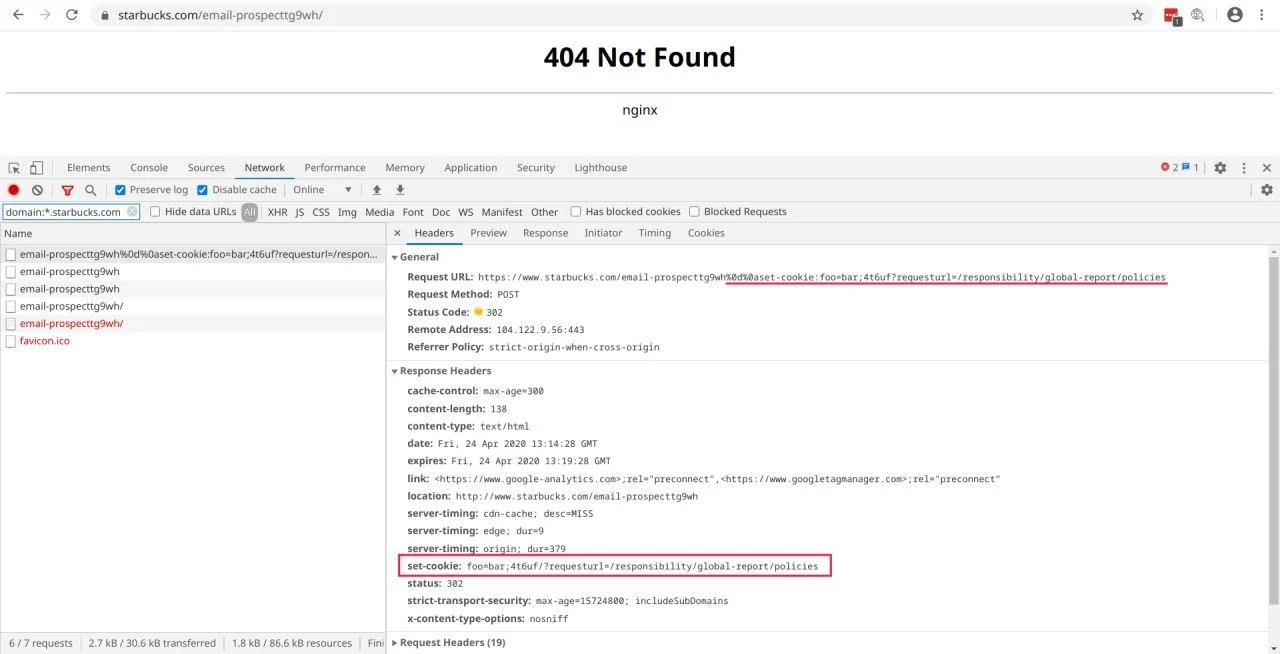
POC: curl -i 'https://www.starbucks.com/email-prospecttg9wh%0d%0aset-cookie:foo%0d%0a%0d%0a4t6uf?requesturl=/responsibility/global-report/policies' -d 'newsletter_signup_email=&newsletter_signup_zipcode=&newsletter_placement=footer' --http1.1
Screenshot Attached.
Regards
Impact
Impact
Possible impacts include;
- Stealing authenticated information via Ajax request with injected CORS headers
- Application DOS using overly long Cookies, etc.
Attachments
Not written yet. The AI write-up for this report has not been written yet. The Original tab links to the source.
How it worked
Root cause
Likely the endpoint copied a user-supplied URL parameter into the HTTP response headers without stripping carriage-return and line-feed characters, allowing header injection and response splitting.
Impact
An attacker could inject arbitrary response headers and split responses, which may allow stealing authenticated information through Ajax requests with injected CORS headers or cause denial of service using overly long cookies.
What the attacker needed
Endpoint reflects a URL parameter
The fix
The reporter confirmed the issue was resolved, though the report does not describe the fix.
Explained by bugbounty.wiki with AI from the original and checked against quotes from it; it can still be wrong. Read the original before relying on a detail.
Not written yet. The AI write-up for this report has not been written yet. The Original tab links to the source.
When a web server sends a page back, it first sends hidden 'headers' that tell the browser things like what type of content follows and what cookies to store. If a site copies part of the web address into those headers without cleaning it, an attacker can sneak in extra line breaks and add their own headers. Here the researcher showed that adding special encoded line-break characters to a URL parameter let them inject a cookie header of their choosing.
What is Smuggling / CRLF?
A front end and a back end split one connection's bytes into requests differently, letting an attacker hide a request inside another user's.




