Reflected Cross site Scripting (XSS) on www.starbucks.com
The sign-in page's ReturnUrl parameter was reflected into the page without proper escaping, so a crafted link could run script in the victim's browser after they logged in. An attacker could use this to execute JavaScript in the context of the victim's Starbucks account.

- Triaged in 11 hours
- Fixed in 4 months
- Paid in 14 days
- Disclosed after 4 months
Summary: Reflected Cross site Scripting (XSS) on https://www.starbucks.com/account/signin?ReturnUrl
Description: The attacker can execute javascript on the victims account just after the authentication process.
Platform(s) Affected: www.starbucks.com www.starbucks.ca www.starbucks.com.br www.starbucks.co.uk www.starbucks.de www.starbucks.fr
Steps To Reproduce:
- Open the url: https://www.starbucks.com/account/signin?ReturnUrl=%19Jav%09asc%09ript%3ahttps%20%3a%2f%2fwww%2estarbucks%2ecom%2f%250Aalert%2528document.domain%2529
- Login
- The JS will execute on users(victims) account.
Supporting Material/References:
Screenshot:
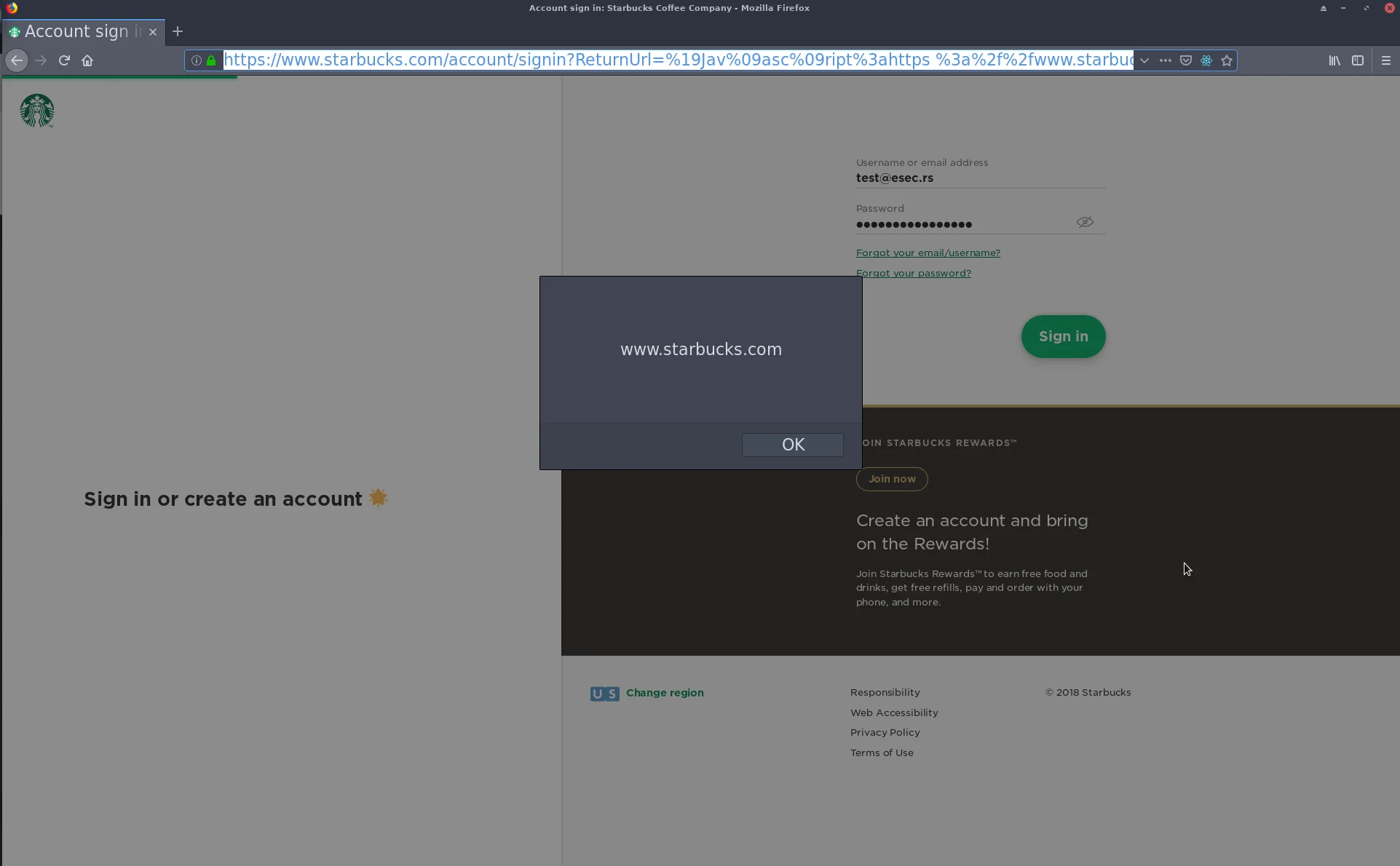
How can the system be exploited with this bug?
The attacker can execute JS code.
How did you come across this bug ?
I was testing for open redirect vulnerability.
Recommendations for fix
Content based escaping on the users input, in this case the redirect parameter.
Impact
The attacker can execute JS code.
Not written yet. The AI write-up for this report has not been written yet. The Original tab links to the source.
How it worked
Root cause
Likely the ReturnUrl parameter was reflected into the page without content-based escaping, allowing a javascript: value to be executed.
Impact
An attacker could execute JavaScript in the victim's account after authentication, though the report gives no further detail on what that script could achieve.
What the attacker needed
Victim clicks a crafted link; victim logs in
How it was found
- Open the crafted sign-in URL containing the manipulated ReturnUrl value.
- Log in to the account.
- The injected JavaScript runs in the victim's account.
Explained by bugbounty.wiki with AI from the original and checked against quotes from it; it can still be wrong. Read the original before relying on a detail.
Not written yet. The AI write-up for this report has not been written yet. The Original tab links to the source.
When you sign in, the site can send you back to a page you asked for using a value in the web address. Here that value was placed into the page without being made safe, so a link could carry hidden code that the browser runs. That lets an attacker run their own code as if it were part of the Starbucks site.
What is XSS?
Script an attacker supplies runs in another user's browser, on the target's origin, with that user's session.