PII at Your Fingertips: How I Stumbled Upon an Easy-to-Find Data Leakage Vulnerability @ Swisscom
An API endpoint used by a chat feature returned all users' first names, last names and email addresses, even though individual profile pages returned null values. An attacker could enumerate the user list and harvest personal data.
 Published on medium.com
This write up showcases a PII leakage vulnerability that was found back in May this year. The vulnerability was fixed by Swisscom.
The full write-up lives on its author's site
It belongs to its author, so we link to it rather than copy it. The other two tabs are our own rewrites, checked against it.
Context
Swisscom runs a public bug bounty programme, and this write-up covers a PII leakage found in May 2023 on a domain that was not part of the programme's published scope at the time. The application is a football prediction game under Swisscom's Blue TV brand, which the author describes as covering Blue Cinema, Blue Plus, Blue News and related services. In the application, users create teams, predict match scores, share football related news, and the top teams are offered Champions League tickets.
The relevant feature is chat. Players can chat with each other even when they are not in the same team. A "Start chat with a player" button opens a dialog that lets a user search for players and start a conversation with them.
Setup
The author did not use any special account or role beyond browsing the application as a normal user: signing up and in, placing a post, and joining or creating teams. The tools involved were:
- BrokenLinkHijacker, slightly modified to print unique (sub)domains.
- A custom Python script relying on imgkit to take screenshots of running applications.
- Burp Suite, used to browse the application and inspect its traffic.
The precondition for the finding was simply that the affected domain was reachable and running the application, even though it was not listed in the programme's scope.
Finding it
The recon started from Swisscom's root domain, swisscom.ch, which was passed to BrokenLinkHijacker to look for broken links that could be hijacked:
➜ BrokenLinkHijacker git:(main) ✗ python3 BLH.py https://swisscom.ch -d 3
After collecting the discovered (sub)domains, the author ran the imgkit-based script to screenshot the running applications. One screenshot stood out: an application under the Blue TV brand.
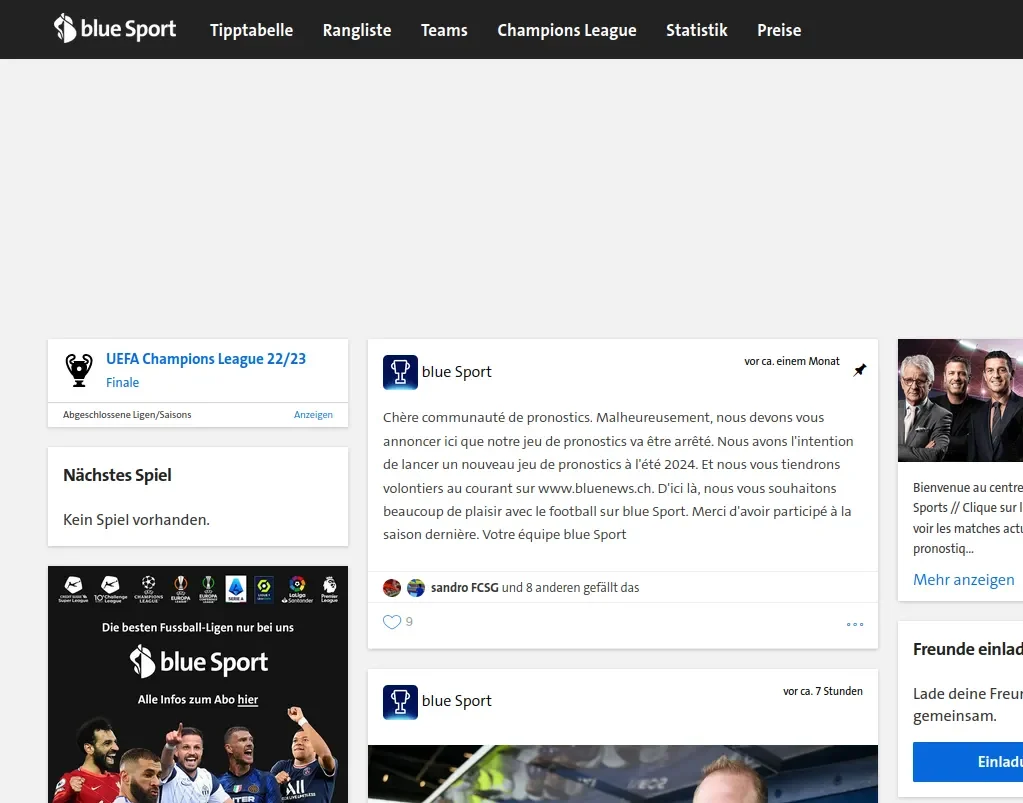
That domain was not included in the in-scope bug bounty domains listed at https://github.com/swisscom/bugbounty/tree/main/scope. The author opened Burp Suite and browsed the application as a normal user, going through every feature: signing up and in, placing a post, and joining or creating teams.
While exploring the chat feature, clicking the "Start chat with a player" button opened a dialog that allowed searching for players and starting a chat with them.
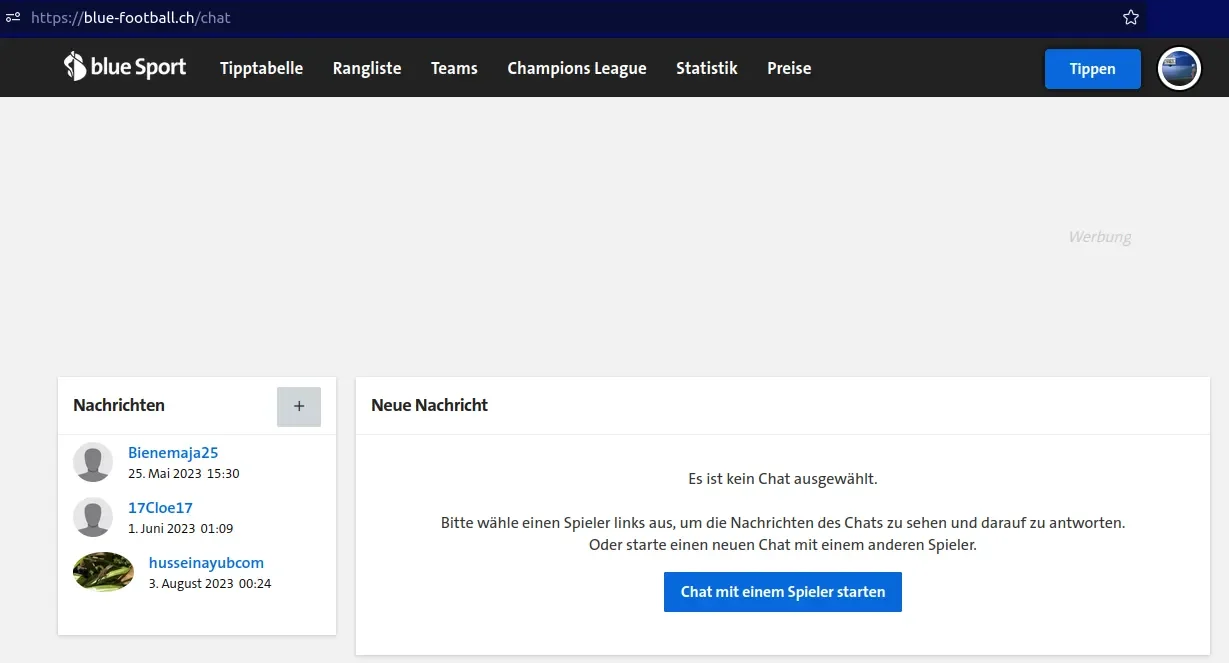
That dialog triggered an API call to the following endpoint:
api/users/listing?limit=20&page=1
The response returned all users' details, including first name, last name and email address.
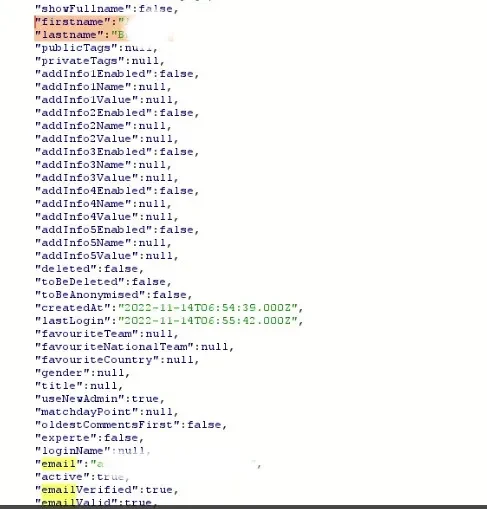
What made this clearly wrong was the contrast with the profile view: visiting a user's profile directly returned the JSON values as null. So the profile endpoint was careful about what it exposed, while the listing endpoint used by the chat search was not.
Exploitation
Step 1: Reach the chat search
As a normal authenticated user, open the chat feature and click "Start chat with a player". This opens the player search dialog.
Step 2: Trigger the listing request
The search dialog issues a request to the listing endpoint:
api/users/listing?limit=20&page=1
The response contains user records with first name, last name and email address.
Step 3: Confirm the exposure
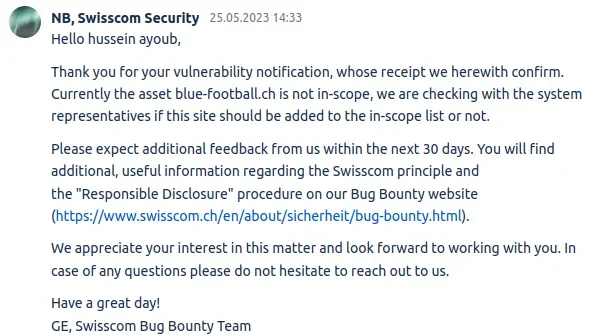
The author built a proof of concept and sent the details to Swisscom's security team. They validated the issue promptly and added the affected domain to the programme's scope.
Root cause
The listing endpoint behind the chat player search returned full user records, including first name, last name and email address, to any user who could open the dialog. The profile endpoint, by contrast, returned those JSON values as null, so the protection existed in one place but not in the other.
Impact
Any user who could open the chat player search received first names, last names and email addresses. The report does not describe rate limiting or any other barrier to enumeration. The author does not claim access to passwords or other account secrets.
Fix
Swisscom fixed the issue; the report does not describe the code change.
Variants to test
- Search and listing endpoints on other targets. Trigger autocomplete or player search features and inspect the JSON. A positive result is a response containing email addresses, names or other fields the UI never displays.
- Compare listing against detail views. Request a user's profile and the listing that feeds a search box. A positive result is the detail view returning nulls or trimmed fields while the listing returns the full record.
- Pagination abuse. Increment
pageand raiselimiton any listing endpoint. - Out-of-scope assets from recon. Run broken link discovery and screenshotting against the root domain, as done here, and test any live application you find. A positive result is a working application on a domain absent from the published scope list, which is worth reporting so it can be added.
What happened, in plain words
A security researcher was looking around Swisscom's websites, outside the list of sites the company had officially invited people to test. He found a small football prediction game, signed up like any normal player, and noticed that one of its features quietly handed out the first name, last name and email address of every user on the site. He reported it, and Swisscom confirmed and fixed it.
This article walks through the same story slowly, explaining each idea as it comes up, so that someone who has never done security testing can follow it.
Some background first
What a bug bounty programme is
Many companies invite outside people to look for security mistakes in their systems and report them. This is called a bug bounty programme. The company publishes a list of websites and apps that are fair game, called the scope. If you find a problem inside the scope, you report it and may receive money, called a bounty. If you test something outside the scope, you are poking at systems the company has not authorised you to test, which is why the scope list matters so much.
A useful comparison: a shop might put a sign outside saying "found a broken lock? tell us and we'll reward you". The sign only covers that shop. Testing the lock on the shop next door, even with good intentions, is not covered by the sign.
What PII is
PII stands for Personally Identifiable Information. It is any data that can be used to identify a specific person: a full name, an email address, a phone number, a home address. PII matters because it is the raw material for scams, spam and phishing. If someone collects a list of names and email addresses, they can send convincing messages to those people, pretending to be the company.
What an API is
When you use a website, your browser shows you pages with buttons and pictures. Behind those pages, the browser is constantly talking to the company's computers, asking for data and sending data back. The set of rules and addresses used for that conversation is called an API (Application Programming Interface).
A simple comparison: a restaurant. You (the browser) do not walk into the kitchen. You tell the waiter what you want, the waiter goes to the kitchen, and the kitchen sends back a plate. The API is the waiter and the menu of things you are allowed to ask for.
API responses are often in a format called JSON, which is just text organised with labels and values, a bit like a very tidy shopping list. A JSON response might look like {"firstName": "...", "email": "..."}. When a field has no value, JSON uses the word null, which means "nothing here".
What the product is
The application in this story is a football prediction game under Swisscom's Blue TV brand. The author explains that the Blue TV brand covers Blue Cinema, Blue Plus, Blue News and related services. In the game, users create teams, predict match scores, share football related news, and the top teams are offered Champions League tickets.
The feature that matters here is chat. Players can chat with each other even when they are not in the same team. A "Start chat with a player" button opens a dialog where you can search for players and start a conversation with them.
How the researcher found the site
Step 1: Start from the main domain
A domain is the main address of a website, like example.com. A subdomain is a smaller address underneath it, like shop.example.com or news.example.com. Big companies have many subdomains, and each one is a separate application that can have its own mistakes.
The researcher started from Swisscom's root domain, swisscom.ch, and passed it to a tool called BrokenLinkHijacker. This tool looks for broken links: links on a website that point to addresses that no longer exist. Broken links are interesting because, in some cases, someone else can register the missing address and take over the link, which is called hijacking.
The researcher slightly modified the script so that it would also print the unique subdomains it came across. He ran it like this:
➜ BrokenLinkHijacker git:(main) ✗ python3 BLH.py https://swisscom.ch -d 3
Line by line:
➜ BrokenLinkHijacker git:(main) ✗is just the command prompt, showing the folder the tool lives in and the branch of its code. It is not part of the command.python3runs the Python programming language, which the tool is written in.BLH.pyis the name of the tool's script file.https://swisscom.chis the starting address to scan.-d 3is an option telling the tool how deep to go, here three levels.
Why this step: the goal was to discover as many subdomains as possible, even ones not listed in the programme's scope, so that the researcher could then look at each one for exposed portals and sensitive data.
Step 2: Take screenshots of everything found
After collecting the list of discovered subdomains, the researcher ran a custom Python script that relies on imgkit. imgkit is a small library that turns a web page into an image, like a camera pointed at a website. The script visited each discovered address and saved a picture of whatever was running there.
Why this step: reading a long list of addresses is slow and boring. Looking at a wall of screenshots is fast, and a live, interesting application stands out immediately.
One screenshot caught his attention. The author notes that the Blue X brand is under Swisscom's Blue TV brand, which includes Blue Cinema, Blue Plus, Blue News and related services.
Surprisingly, the domain of that application was not included in the in-scope bug bounty domains listed at https://github.com/swisscom/bugbounty/tree/main/scope.
Why this matters: the researcher had found a live Swisscom application that the company had not listed as fair game. He did not stop there; he went on to test it, and later the company added it to the scope. The lesson for beginners is that recon can surface assets the company itself has forgotten to list.
Browsing the application like a normal user
The researcher opened Burp Suite and started browsing the application as a normal user. Burp Suite is a tool that sits between your browser and the website, like a recording device on a phone line: it lets you see every request your browser sends and every response the website sends back. You do not need it to browse a site, but it makes the conversation visible.
He went into every single feature: signing up and in, placing a post, and joining or creating teams. This is called manual testing: using the application the way a real person would, while paying attention to what happens behind the scenes.
Why this step: features that look harmless on screen often send requests that contain more data than the screen shows. You cannot spot that without looking at the traffic.
While exploring, he found the chat feature. Players can chat with each other even if they are not in the same team. Clicking the "Start chat with a player" button opened a dialog that allowed searching for players and starting a chat with them.
The mistake
That search dialog, as soon as it opened, caused the browser to make an API call to the following endpoint:
api/users/listing?limit=20&page=1
Line by line:
api/users/listingis the address of a specific function on the server, here one that lists users.?marks the start of the parameters, extra instructions sent along with the address.limit=20asks for at most 20 results at a time.page=1asks for the first page of results.&simply separates one parameter from the next.
Together, limit and page are called pagination: they let a program ask for a long list in small chunks, page by page, the way a book is read.
The response returned all users' details, including first name, last name and email address.
This is the vulnerability. The category is information disclosure, sometimes called data leakage: the application reveals data to someone who should not have it. Here, opening the chat search returned the names and email addresses of other players.
What made it clearly wrong was the contrast with the profile view. Visiting a user's profile directly returned the JSON values as null. In other words, the profile page was careful about what it exposed, while the listing used by the chat search was not. The protection existed in one place but not the other.
A comparison: a hotel receptionist who is asked "is Mr Smith staying here?" might answer only yes or no. That is the profile view. The listing endpoint is a receptionist who, on the same question, hands over the guest's full name and email address. Same hotel, two different levels of discretion.
Proving it and reporting it
The researcher quickly made a PoC, short for proof of concept. A PoC is the smallest, clearest demonstration that a problem is real: here, the request and the response showing the exposed names and email addresses. It is what turns "I think there is a problem" into "here is the problem, and here is how to see it yourself".
He sent the details to Swisscom's security team. They validated the issue promptly and added the affected domain to the programme's scope.
Why it happened
When a program on a server sends data back, it often takes an internal record of a user and turns it into text for the response. This is called serialising.
In plain terms: the profile page had a rule saying "only show these fields", and the listing page had no such rule, so it showed everything it had.
What the impact was
Any user who could open the chat player search received first names, last names and email addresses. The report does not describe rate limiting or any other barrier to enumeration. Enumeration means collecting items one after another in a systematic way, like reading a phone book from cover to cover.
The author does not claim access to passwords or other account secrets.
How it was fixed
Swisscom fixed the issue; the report does not describe the code change.
Timeline
The report gives the following dates:
| Date and time | Event |
|---|---|
| 25.05.2023 13:08 | Report sent |
| 25.05.2023 14:33 | Report triaged |
| 01.06.2023 10:29 | Issue fixed |
| 09.06.2023 14:45 | Bounty awarded |
Triaged means the company's security team looked at the report, confirmed it was real and assigned it to be handled.
Things to try on other targets
These are the same ideas, phrased for someone starting out:
- Search and listing endpoints on other targets. Trigger autocomplete or player search features and inspect the JSON. A positive result is a response containing email addresses, names or other fields the screen never displays.
- Compare listing against detail views. Request a user's profile and the listing that feeds a search box. A positive result is the detail view returning nulls or trimmed fields while the listing returns the full record.
- Pagination abuse. Increment
pageand raiselimiton any listing endpoint. - Out-of-scope assets from recon. Run broken link discovery and screenshotting against the root domain, as done here, and test any live application you find. A positive result is a working application on a domain absent from the published scope list, which is worth reporting so it can be added.
Glossary
- API: the set of addresses and rules a browser uses to talk to a company's servers, like a menu of requests the server will answer.
- Bounty: money paid by a company to someone who reports a valid security problem.
- Broken link: a link pointing to an address that no longer exists.
- Bug bounty programme: a scheme where a company invites outside people to find and report security problems, usually within a published scope, often for a reward.
- Burp Suite: a tool that sits between your browser and a website so you can see every request and response.
- Domain: the main address of a website, such as
example.com. - Endpoint: a specific address on a server that performs one function, such as listing users.
- Enumeration: collecting items one after another in a systematic way, such as reading a list page by page.
- Hijacking: taking over a link or address that someone else has left unclaimed or broken.
- Information disclosure: a vulnerability where an application reveals data to someone who should not have it; also called data leakage.
- JSON: a text format for data, organised as labels and values, often used in API responses.
null: the JSON word for "no value here".- Pagination: splitting a long list into smaller chunks, page by page, using parameters such as
limitandpage. - Parameter: an extra instruction sent along with an address, after the
?, such aslimit=20. - PII: Personally Identifiable Information, any data that can identify a specific person, such as a name or email address.
- PoC (proof of concept): the smallest, clearest demonstration that a problem is real.
- Rate limiting: a server rule that limits how many requests someone can make in a period of time.
- Recon: short for reconnaissance, the work of discovering a company's websites, subdomains and applications before testing them.
- Scope: the published list of systems a company authorises for testing in its bug bounty programme.
- Serialising: turning an internal data record into text so it can be sent in a response.
- Subdomain: a smaller address underneath a main domain, such as
shop.example.com. - Triaged: reviewed and confirmed by the company's security team, then assigned for handling.




