Cross-Site Scripting Vulnerability in urbandictionary.com
The error parameter on a Cloudinary CORS page reflected user input without sanitisation, allowing an attacker to inject a script. An attacker could trick a victim into visiting a crafted URL to execute malicious JavaScript in the victim's browser.
 Originally disclosed on HackerOne
- Triaged in 23 days
- Fixed in 23 days
- Disclosed after 3 months
User can upload image for any definition available in urbandictionary.com. If anyone upload Invalid image file then you return a message through a url like this http://www.urbandictionary.com/cloudinary_cors.html?error=Invalid+image+file
Here the error parameter is vulnerable to xss.
Impact When an user navigates to the affected web page in a browser, the XSS payload will be served as part of the web page . This means that victims will inadvertently end-up executing the malicious script once the page is viewed in a browser. Possible Attack Cookie theft Data theft Insecure redirect
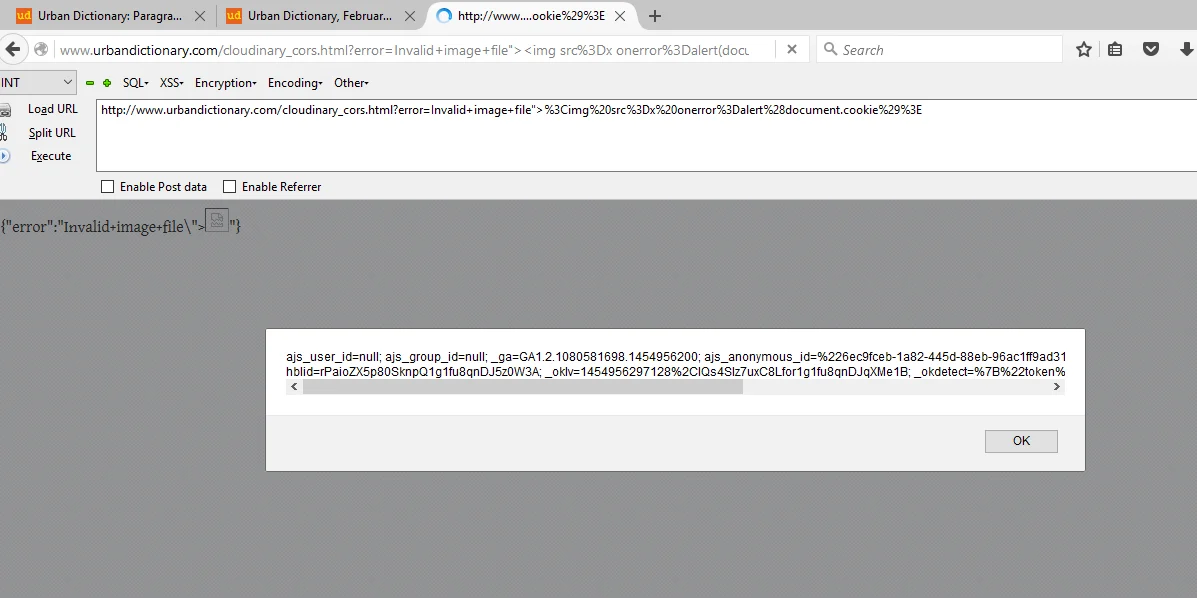
Steps to reproduce Just navigate to theurl given bellow
http://www.urbandictionary.com/cloudinary_cors.html?error=Invalid+image+file">%3Cimg%20src%3Dx%20onerror%3Dalert%28document.cookie%29%3E
Tested on firefox
Thanks.
Attachments
Not written yet. The AI write-up for this report has not been written yet. The Original tab links to the source.
How it worked
Impact
An attacker could execute arbitrary JavaScript in a victim's browser, leading to cookie theft, data theft, or insecure redirects.
What the attacker needed
Victim clicks a crafted link
How it was found
- Navigate to the provided URL with a crafted error parameter containing a script payload.
Explained by bugbounty.wiki with AI from the original and checked against quotes from it; it can still be wrong. Read the original before relying on a detail.
Not written yet. The AI write-up for this report has not been written yet. The Original tab links to the source.
When a website takes text from the URL and puts it directly into the page without cleaning it, an attacker can include code that the browser runs. This is called cross-site scripting (XSS). Here, the error message shown after uploading a bad image included whatever was in the URL, so an attacker could make a link that runs their own script when clicked.
What is XSS?
Script an attacker supplies runs in another user's browser, on the target's origin, with that user's session.







