Bypassing captcha in registration on Hosted site
The registration form used a simple math captcha that could be solved automatically by a script, allowing mass account creation. An attacker could automate registrations, potentially degrading server performance through repeated database transactions.

- Disclosed after 2 months
Hello again,
I believe the captcha on the user registration form is very simple and can be easily bypassed to automatically register any number of accounts.
A program can read the math captcha, solve it and submit the form with the answer and the other required parameters & headers.
Note: I read the out of scope guideline about "rate limiting". I guess that's about rate limiting password change or other places. Want to make sure this bug is not neglected.
Risk
A bad guy can automate the form submission. This has a potential to degrade the server performance as each submission invokes multiple database transactions like checking username, inserting the form data into user table etc.
Proof of concept
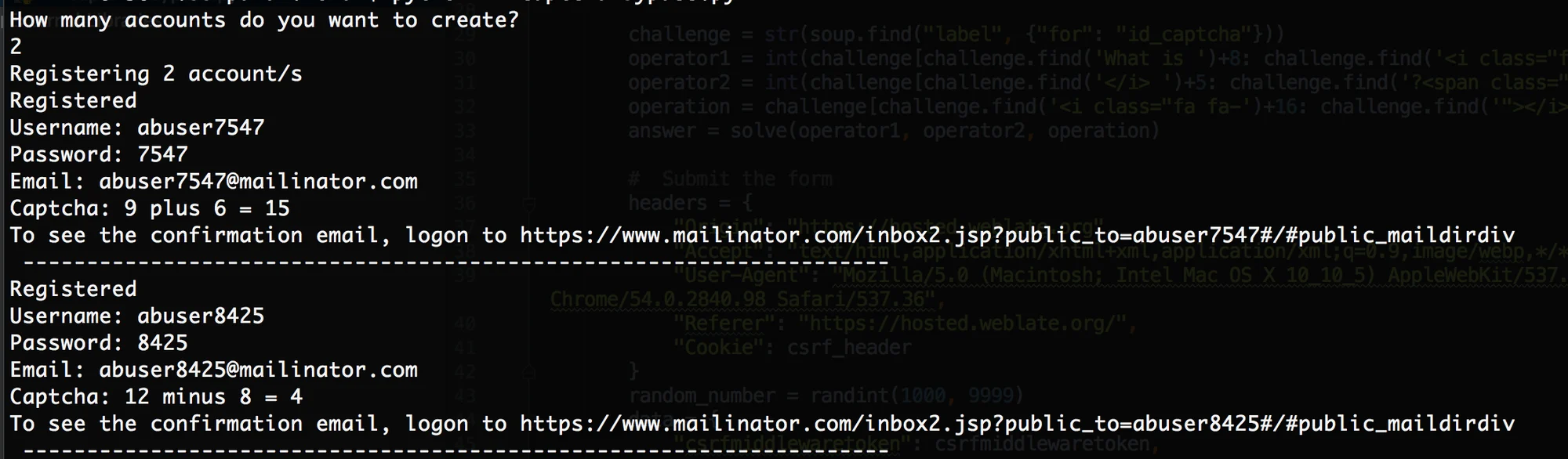
I'm attaching a small python script to this report, which can completely automates the registration form submission. When you run the script, it asks how many accounts you want to register. Once you enter, it creates that many users and also prints user details, captcha challenge with question and the link to access the public email inbox.
How to run the POC
- Open a command or Terminal if on mac
- Enter
python <PATH>/wl-captcha-bypass.py - Enter a small number for
How many accounts do you want to create? - Note the response. Follow the guide to verify the confirmation email. You can also verify at the backend.
Requirement to run the POC Python Script
- python 2.7+
- request
- beautifulsoup
Please refer the internet to set up
Suggested Fix
- Configure a hard captcha. You can consider Google's reCAPTCHA.
Let me know if any questions.
Attachments
Not written yet. The AI write-up for this report has not been written yet. The Original tab links to the source.
How it worked
Root cause
Likely the captcha was a simple arithmetic question that could be parsed and solved programmatically, with no other anti-automation control.
Impact
An attacker could automate registration of many accounts, which could degrade server performance due to multiple database transactions per submission.
What the attacker needed
Python 2.7+ with requests and beautifulsoup; Access to the registration form
The fix
The captcha should be replaced with a harder challenge, such as Google's reCAPTCHA.
How it was found
- Run the provided Python script from a terminal.
- Enter how many accounts to create.
- The script solves the captcha and submits the registration form for each account.
- Verify the created accounts via the confirmation email or backend.
Explained by bugbounty.wiki with AI from the original and checked against quotes from it; it can still be wrong. Read the original before relying on a detail.
Not written yet. The AI write-up for this report has not been written yet. The Original tab links to the source.
A captcha is a test meant to prove a human is filling in a form, often a simple maths question. Here the question was so easy that a computer script could read it, work out the answer and submit the form automatically. That let someone create many accounts without doing it by hand.
What is DoS?
A request that exhausts resources or crashes a component. Many programs forbid testing it; reports usually show it from code, not by attacking.





