Stored XSS on Admin Access Page - Email field
The Email field on the Admin Access page was not sanitised, allowing a stored cross-site scripting attack. An attacker with an admin account could inject a script that executes in another admin's browser when they view the page.

- Triaged in 22 hours
- Fixed in 4 months
- Disclosed after 10 months
"Cricetinae" :)
###Short Description
The Email field is not sanitized on Inventory > Admin Access page resulting in to Stored Cross-Site Scripting vulnerability.
###Vulnerability Details
Cross-Site Scripting issue let's one to run a javascript of choice. It helps most of the client side risks including but not limited to phishing, temporary deface, browser key-logger and others. Exploitation frameworks like BeEF eases the offensive attack.
Stored XSS is more risky than the reflected ones because of the fact that the malicious script is persisted across. It can affect all the time and all the users who has the access to the page.
Attack Vector
As this is a stored XSS, the attack vector lies in one user phishing other users. If there are multiple administrators, one admin can get a javascript backdoor on another admin's browser.
Steps to Reproduce
To effectively illustrate one user affect another user, please create 2 admin accounts and follow the below instruction:
- Login as
admin1. Navigate to Preferences > Change E-mail - Enter the current password and
[email protected]<script>alert('xss');</script>for Email address field. Save and logout - Login as
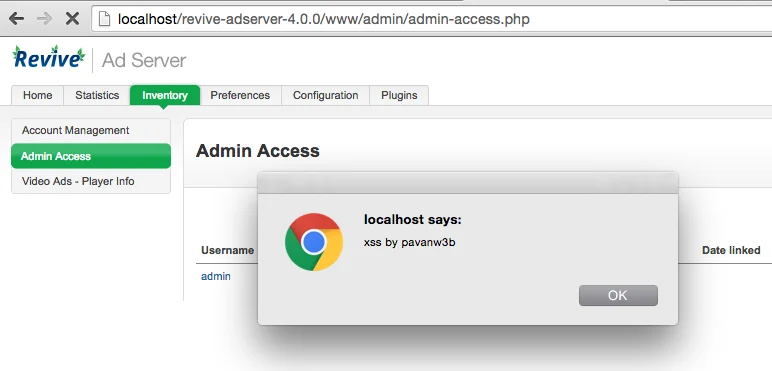
admin2. - Navigate to Inventory > Admin Access and notice the alert box.
Attached screenshot for a reference.
Test Environment Details
Version: Latest as on Oct 2: revive-adserver-4.0.0 downloaded from the official source Setup type: local Browser: Firefox 47.0 OS: Mac OS X
Cheers, Pavan
Attachments
Not written yet. The AI write-up for this report has not been written yet. The Original tab links to the source.
How it worked
Root cause
Likely the application stored the email address without sanitising it and later rendered it on the Admin Access page without proper output encoding.
Impact
An attacker with an admin account could execute arbitrary JavaScript in another admin's browser, enabling phishing, temporary defacement, keylogging, or use of exploitation frameworks like BeEF.
What the attacker needed
Two admin accounts; attacker has admin access; victim admin views Admin Access page
How it was found
- Log in as admin1 and go to Preferences > Change E-mail.
- Enter the current password and an email address containing a script payload, then save and log out.
- Log in as admin2.
- Navigate to Inventory > Admin Access and observe the alert box.
Explained by bugbounty.wiki with AI from the original and checked against quotes from it; it can still be wrong. Read the original before relying on a detail.
Not written yet. The AI write-up for this report has not been written yet. The Original tab links to the source.
When a website saves user input without cleaning it, a malicious script can be stored and later run in someone else's browser. Here, an admin could put a script into their email address, and when another admin looked at the admin list, the script ran, with risks such as phishing or keylogging.
What is XSS?
Script an attacker supplies runs in another user's browser, on the target's origin, with that user's session.






