Reflected XSS on Uber.com careers
The city GET parameter on the Uber careers page was not properly sanitised, allowing an attacker to inject arbitrary JavaScript. An attacker could execute script in a victim's browser to phish, deface the page, or steal credentials via a fake login page.

- Triaged in under an hour
- Fixed in 40 days
- Paid in 48 days
- Disclosed after 48 days
Summary by the researcher
This issue was originally reported via email: [email protected] Matthew invited to this private program and asked to submit here. Thank you team!
The report
###Location www.uber.com/careers/
###Description: It is possible for an attacker to inject an arbitrary javascript into city GET parameter. This leads to phishing, defacing from URL, stealing credentials by using a fake login page and many other client side risks.
###POC:
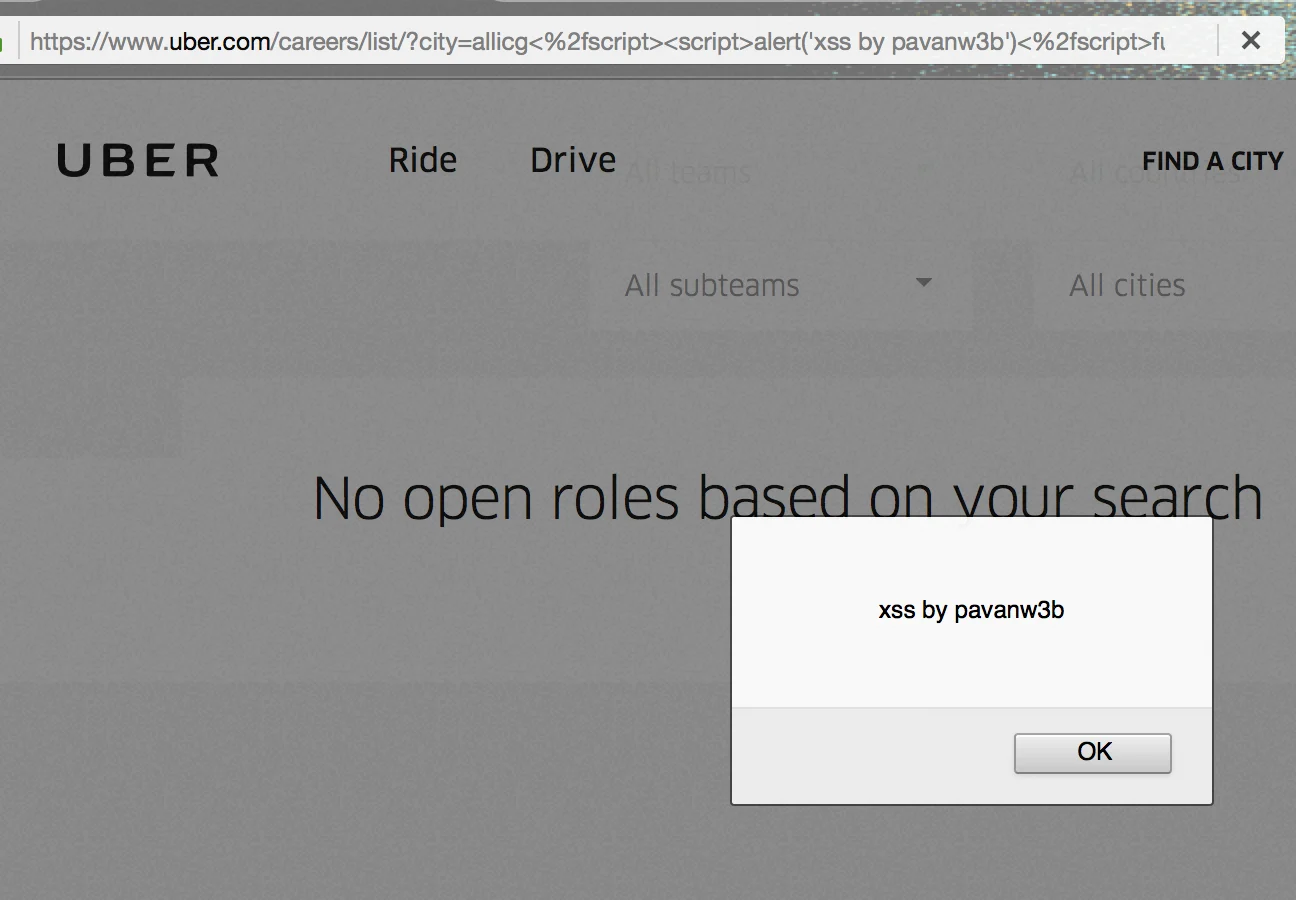
- Logon to [uber.com/careers/list/?city=...](https://www.uber.com/careers/list/?city=allicg<%2fscript><script>alert('xss by pavanw3b')<%2fscript>fupaiiz&country=all&keywords=&subteam=all&team=all) on firefox.
- Note the alert xss by pavanw3b as the screenshot attached.
Tested on latest firefox: 4.0.2
Please let me know if you need further explanation or details.
Cheers, Pavan www.pavanw3b.com | fb/pavanw3b | @pavanw3b
Attachments
Not written yet. The AI write-up for this report has not been written yet. The Original tab links to the source.
How it worked
Impact
An attacker could run arbitrary JavaScript in a victim's browser, enabling phishing, page defacement, credential theft via a fake login page, and other client-side risks.
What the attacker needed
Victim visits a crafted URL
Explained by bugbounty.wiki with AI from the original and checked against quotes from it; it can still be wrong. Read the original before relying on a detail.
Not written yet. The AI write-up for this report has not been written yet. The Original tab links to the source.
A website sometimes takes information from the address bar (like a search term) and puts it directly into the page without checking it. If that information contains code, the browser runs it as if the site itself had written it. This lets an attacker make the page do things the site owner never intended, such as showing a fake login form.
What is XSS?
Script an attacker supplies runs in another user's browser, on the target's origin, with that user's session.






