Content Spoofing OR Text Injection in https://withinsecurity.com
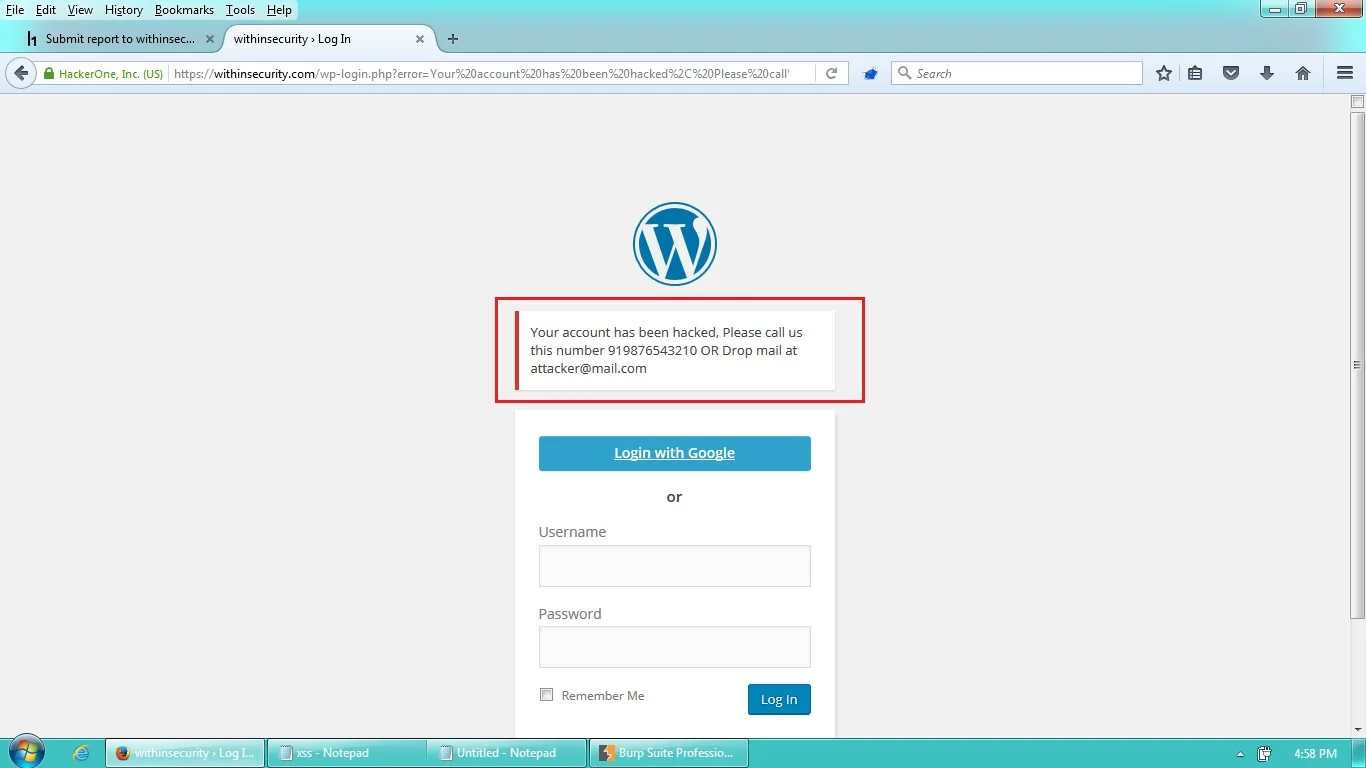
The error parameter on the WordPress login page reflected user-supplied text, allowing an attacker to display arbitrary content such as a fake security warning. An attacker could craft a link that shows misleading text to trick users into calling a phone number or emailing an address.
 Originally disclosed on HackerOne
- Triaged in 4 days
- Fixed in 4 days
- Paid in 4 days
- Disclosed after 4 days
Hi,
I just found Content Spoofing OR Text-based injection vulnerability in https://withinsecurity.com site that would like to get fixed, Below are the POC and steps to reproduced an issue.
1] Go to https://withinsecurity.com this site 2] Then just changed above url like this https://withinsecurity.com/wp-admin/ then it's redirecting to https://accounts.google.com/o/oauth2/auth?response_type=code&redirect_uri=https%3A%2F%2Fwithinsecurity.com%2Fwp-login.php&client_id=484006783216-3i2lf5d4bdga5a8lfmcap7cbq43obg4u.apps.googleusercontent.com&scope=openid+email+https%3A%2F%2Fwww.googleapis.com%2Fauth%2Fuserinfo.profile&access_type=online&approval_prompt=auto&state=cb04a91ac5%257Chttps%253A%252F%252Fwithinsecurity.com%252Fwp-admin%252F [ I'm authenticated in google that's why] 3] Then clicked on "Deny" button then i got this page https://withinsecurity.com/wp-login.php?error=access_denied&state=cb04a91ac5%257Chttps%253A%252F%252Fwithinsecurity.com%252Fwp-admin%252F# 4] In above page, I found "error" parameter is vulnerable for Content Spoofing OR Text-based injection attacks. 5] Ok, we need to changed above url like this https://withinsecurity.com/wp-login.php?error=Your%20account%20has%20been%20hacked%2C%20Please%20call%20us%20this%20number%20919876543210%20OR%20Drop%20mail%20at%20attacker%40mail.com&state=cb04a91ac5%257Chttps%253A%252F%252Fwithinsecurity.com%252Fwp-admin%252F# 6] Once above page loads then user supplied text/content has been displayed on vulnerable page. 7] That means above mention URL's "error" parameter is vulnerable for Content Spoofing OR Text Injection. 8] My OS in windows7 & Firefox 43.0.4 9] Let me know if you have any query.
Thanks & Regards Deepak
Attachments
Not written yet. The AI write-up for this report has not been written yet. The Original tab links to the source.
How it worked
Root cause
Likely the application reflected the error parameter value into the page without validating or encoding it, allowing arbitrary text to be displayed.
What the attacker needed
Victim clicks a crafted link
How it was found
- Visit the site and change the URL to the wp-admin path.
- The site redirects to a Google OAuth page; click Deny.
- The site returns to the login page with an error parameter in the URL.
- Modify the error parameter value to contain arbitrary text.
- Load the modified URL and observe the supplied text displayed on the page.
Explained by bugbounty.wiki with AI from the original and checked against quotes from it; it can still be wrong. Read the original before relying on a detail.
Not written yet. The AI write-up for this report has not been written yet. The Original tab links to the source.
When a website takes text from the address bar and puts it directly on the page, an attacker can make the page say anything they want. Here, the 'error' part of the link was shown as-is, so a crafted link could display a fake message. This is called content spoofing or text injection.
What is XSS?
Script an attacker supplies runs in another user's browser, on the target's origin, with that user's session.




