PII of users can be downloaded from export pages
Export pages on the site served CSV files containing participants' personal data (name, email, phone, role, organisation) without any authentication. An attacker could enumerate page identifiers to discover these export URLs and download the personal data of many hackathon participants.

- Fixed in 12 hours
- Paid in 4 days
- Disclosed after 2.1 years
Description:
On the https://doaction.org/ pages can be enumerated via 'p' get parameter, for example: https://doaction.org/?p=1657 redirects to https://doaction.org/event/ijebu-2019/ https://doaction.org/?p=1320 redirects to https://doaction.org/non-profit/test/ Using it I have enumerated almost 1000 unique endpoints and on some of them I found csv files with PII of users (Name,Email,Phone,Role,Organisation ). I suppose that this is the data of hackathons participants. Links to download pages: https://doaction.org/do_action-export-1498557984/ https://doaction.org/do_action-export-1498737049/ https://doaction.org/do_action-export-1498745152/ https://doaction.org/do_action-export-1498812322/ https://doaction.org/do_action-export-1500046180/ https://doaction.org/do_action-export-1500469161/ https://doaction.org/do_action-export-1518613217/ https://doaction.org/do_action-export-1519205241/ https://doaction.org/do_action-export-1519327599/ https://doaction.org/do_action-export-1523894240/ https://doaction.org/do_action-export-1529355810/ https://doaction.org/do_action-export-1530608893/ https://doaction.org/do_action-export-1530956399/ https://doaction.org/do_action-export-1530964074/ https://doaction.org/do_action-export-1530964096/ https://doaction.org/do_action-export-1531988106/ https://doaction.org/do_action-export-1532000396/ https://doaction.org/do_action-export-1532075463/ https://doaction.org/do_action-export-1532672117/ https://doaction.org/do_action-export-1535471764/ https://doaction.org/do_action-export-1535751740/ https://doaction.org/do_action-export-1535999159/ https://doaction.org/do_action-export-1536309599/ https://doaction.org/do_action-export-1536389295/ https://doaction.org/do_action-export-1540023637/ https://doaction.org/do_action-export-1552910175/ https://doaction.org/do_action-export-1553260656/ https://doaction.org/do_action-export-1553882619/ https://doaction.org/do_action-export-1554723418/ https://doaction.org/do_action-export-1554815348/ https://doaction.org/do_action-export-1555393513/ https://doaction.org/do_action-export-1555393534/ https://doaction.org/do_action-export-1555393708/ https://doaction.org/do_action-export-1555393762/ https://doaction.org/do_action-export-1556007840/ https://doaction.org/do_action-export-1556007849/ https://doaction.org/do_action-export-1556007854/ https://doaction.org/do_action-export-1556739301/ https://doaction.org/do_action-export-1556903021/ https://doaction.org/do_action-export-1556946934/ https://doaction.org/do_action-export-1559905698/ https://doaction.org/do_action-export-1560342197/ https://doaction.org/do_action-export-1561023007/ https://doaction.org/do_action-export-1561023537/ https://doaction.org/do_action-export-1561023566/ https://doaction.org/do_action-export-1561023592/ https://doaction.org/do_action-export-1561023611/ https://doaction.org/do_action-export-1561023668/ https://doaction.org/do_action-export-1561023675/ https://doaction.org/do_action-export-1561180440/ https://doaction.org/do_action-export-1561973925/ https://doaction.org/do_action-export-1562147045/ https://doaction.org/do_action-export-1562194238/ https://doaction.org/do_action-export-1562194534/ https://doaction.org/do_action-export-1562571037/ https://doaction.org/do_action-export-1562669416/ https://doaction.org/do_action-export-1562930528/ https://doaction.org/do_action-export-1565427972/ https://doaction.org/do_action-export-1565441079/ https://doaction.org/do_action-export-1567233021/ https://doaction.org/do_action-export-1567233029/ https://doaction.org/do_action-export-1567233035/ https://doaction.org/do_action-export-1567233041/ https://doaction.org/do_action-export-1567233047/ https://doaction.org/do_action-export-1567233054/ https://doaction.org/do_action-export-1567827712/ https://doaction.org/do_action-export-1571049910/ https://doaction.org/do_action-export-1571361570/ https://doaction.org/do_action-export-1571421316/ https://doaction.org/do_action-export-1574064498/ https://doaction.org/do_action-export-1575649680/ https://doaction.org/do_action-export-1576268072/ https://doaction.org/do_action-export-1578466099/ https://doaction.org/do_action-export-1578472524/
Steps To Reproduce:
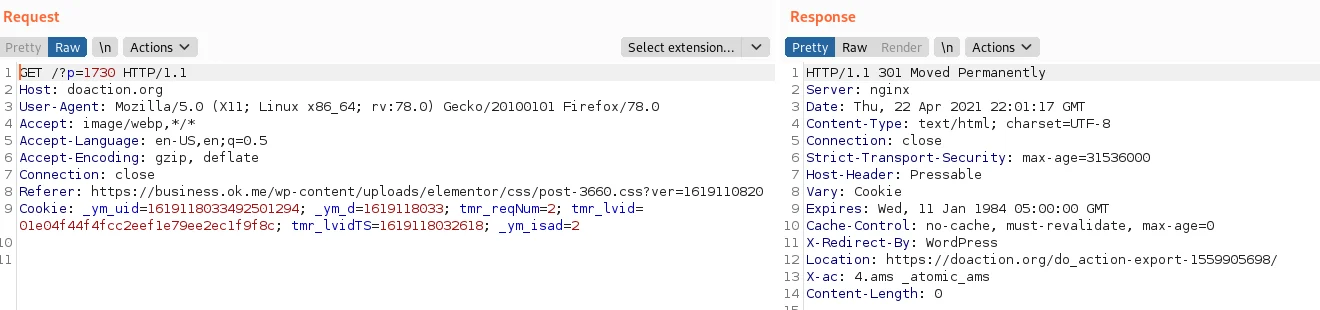
- Enumerate endpoints requesting https://doaction.org/?p={id}. I tried [1..10000] ids in my research. You will get 301 response on valid ones, and you can extract full path to page from Location header:
- Research endpoints and on some PII is avaliable
Recommendations
Restrict access to sensitive files using some form of authentication or delete them.
Impact
PII data leakage
Context
doaction.org is a WordPress site. WordPress exposes a query parameter, p, that selects a post or page by its numeric ID. On a default installation, a request such as https://doaction.org/?p=1657 resolves the ID and serves the corresponding content, often redirecting to the canonical permalink for that post.
The report describes how that ID space was enumerated and how, among the resolved pages, some export pages were found that served CSV files containing personal data of users: Name, Email, Phone, Role and Organisation. The researcher supposes this is data of hackathon participants.
Setup
No accounts, roles, tools or versions are described in the report. The only precondition described is access to the public site at https://doaction.org/.
Finding it
The researcher noticed that pages can be enumerated through the p GET parameter. Two examples are given:
https://doaction.org/?p=1657
redirects to https://doaction.org/event/ijebu-2019/, and
https://doaction.org/?p=1320
redirects to https://doaction.org/non-profit/test/.
Because the numeric ID maps to a real page and the full path is disclosed in the redirect, the ID space can be walked to discover endpoints. Using this, the researcher enumerated almost 1000 unique endpoints. On some of them, CSV files with PII of users were available for download.
Exploitation
Step 1: enumerate IDs and read the redirect target
The researcher requested https://doaction.org/?p={id} for IDs in the range [1..10000]. Valid IDs answer with a 301 response, and the full path to the page can be extracted from the Location header.
The screenshot shows a request to the ?p= parameter and the 301 response with the Location header carrying the resolved path. That header is what turns a blind ID sweep into a list of real endpoints.
Step 2: review the discovered endpoints
Among the enumerated endpoints, some served export pages with CSV files containing PII. The report lists the following download pages:
https://doaction.org/do_action-export-1498557984/
https://doaction.org/do_action-export-1498737049/
https://doaction.org/do_action-export-1498745152/
https://doaction.org/do_action-export-1498812322/
https://doaction.org/do_action-export-1500046180/
https://doaction.org/do_action-export-1500469161/
https://doaction.org/do_action-export-1518613217/
https://doaction.org/do_action-export-1519205241/
https://doaction.org/do_action-export-1519327599/
https://doaction.org/do_action-export-1523894240/
https://doaction.org/do_action-export-1529355810/
https://doaction.org/do_action-export-1530608893/
https://doaction.org/do_action-export-1530956399/
https://doaction.org/do_action-export-1530964074/
https://doaction.org/do_action-export-1530964096/
https://doaction.org/do_action-export-1531988106/
https://doaction.org/do_action-export-1532000396/
https://doaction.org/do_action-export-1532075463/
https://doaction.org/do_action-export-1532672117/
https://doaction.org/do_action-export-1535471764/
https://doaction.org/do_action-export-1535751740/
https://doaction.org/do_action-export-1535999159/
https://doaction.org/do_action-export-1536309599/
https://doaction.org/do_action-export-1536389295/
https://doaction.org/do_action-export-1540023637/
https://doaction.org/do_action-export-1552910175/
https://doaction.org/do_action-export-1553260656/
https://doaction.org/do_action-export-1553882619/
https://doaction.org/do_action-export-1554723418/
https://doaction.org/do_action-export-1554815348/
https://doaction.org/do_action-export-1555393513/
https://doaction.org/do_action-export-1555393534/
https://doaction.org/do_action-export-1555393708/
https://doaction.org/do_action-export-1555393762/
https://doaction.org/do_action-export-1556007840/
https://doaction.org/do_action-export-1556007849/
https://doaction.org/do_action-export-1556007854/
https://doaction.org/do_action-export-1556739301/
https://doaction.org/do_action-export-1556903021/
https://doaction.org/do_action-export-1556946934/
https://doaction.org/do_action-export-1559905698/
https://doaction.org/do_action-export-1560342197/
https://doaction.org/do_action-export-1561023007/
https://doaction.org/do_action-export-1561023537/
https://doaction.org/do_action-export-1561023566/
https://doaction.org/do_action-export-1561023592/
https://doaction.org/do_action-export-1561023611/
https://doaction.org/do_action-export-1561023668/
https://doaction.org/do_action-export-1561023675/
https://doaction.org/do_action-export-1561180440/
https://doaction.org/do_action-export-1561973925/
https://doaction.org/do_action-export-1562147045/
https://doaction.org/do_action-export-1562194238/
https://doaction.org/do_action-export-1562194534/
https://doaction.org/do_action-export-1562571037/
https://doaction.org/do_action-export-1562669416/
https://doaction.org/do_action-export-1562930528/
https://doaction.org/do_action-export-1565427972/
https://doaction.org/do_action-export-1565441079/
https://doaction.org/do_action-export-1567233021/
https://doaction.org/do_action-export-1567233029/
https://doaction.org/do_action-export-1567233035/
https://doaction.org/do_action-export-1567233041/
https://doaction.org/do_action-export-1567233047/
https://doaction.org/do_action-export-1567233054/
https://doaction.org/do_action-export-1567827712/
https://doaction.org/do_action-export-1571049910/
https://doaction.org/do_action-export-1571361570/
https://doaction.org/do_action-export-1571421316/
https://doaction.org/do_action-export-1574064498/
https://doaction.org/do_action-export-1575649680/
https://doaction.org/do_action-export-1576268072/
https://doaction.org/do_action-export-1578466099/
https://doaction.org/do_action-export-1578472524/
Each of these pages exposes a CSV file with the fields Name, Email, Phone, Role and Organisation. The report does not describe the response headers or the exact file names served by these pages.
Root cause
The export pages are discoverable through the public ID space. The p parameter resolves any post ID and the 301 redirect discloses the canonical path, so pages that were never linked can still be discovered by walking the ID range. The report does not analyse the code behind the export feature; the likely cause is that the export files or their download pages were left publicly accessible instead of being protected by authentication.
Impact
An unauthenticated attacker can download CSV files containing PII of users: Name, Email, Phone, Role and Organisation. The researcher supposes this is data of hackathons participants. The number of affected users is not stated.
Fix
The recommendation in the report is to restrict access to sensitive files using some form of authentication, or to delete them. The report does not say which of the two was applied.
Variants to test
- A positive result is a set of canonical paths that are not linked from the site's navigation.
- A positive result is a downloadable CSV or similar file.
- A positive result is a
200with file content for an unauthenticated client. - A positive result confirms PII exposure rather than aggregate statistics.
What happened, in plain words
A website called doaction.org runs on WordPress, a popular system for building websites. WordPress gives every post and page a number, and it lets anyone ask for a page by that number using a short piece of the web address called a parameter. The researcher found that by trying many numbers in a row, they could discover pages on the site that are not linked from anywhere. Among those hidden pages were export pages: pages that hand out a file containing a list of people, with their name, email address, phone number, role and organisation. Those files contained a list of people, with their name, email address, phone number, role and organisation. The researcher supposes the people in the files are hackathon participants.
Background you need first
A few ideas come up again and again in this report, so here they are from zero.
WordPress and posts. WordPress stores content as "posts" and "pages". Each one has a numeric ID, like a row number in a spreadsheet. The site can look up a post by that number and show it to you.
The p parameter. A URL (web address) can carry extra information after a question mark. The part after ? is the query string, and each name=value pair in it is a parameter. In https://doaction.org/?p=1657, the parameter is named p and its value is 1657. On WordPress, p means "show me the post with this ID".
GET request. When you type an address into your browser and press Enter, the browser sends a GET request: a request that asks the server to give back a page. Parameters in the address travel with that request.
Redirect and the 301 status code. Sometimes a server does not send the page itself but instead says "the real address of this page is over there, go ask for that". That answer is a redirect, and 301 is the status code for a permanent redirect. The new address is placed in a response header called Location. A header is a small labelled line of extra information that travels with the response, separate from the page content.
Enumeration. Enumeration means walking through a list of possible values one by one to see which ones exist. If IDs are numbers, you can try 1, 2, 3 and so on. It is like trying every locker number in a corridor to see which ones open.
CSV. A CSV file is a plain text file where each line is a row and values are separated by commas. It opens neatly in a spreadsheet. It is a common way to export a list of records.
PII. PII stands for personally identifiable information: data that identifies a real person, such as a name, an email address or a phone number. Leaking it is a privacy problem, because it can be used for spam, phishing or worse.
Information disclosure. This is the name of the weakness class here: the site reveals information to someone who should not have it. Nothing is broken or changed; the problem is that data which should be private is simply handed out.
Unauthenticated. Unauthenticated means "without logging in". If a page can be fetched by anyone with a browser and no account, it is unauthenticated access.
Setting the scene
doaction.org is a WordPress site. WordPress exposes the p parameter, which selects a post or page by its numeric ID. On a default installation, a request such as https://doaction.org/?p=1657 resolves the ID and serves the corresponding content, often redirecting to the canonical permalink for that post. A permalink is the "official" permanent address of a page, the tidy human-readable one rather than the numeric shortcut.
The report describes how that ID space was enumerated and how, among the resolved pages, some export pages were found that served CSV files containing personal data of users: Name, Email, Phone, Role and Organisation. The researcher supposes this is data of hackathon participants.
What you need to try it
No accounts, roles, tools or versions are described in the report. The only precondition described is access to the public site at https://doaction.org/. In other words, a browser and an internet connection are enough; no login, no special software.
Finding it
The researcher noticed that pages can be enumerated through the p GET parameter. Two examples are given:
https://doaction.org/?p=1657
This address redirects to https://doaction.org/event/ijebu-2019/, and
https://doaction.org/?p=1320
redirects to https://doaction.org/non-profit/test/.
What these two examples show: you ask for a page by its number, and the server answers with a redirect that spells out the real, readable address of that page. The first line is the shortcut; the second is where it lands. Because the numeric ID maps to a real page and the full path is disclosed in the redirect, the ID space can be walked to discover endpoints. An endpoint here simply means an address on the site that responds to requests. Using this, the researcher enumerated almost 1000 unique endpoints. On some of them, CSV files with PII of users were available for download.
Why does this matter? Normally you find pages by clicking links. A page that nobody links to is effectively hidden, but not protected: if you can guess its number, you can still reach it. The redirect is the key, because it tells you the real address of each numbered page, turning a blind guess into a confirmed discovery.
Exploitation
Step 1: enumerate IDs and read the redirect target
The researcher requested https://doaction.org/?p={id} for IDs in the range [1..10000]. The curly braces are a placeholder: {id} stands for each number in turn, so the requests were ?p=1, ?p=2, and so on up to ?p=10000. Valid IDs answer with a 301 response, and the full path to the page can be extracted from the Location header.
The screenshot shows a request to the ?p= parameter and the 301 response with the Location header carrying the resolved path. That header is what turns a blind ID sweep into a list of real endpoints. In plain terms: you knock on 10,000 numbered doors; the ones that answer with a redirect tell you, in the answer itself, the proper address of what is behind the door. You collect those addresses into a list.
Why do it this way? Because there is no index of these pages. The numbers are the only handle you have, and the redirect is the only thing that tells you what each number actually points to.
Step 2: review the discovered endpoints
Among the enumerated endpoints, some served export pages with CSV files containing PII. The report lists the following download pages:
https://doaction.org/do_action-export-1498557984/
https://doaction.org/do_action-export-1498737049/
https://doaction.org/do_action-export-1498745152/
https://doaction.org/do_action-export-1498812322/
https://doaction.org/do_action-export-1500046180/
https://doaction.org/do_action-export-1500469161/
https://doaction.org/do_action-export-1518613217/
https://doaction.org/do_action-export-1519205241/
https://doaction.org/do_action-export-1519327599/
https://doaction.org/do_action-export-1523894240/
https://doaction.org/do_action-export-1529355810/
https://doaction.org/do_action-export-1530608893/
https://doaction.org/do_action-export-1530956399/
https://doaction.org/do_action-export-1530964074/
https://doaction.org/do_action-export-1530964096/
https://doaction.org/do_action-export-1531988106/
https://doaction.org/do_action-export-1532000396/
https://doaction.org/do_action-export-1532075463/
https://doaction.org/do_action-export-1532672117/
https://doaction.org/do_action-export-1535471764/
https://doaction.org/do_action-export-1535751740/
https://doaction.org/do_action-export-1535999159/
https://doaction.org/do_action-export-1536309599/
https://doaction.org/do_action-export-1536389295/
https://doaction.org/do_action-export-1540023637/
https://doaction.org/do_action-export-1552910175/
https://doaction.org/do_action-export-1553260656/
https://doaction.org/do_action-export-1553882619/
https://doaction.org/do_action-export-1554723418/
https://doaction.org/do_action-export-1554815348/
https://doaction.org/do_action-export-1555393513/
https://doaction.org/do_action-export-1555393534/
https://doaction.org/do_action-export-1555393708/
https://doaction.org/do_action-export-1555393762/
https://doaction.org/do_action-export-1556007840/
https://doaction.org/do_action-export-1556007849/
https://doaction.org/do_action-export-1556007854/
https://doaction.org/do_action-export-1556739301/
https://doaction.org/do_action-export-1556903021/
https://doaction.org/do_action-export-1556946934/
https://doaction.org/do_action-export-1559905698/
https://doaction.org/do_action-export-1560342197/
https://doaction.org/do_action-export-1561023007/
https://doaction.org/do_action-export-1561023537/
https://doaction.org/do_action-export-1561023566/
https://doaction.org/do_action-export-1561023592/
https://doaction.org/do_action-export-1561023611/
https://doaction.org/do_action-export-1561023668/
https://doaction.org/do_action-export-1561023675/
https://doaction.org/do_action-export-1561180440/
https://doaction.org/do_action-export-1561973925/
https://doaction.org/do_action-export-1562147045/
https://doaction.org/do_action-export-1562194238/
https://doaction.org/do_action-export-1562194534/
https://doaction.org/do_action-export-1562571037/
https://doaction.org/do_action-export-1562669416/
https://doaction.org/do_action-export-1562930528/
https://doaction.org/do_action-export-1565427972/
https://doaction.org/do_action-export-1565441079/
https://doaction.org/do_action-export-1567233021/
https://doaction.org/do_action-export-1567233029/
https://doaction.org/do_action-export-1567233035/
https://doaction.org/do_action-export-1567233041/
https://doaction.org/do_action-export-1567233047/
https://doaction.org/do_action-export-1567233054/
https://doaction.org/do_action-export-1567827712/
https://doaction.org/do_action-export-1571049910/
https://doaction.org/do_action-export-1571361570/
https://doaction.org/do_action-export-1571421316/
https://doaction.org/do_action-export-1574064498/
https://doaction.org/do_action-export-1575649680/
https://doaction.org/do_action-export-1576268072/
https://doaction.org/do_action-export-1578466099/
https://doaction.org/do_action-export-1578472524/
Each line in this block is one address of an export page. They all share the same shape: the site name, then do_action-export-, then a long number, then a trailing slash. The long number looks like a timestamp, but the report does not say what it is. The point is that these addresses were found through the enumeration, and each one leads to a page that offers a file for download.
Each of these pages exposes a CSV file with the fields Name, Email, Phone, Role and Organisation. The report does not describe the response headers or the exact file names served by these pages. So the columns are known, but the file naming and delivery details are not part of the report.
Why review the endpoints at all? Because enumeration alone only gives you addresses. The value is in what those addresses return. Here, some of them returned personal data, which is the actual finding.
Why it works
The export pages are discoverable through the public ID space. The p parameter resolves any post ID and the 301 redirect discloses the canonical path, so pages that were never linked can still be discovered by walking the ID range. The report does not analyse the code behind the export feature; the likely cause is that the export files or their download pages were left publicly accessible instead of being protected by authentication.
A simple comparison: a document left on a desk in a public lobby is not secret, even if nobody hands it to you. Here the export pages were left in the public lobby of the website, and the ID sweep was simply a way of finding the desk.
Impact
An unauthenticated attacker can download CSV files containing PII of users: Name, Email, Phone, Role and Organisation. The researcher supposes this is data of hackathons participants. The number of affected users is not stated.
CVSS is a standard scoring system for the seriousness of a security issue; 6.1 is in the medium band. Information disclosure means the harm is exposure of data rather than, say, someone taking control of the site.
The fix
The recommendation in the report is to restrict access to sensitive files using some form of authentication, or to delete them. In everyday terms: either put a lock on the door (require a login before the file can be downloaded) or take the file off the shelf entirely.
Variants to test
- A positive result is a set of canonical paths that are not linked from the site's navigation.
- A positive result is a downloadable CSV or similar file. A slug is the readable part of a web address that identifies a page.
- A positive result is a
200with file content for an unauthenticated client. A cookie is a small piece of data the site stores in your browser to remember who you are; a200status code means "here is the content you asked for". - A positive result confirms PII exposure rather than aggregate statistics. Aggregate statistics are totals and averages that do not identify anyone; personal fields do.
Glossary
- WordPress: a widely used system for building and running websites, where content is stored as posts and pages.
- Post ID: the number WordPress uses internally to identify a post or page.
- URL: the address of a resource on the web, such as a page or a file.
- Query string: the part of a URL after the
?, carrying parameters. - Parameter: a
name=valuepair in a query string, such asp=1657. - GET request: a request from a browser asking a server to return a page or file.
- Endpoint: an address on a site that responds to requests.
- Status code: a three-digit number in the response saying what happened, such as
200for success or301for a permanent redirect. - Redirect: a response telling the browser to go to a different address instead.
Locationheader: the response header that carries the address a redirect points to.- Header: a labelled line of extra information sent with a request or response, separate from the page content.
- Permalink: the permanent, human-readable address of a page.
- Enumeration: trying a list of possible values one by one to find which exist.
- CSV: a plain text file of rows and comma-separated values, openable in a spreadsheet.
- PII: personally identifiable information, data that identifies a real person, such as a name, email or phone number.
- Information disclosure: a weakness where a site reveals data to someone who should not have it.
- Unauthenticated: without logging in or proving who you are.
- CVSS: a standard scoring system for the severity of a security issue.
- Slug: the readable part of a web address that identifies a page.
- Cookie: a small piece of data a site stores in your browser to remember your session.
- Session: the state of being logged in or recognised by a site across several requests.
- Aggregate statistics: totals or averages that describe a group without identifying individuals.